

Audio By Carbonatix
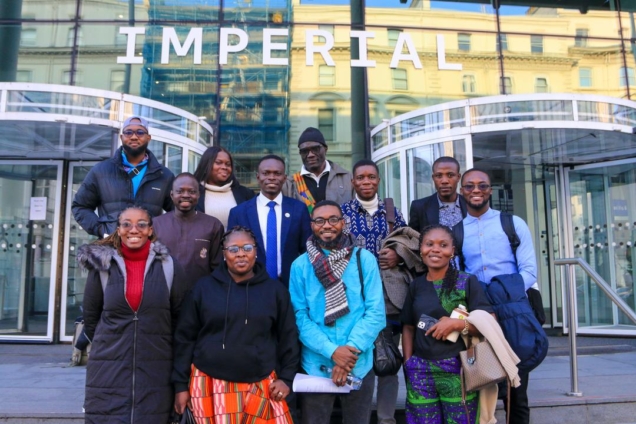
Ten journalists from Ghana spent days in the United Kingdom’s capital, London, to receive hands-on training on Science, Technology and Innovation (ST&I) reporting at the Imperial College, London.
This initiative, under the auspices of the British High Commission, Accra is part of the 2023 UK-Ghana ST&I Strategy, fully sponsored the ten journalists for a three-day training.
The project is in partnership with the Responsible Artificial Intelligence Lab (RAIL) at the Kwame Nkrumah University of Science and Technology (KNUST), and the Ministry of Environment, Science and Technology (MEST).

It seeks to enhance local media practitioners’ ability to translate complex ST&I developments into accessible stories for the public.
The journalists, including The Multimedia Group’s Anass Sabit and Emmanuel Bright Quaicoe, had previously emerged as winners in a competitive science media pitch during a week-long media capacity-building workshop held in Accra.
Their outstanding efforts earned them an opportunity for further training at Europe’s best university and a world-leading university for science, technology, engineering, medicine and business.
The training provided them access to cutting-edge research facilities and expert faculty members at both the Main and White City campuses of the university in London, including the President of Imperial College, Professor Hugh Brady.

The journalists were eager to obtain practical insights into global science communication trends, innovative research, and collaborative opportunities seeking to revolutionise ST&I reporting in Ghana.
With an urgent need for ST& I to inform decision making, President of Imperial College London, Professor Hugh Brady, says Ghana’s universities can help drive economic growth.
President Brady said, "our partnerships with Ghanaian institutions will have a focus on grand challenges such as pandemic preparedness, infectious diseases, food and water security and future cities, but also how to harness the power of Ghana's universities to drive economic growth. The Imperial Global Ghana hub will create a bridge between innovation ecosystems, so you get a flow of ideas, talent and capital”.
President Brady also highlighted the positive potential of artificial intelligence to democratise research in Ghana.

"AI is one of Imperial's big strengths, we have around 1,000 researchers working on various aspects of AI. We're very excited that the Imperial-Schmidt AI Fellows Programme allows us to partner with Ghana,” he said.
He continued that: “AI is going to be one of the great democratisers of research, and I am very excited about the potential and possibilities for Ghana."
Head of the Emerging Chemical Contaminants team at Imperial’s Environmental Research Group, Dr Leon Barron, highlighted ongoing research by the group in Ghana which focuses on clean air monitoring and sustainable solutions.
A workshop on Science communication, led by Dr. Stephen Webster, Senior Lecturer in Science Communication, and Ehsan Masood, Bureau Chief (Editorials, Africa and the Middle East) at Nature - a Science magazine - ignited intriguing dialogue on the role of science journalists in Ghana.

It also unveiled cultural differences in science reporting and best practices to be adopted in science communication, viewed from the UK perspective.
Throughout the training programme, the journalists engaged in interactive workshops and practical sessions, including a visit to the Polymateria Laboratory.
The lab is home to the world’s first biodegradable technology capable of fully breaking down polypropylene (PP) and polyethylene (PE) materials into wax components which are less harmful to the environment.
A networking session with Ghanaian postgraduate students at the University afforded the journalists and other Ghanaian students a platform to exchange ideas on advancing science and technology in their home country and on the continent while aiming for collaborations.

The journalists also paid a visit to the Science Media Centre - an independent press office for science in the UK and globally.
The centre aims to make it convenient for journalists to access the best science knowledge and understanding, bridging the gap between scientists and the media, and also enhance the science communication standards.
With an in-depth repertoire of experience and knowledge, the journalists who are now the mouthpiece for science reporting are expected to tell compelling narratives on how science, technology and innovation can shape Ghana for future developments.
Latest Stories
-
Photos: Speaker Bagbin Commissions MPs constituency office under parliamentary decentralisation programme
8 minutes -
Black Stars technical advisor Winfried Schäfer sacked as GFA shakes up backroom staff
13 minutes -
Wenchi water project almost complete, critical to gov’t agenda – GWL MD
29 minutes -
Anti-LGBTQ+ bill not part of government’s legislative agenda – Inusah Fuseini
31 minutes -
Anti-LGBTQ Bill: Forget the rumour mongers, I’m a man of action, and will pass the bill – Speaker
1 hour -
Women and children among those killed in Sudanese army shelling of wedding celebration
1 hour -
President Mahama is not sincere with Ghanaians on LGBTQ bill matter – Hassan Tampuli
2 hours -
Gov’t to establish Prison Industrial Hub to equip inmates with income-generating skills – Prison Service boss
2 hours -
Alhassan Tampuli donates cement, roofing sheets to support storm victims in Gushegu
2 hours -
Alhassan Tampuli appeals for urgent support for storm victims in Gushegu
2 hours -
The hypocrisy must stop; pass Anti-LGBTQ+ Bill now – Alhassan Tampuli to Mahama
2 hours -
Imprisonment should be rehabilitative, not punitive – Ghana Prisons boss at UNGA
2 hours -
Ga Adangbe traditional priests petition Mahama over McDan aviation licence revocation
3 hours -
Anti-LGBTQ Bill: NDC’s arrogance is worrying – Hassan Tampuli
3 hours -
Let’s give OSP time to mature, not to scrap it – Hassan Tampuli
3 hours