


Audio By Carbonatix
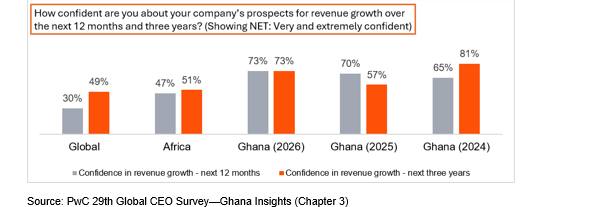
Seventy-three percent of Chief Executive Officers (CEOs) in Ghana are very or extremely confident in revenue growth over the next 12 months and three years.
Yet a third also feel highly exposed to technology disruption, and nearly half expect tariffs to compress margins even though few feel directly exposed.
“Confidence is surging. Risk perceptions are mutating. And the difference between momentum and missed opportunity will be what CEOs choose to do next”, PwC’s 29th Global CEO Survey has revealed.
The Ghana cut of PwC’s 29th Global CEO Survey offers a clear, if nuanced, message: macro headwinds have eased; optimism is back; the risk map is being redrawn around technology; and the winners will be those who monetise stability quickly while rewiring for an AI‑led, cross‑industry future.
A New Optimism—Tempered by Realism
The report alluded that the mood has shifted markedly. Four in five CEOs in Ghana expect global economic conditions to improve over the next year—up from under half last year and ahead of both global and African peers.
At home, falling inflation, a stronger currency and better‑than‑expected Gross Domestic Product (GDP) growth through much of 2025 and into early 2026 have restored confidence. By March 2026, inflation had decelerated to 3.2%, before ticking up to 3.4% (April), then 3.7% in May. The policy rate had also been lowered from 28% (March 2025) to 14%, signalling a more accommodative environment.
“This macro reset is reflected in corporate confidence. Seventy‑three percent of Ghana’s CEOs are very or extremely confident about their company’s revenue prospects over both the next 12 months and the next three years—up sharply from last year’s medium‑term reading. Interestingly, relatively few CEOs appear uneasy about the strength of their leadership benches: only 15% worry they lack the right top team, compared to 21% in Africa and globally”.
CEOs Cautiously Optimistic
The report added that executives in Ghana are acutely aware that currency stability remains fragile and that external shocks—commodity swings, geopolitical tension, supply chain disruptions—could quickly test the recovery.
“They also see an inflection point in business fundamentals: the blurring of industry lines is now a durable feature of the landscape, and the “Great Reconfiguration” of value pools is real. That reality is already in the numbers”.
“Equally important, this cautious optimism also underscores CEOs’ admission—perhaps, not overtly—that they need to do more at company levels to ensure they position their companies to convert the opportunities that a good macro-economic environment might spawn.” — George Arhin, Partner, PwC Ghana.
The Risk Map is Shifting Towards Technology
For the third year running, macroeconomic volatility ranks among CEOs’ top short‑term threats.
But this year, technology disruption has risen rapidly on the risk register, overtaking inflation and cyber as a near‑term concern. Thirty‑three percent of Ghana’s CEOs say they feel highly or extremely exposed to tech disruption in the next 12 months.
Many worry they are not transforming fast enough to keep pace, with 48% anxious about safeguarding their company’s medium‑to‑long‑term viability.
That anxiety is well placed. AI’s potential is accelerating—and unevenly distributed.
Eighteen percent of CEOs in Ghana also say they are already getting full value from AI, while nearly four in ten report they are experimenting but have yet to see material financial impact.
The implication is clear: first movers are banking real profit and loss gains while many are still in the lab. .
There is also another, subtler tension: an apparent underweighting of cyber risk even as technology disruption climbs.
Latest Stories
-
Ghana Battalion 14 completes reconnaissance mission ahead of UN peacekeeping deployment in South Sudan
11 minutes -
HAWA Project Manager calls for climate-responsive humanitarian systems as extreme weather intensifies
14 minutes -
KMA ‘samansaman’ arrests 13 over poor sanitary practices in their homes
15 minutes -
KAIPTC opens HAWA 2026, calls for stronger regional cooperation to tackle West Africa’s humanitarian crises
16 minutes -
Nearly one in five Ghanaians may be living with chronic kidney disease as cases surge nationwide
18 minutes -
Big Push: Rehabilitation of 81.3km of roads in Ajumako-Enyan-Essiam reaches 73% completion
19 minutes -
NPP alleges political frustration in Hanan’s arrest case
20 minutes -
73% of CEOs bullish about economy but worried of technology risks – PwC
23 minutes -
Interior Minister urges immigration commanders to strengthen coordination against emerging security threats
23 minutes -
Ghana Armed Forces launches three-week security exercise in Nkwanta and Bawku
24 minutes -
Eight rescued from seaplane that made ‘hard landing’ in Manhattan river
28 minutes -
Ex-Syrian intelligence chief found guilty of torture and sexual abuse by Austrian court
28 minutes -
Nexus Global Services holds workshop to prepare kidney patients for transplants
28 minutes -
Is Ghana finally winning war against romance scams?
44 minutes -
Health Ministry opens recruitment for 36th batch of Medical Officers and Dentists
1 hour