


Audio By Carbonatix
Scientists in Cambridge have built a virtual reality (VR) 3D model of cancer, providing a new way to look at the disease.
The tumour sample, taken from a patient, can be studied in detail and from all angles, with each individual cell mapped.
Researchers say it will increase our understanding of cancer and help in the search for new treatments.
The project is part of an international research scheme.
How it was done
- Researchers start with a 1mm cubed piece of breast cancer tissue biopsy, containing around 100,000 cells
- Wafer thin slices are cut, scanned and then stained with markers to show their molecular make-up and DNA characteristics
- The tumour is rebuilt using virtual reality
- The 3D tumour can be analysed within a virtual reality laboratory
The VR system allows multiple users from anywhere in the world to examine the tumour.
Prof Greg Hannon, director of Cancer Research UK Cambridge Institute (CRUK), told the BBC: "No-one has examined the geography of a tumour in this level of detail before; it is a new way of looking at cancer."
The 'virtual tumour' project is part of CRUK's Grand Challenge Awards.
Within a 'virtual' laboratory, Prof Hannon and I became avatars, whilst the cancer was represented by a multi-coloured mass of bubbles.
Although the human tissue sample was about the size of a pinhead, within the virtual laboratory it could be magnified to appear several metres across.
To explore the tumour in more detail, the VR system allowed us to 'fly through' the cells.
The virtual tumour we were looking at through our headsets was taken from the lining of the breast milk ducts.
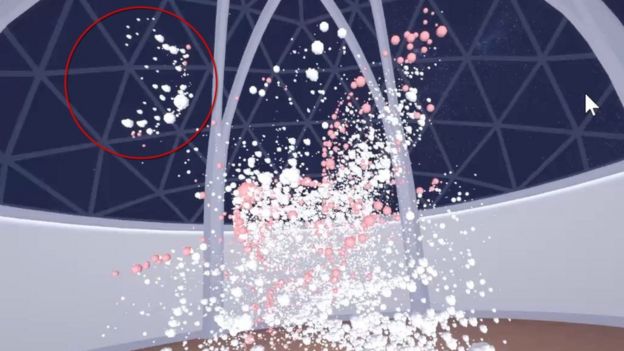
A group of cells, circled, have broken away from the main tumour mass
As Prof Hannon rotated the model, he pointed to a group of cells that were flying off from the main group: "Here you can see some tumour cells which have escaped from the duct.
"This may be the point at which the cancer spread to surrounding tissue - and became really dangerous - examining the tumour in 3D allows us to capture this moment."
Prof Karen Vousden, CRUK's chief scientist, runs a lab at the Francis Crick Institute in London which examines how specific genes help protect us from cancer, and what happens when they go wrong.
She told the BBC: "Understanding how cancer cells interact with each other and with healthy tissue is critical if we are going to develop new therapies - looking at tumours using this new system is so much more dynamic than the static 2D versions we are used to."
Latest Stories
-
Ghana Navy participates in African Maritime Forces Summit in Morocco
3 minutes -
GNFS intensifies fire safety education in Eastern Region communities
5 minutes -
BoG, GoldBod finalising new financing model to reduce pressure on central bank balance sheet
8 minutes -
Michelin-starred restaurateur faces jail for using ants as dessert garnish
14 minutes -
The evidence that jailed Wontumi was built by NPP – Mustapha Gbande
18 minutes -
Africa can no longer rely on foreign aid for healthcare – Deputy Health Minister
28 minutes -
COCOBOD’s shift to local market financing is the right move – BoG
32 minutes -
Minority labels economy a ‘galamsey economy’, questions government’s growth claims ahead of budget review
33 minutes -
Joy FM’s Showbiz Roundtable to assess Mahama administration’s performance in tourism, culture and creative arts
33 minutes -
Finance Ministry must fund GoldBod operations after BoG exit – Economist
33 minutes -
BoG to sell remaining stakes in ADB, NIB – Dr. Asiama
42 minutes -
Ghana, Netherlands deepen security cooperation to combat organised crime and drug trafficking
45 minutes -
JoyNews’ Digital Economy forum aiming to shape Ghana’s digital future comes off tonight
51 minutes -
Africa must fund its own health systems to achieve universal healthcare – African Union Commissioner for Health
51 minutes -
UNFPA Ghana, Prudential Life Insurance graduate 25 former head porters in painting and tiling skills
53 minutes