


Audio By Carbonatix
Nigerians are heading to the polls to elect state and local representatives, two weeks after the presidential poll.
Ballots are being cast in 29 of the country's 36 states.
In oil-rich Nigeria, some state governors control budgets larger than those of neighbouring countries and so these are often keenly contested.
President Muhammadu Buhari beat his main rival Atiku Abubakar in the 23 February election, securing a second term.
Across the country, Mr Buhari's All Progressives Congress (APC) got 15.2 million votes while Mr Abubakar's People's Democratic Party (PDP) received 11.3 million. There are 73 million registered voters.
The APC won 19 states, while the PDP secured 16 plus the capital Abuja.
Mr Abubakar said the election was a "sham" and was not free and fair. He has since filed a petition challenging President Buhari's win.
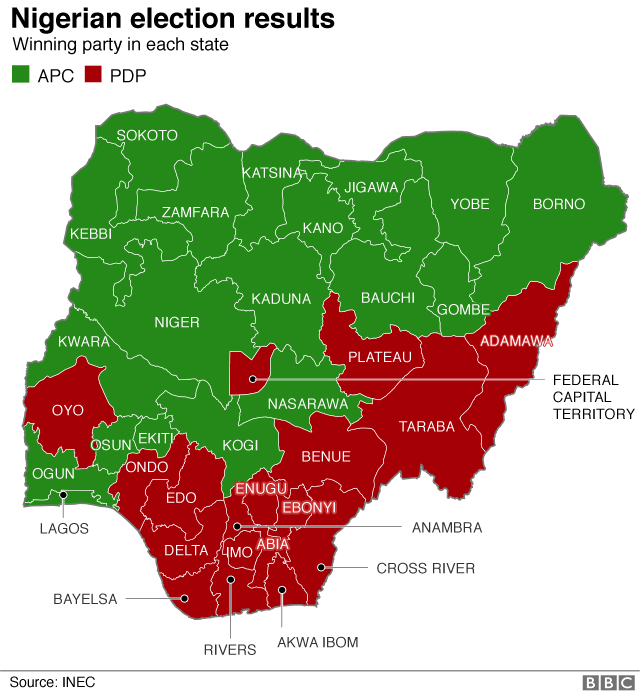
Although turnout for the presidential election was low across the country, it was higher in the northern states - one factor behind Mr Buhari's victory.
Fears of possible election-related violence has led to the massive deployment of security personnel across the country.
Seven states - Kogi, Bayelsa, Ekiti, Osun, Ondo, Edo and Anambra - will not hold elections because their governors have not finished their four-year terms.
The turnout for the state elections is expected to be higher than the 35.5% in last month's presidential election, down from 44% in 2015.
Most Nigerians take state elections seriously because their lives are directly impacted by the governor and representatives in the state legislature.
For instance, in 2000 - Governor Ahmed Sani Yerima introduced sharia law in Zamfara state and some other state governors in the north followed suit, even though the federal government wasn't fully in support of that idea.
The governors also enjoy political influence and control huge budgets.
Lagos, one of the most contested states, has an estimated population of 17.5 million people - this is more than the combined population of Gabon, The Gambia, Liberia, Cape Verde and Sierra Leone.
The state's GDP is more than that of Kenya. In fact, Lagos would be the fifth largest economy in Africa if it were a country.
Other key battle grounds that will be hotly contested between the APC and PDP are Kaduna, Akwa Ibom, Imo, Kano and Kwara.
Latest Stories
-
Ampem Darkoa Ladies miss out on CAF Champions League qualification after penalty shootout loss
1 hour -
Herbal Medicine: Less than 15% practitioners registered
4 hours -
Road inspections not a witch-hunt against contractors — Agbodza
4 hours -
HTU clinic upgraded to primary hospital after HeFRA inspection
4 hours -
“When I am gone, just like Kwame Nkrumah people will appreciate me” – Kurt Okraku
5 hours -
“I love people who are not only critical but constructive” – Kurt Okraku
5 hours -
TECNO’s Modular Phone and TAURUS win gold at IFA 2026, recognising breakthroughs in mobile and gaming technology
5 hours -
Youth Forum in Accra calls for debt cancellation, reparations and African economic independence
5 hours -
Dr Abu Sakara urges African youth to seize global upheaval for economic emancipation
5 hours -
Fulham booed off after third defeat in a row
5 hours -
Joy FM Back-to-School Fair 2026 ends in massive success after two days of discounts and one-stop shopping
6 hours -
Man City maintain 100% start with win over Coventry
6 hours -
Kwesi Pratt urges African youth to reject ‘Gen Z revolution’, reclaim Africa’s resources
6 hours -
Forest and Tottenham both still looking for first win after scrappy draw
6 hours -
Inter Milan mount stunning comeback to beat Napoli
6 hours