


Audio By Carbonatix
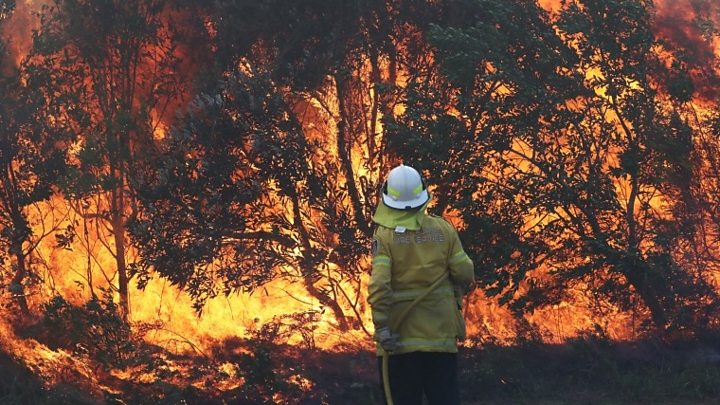
At least three people are dead and four missing in "unprecedented" bushfires in Australia.
On Saturday, the fire emergency's second day, officials warned the death toll was likely to continue to rise.
Prime Minister Scott Morrison said the military could be called upon to support the 1,300 firefighters currently tackling about 100 blazes.
Hundreds of civilians have also volunteered to help in affected areas in Queensland and New South Wales.
"My only thoughts today are with those who have lost their lives and their families," Mr Morrison added.
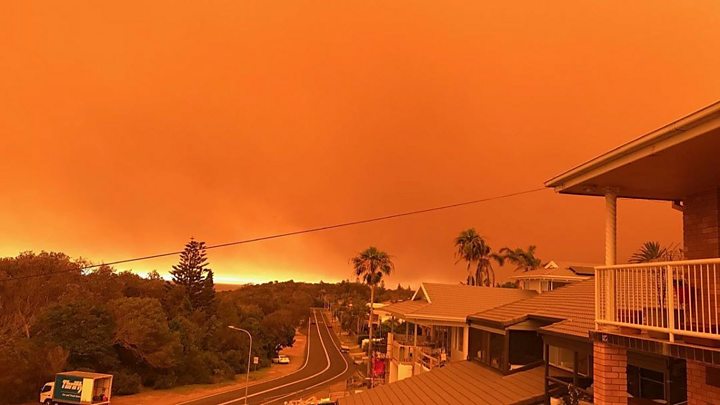 Media caption"Unprecedented" bushfires turn skies orange
In Queensland, thousands of people spent the night in evacuation centres while officials assessed whether it was safe for them to return home.
Meanwhile fire officials in NSW confirmed that more than 150 homes had been destroyed.
Gusty winds and up to 35C heat have exacerbated the fires, many of which are in drought-affected areas.
Media caption"Unprecedented" bushfires turn skies orange
In Queensland, thousands of people spent the night in evacuation centres while officials assessed whether it was safe for them to return home.
Meanwhile fire officials in NSW confirmed that more than 150 homes had been destroyed.
Gusty winds and up to 35C heat have exacerbated the fires, many of which are in drought-affected areas.
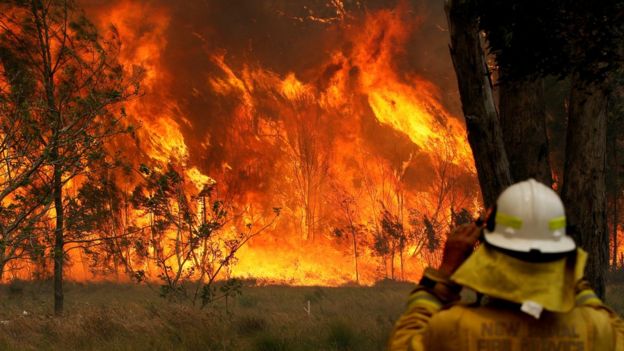 Image copyrightREUTERS
Image captionAbout 1,000 firefighters have been tackling the blazes across New South Wales
But fire authorities said that falling temperatures, increases in humidity and helicopter assistance were helping with efforts to tackle the blazes.
The blazes are spread across about 1,000 km (621 miles) of Australia's coast, stretching the emergency response.
Some people were warned to seek shelter from fires rather than flee, as it was now too late to leave.
Image copyrightREUTERS
Image captionAbout 1,000 firefighters have been tackling the blazes across New South Wales
But fire authorities said that falling temperatures, increases in humidity and helicopter assistance were helping with efforts to tackle the blazes.
The blazes are spread across about 1,000 km (621 miles) of Australia's coast, stretching the emergency response.
Some people were warned to seek shelter from fires rather than flee, as it was now too late to leave.
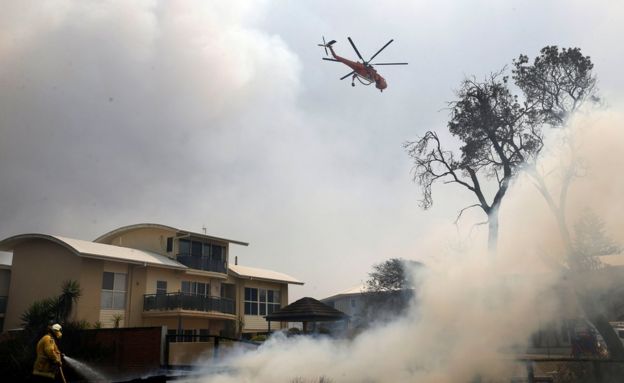 Image copyrightREUTERS
Image captionWater-bombing helicopters have been deployed to the site of the fires
In NSW, the worst-hit state, crews have fought hundreds of fires since last month, when two people died while trying to protect their home.
Last week, one blaze burned though 2,000 hectares of bush which contained a koala sanctuary. Hundreds of the animals were feared to have died.
More than half the koalas living at another sanctuary may have also been killed by wildfires, according to charity Koala Conservation Australia.
Image copyrightREUTERS
Image captionWater-bombing helicopters have been deployed to the site of the fires
In NSW, the worst-hit state, crews have fought hundreds of fires since last month, when two people died while trying to protect their home.
Last week, one blaze burned though 2,000 hectares of bush which contained a koala sanctuary. Hundreds of the animals were feared to have died.
More than half the koalas living at another sanctuary may have also been killed by wildfires, according to charity Koala Conservation Australia.
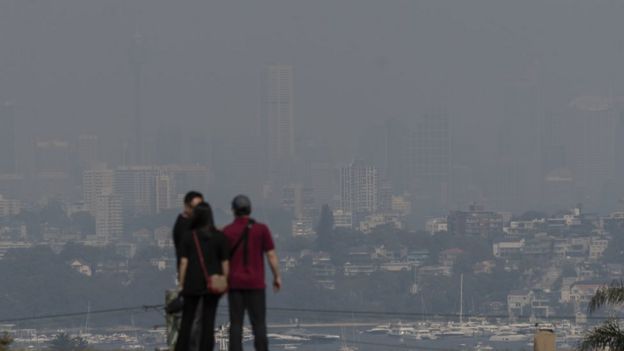 Image copyrightGETTY IMAGES
Image captionStrong northerly winds shrouded Sydney in smoke from the bushfires
Last week, Sydney was blanketed by smoke for days by fires in Port Macquarie - a region 380km away.
The poor air quality prompted health warnings for those with asthma and other respiratory problems.
Image copyrightGETTY IMAGES
Image captionStrong northerly winds shrouded Sydney in smoke from the bushfires
Last week, Sydney was blanketed by smoke for days by fires in Port Macquarie - a region 380km away.
The poor air quality prompted health warnings for those with asthma and other respiratory problems.
 Media captionWhy Australia bushfires are now "hotter and more intense"
Officials have confirmed that 2018 and 2017 were Australia's third and fourth-hottest years on record respectively.
The bureau's State of the Climate 2018 report said climate change had led to an increase in extreme heat events and increased the severity of other natural disasters, such as drought.
Even if global temperatures are contained to a 2C rise above pre-industrial levels - a limit set out in the landmark Paris accord, agreed by 188 nations in 2015 - scientists believe the country is facing a dangerous new normal.
Last year, a UN report said Australia was falling short in efforts to cut its CO2 emissions.
Media captionWhy Australia bushfires are now "hotter and more intense"
Officials have confirmed that 2018 and 2017 were Australia's third and fourth-hottest years on record respectively.
The bureau's State of the Climate 2018 report said climate change had led to an increase in extreme heat events and increased the severity of other natural disasters, such as drought.
Even if global temperatures are contained to a 2C rise above pre-industrial levels - a limit set out in the landmark Paris accord, agreed by 188 nations in 2015 - scientists believe the country is facing a dangerous new normal.
Last year, a UN report said Australia was falling short in efforts to cut its CO2 emissions.
Media caption"Unprecedented" bushfires turn skies orange
In Queensland, thousands of people spent the night in evacuation centres while officials assessed whether it was safe for them to return home.
Meanwhile fire officials in NSW confirmed that more than 150 homes had been destroyed.
Gusty winds and up to 35C heat have exacerbated the fires, many of which are in drought-affected areas.
Who were the victims?
While clearing affected areas on Friday, fire crews discovered the body of one victim in a burned out car near Glen Innes, about 550km (340 miles) north of Sydney. In the same town on the same day, a woman was found suffering from severe burns. She was rushed to hospital but died shortly afterwards. On Saturday, NSW police confirmed that a third person had died after a body was found in a burnt-out home near Taree, a town about 300km north of Sydney. Police said the home belonged to a woman aged 63, but that they wouldn't be able to confirm their identity until a post-mortem had been carried out.What's the latest?
On Saturday, NSW Rural Fire Service Commissioner Shane Fitzsimmons said there would be little reprieve in fire conditions over the next week, or throughout the summer months of December, January and February. "The forecast for the balance of the season continues to be driven by above-normal temperatures (and) below-average rainfall to dominate over the coming months," he told Reuters news agency. At one point on Friday, 17 emergency-level fires were burning simultaneously across NSW.Image copyrightREUTERS
Image captionAbout 1,000 firefighters have been tackling the blazes across New South Wales
But fire authorities said that falling temperatures, increases in humidity and helicopter assistance were helping with efforts to tackle the blazes.
The blazes are spread across about 1,000 km (621 miles) of Australia's coast, stretching the emergency response.
Some people were warned to seek shelter from fires rather than flee, as it was now too late to leave.
Image copyrightREUTERS
Image captionWater-bombing helicopters have been deployed to the site of the fires
In NSW, the worst-hit state, crews have fought hundreds of fires since last month, when two people died while trying to protect their home.
Last week, one blaze burned though 2,000 hectares of bush which contained a koala sanctuary. Hundreds of the animals were feared to have died.
More than half the koalas living at another sanctuary may have also been killed by wildfires, according to charity Koala Conservation Australia.
What about the drought?
Rains lashed NSW earlier this week, providing much relief to farmers. But the storms were not nearly enough to end the long-running drought. Authorities in the state warn that many fires will continue to burn unless there is more rain. "We just cannot overstate the profound impact that the drought is having on fire behaviour," Mr Fitzsimmons said. Water-bombing aircraft are often flying long distances because of the difficulty of accessing water in dry areas. In some cases authorities have drilled bores to keep up with demand. "We've very mindful of the scarcity of water and how precious it is, but the reality is we can't do firefighting without water," Mr Fitzsimmons said.Image copyrightGETTY IMAGES
Image captionStrong northerly winds shrouded Sydney in smoke from the bushfires
Last week, Sydney was blanketed by smoke for days by fires in Port Macquarie - a region 380km away.
The poor air quality prompted health warnings for those with asthma and other respiratory problems.
Is this linked to climate change?
Australia's fire season risks growing longer and more intense due to climate change, according to scientists. Authorities said they were concerned about the severity of the fires ahead of its hottest months, a year after the nation experienced its warmest summer on record.
Media captionWhy Australia bushfires are now "hotter and more intense"
Officials have confirmed that 2018 and 2017 were Australia's third and fourth-hottest years on record respectively.
The bureau's State of the Climate 2018 report said climate change had led to an increase in extreme heat events and increased the severity of other natural disasters, such as drought.
Even if global temperatures are contained to a 2C rise above pre-industrial levels - a limit set out in the landmark Paris accord, agreed by 188 nations in 2015 - scientists believe the country is facing a dangerous new normal.
Last year, a UN report said Australia was falling short in efforts to cut its CO2 emissions.DISCLAIMER: The Views, Comments, Opinions, Contributions and Statements made by Readers and Contributors on this platform do not necessarily represent the views or policy of Multimedia Group Limited.
DISCLAIMER: The Views, Comments, Opinions, Contributions and Statements made by Readers and Contributors on this platform do not necessarily represent the views or policy of Multimedia Group Limited.
Latest Stories
-
Oil hits over 1-week low on hopes of boost to diplomacy in Iran war
1 hour -
They take GH¢100, sometimes GH¢200 – Okada riders allege police extortion in Accra
1 hour -
NACOC: We’ve found no presidential escort among suspects in €225m France cocaine case
1 hour -
Don’t turn students away over trunks and chop boxes – GES
2 hours -
Italian Apple store employees strike on iPhone 18 Pro launch day
2 hours -
Apple’s Tim Cook sees Australia’s social media curbs as ‘world-leading’, PM says
2 hours -
Amazon raises minimum hourly pay by $1 to $20 for US operations workers
2 hours -
Insurance cost has largely remained stable – NPA boss on transport fare pressure
2 hours -
Multiple unions threaten strikes at Barrick’s flagship Mali gold mine, documents show
3 hours -
Infantino invited to African summit as he faces challenge to FIFA leadership
3 hours -
NPA boss flags ‘recalcitrant’ transport operators raising fares arbitrarily
3 hours -
GPRTU fare hike put on ice after talks with government – NPA boss reveals
3 hours -
I’m greatly worried – NPA boss on threat of higher transport fares
4 hours -
We are largely import-dependent – NPA boss on Ghana’s fuel vulnerability
4 hours -
Ghana’s fuel market is built for turbulence – NPA’s Edudzi Tamakloe explains why
4 hours