

Audio By Carbonatix
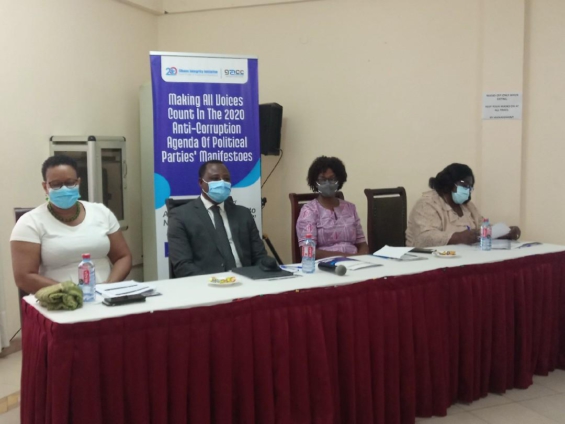
The Ghana Anti-Corruption Coalition (GACC) has launched the Citizens' Anti-Corruption Manifesto (CACM) to serve as a basis for conversations on potential anti-corruption reforms.
Executive Secretary of the GACC Beauty Emefa Narteh, expressed the hope that political parties would embrace the issues identified by citizens and be guided by the broad recommendations to fashion out their own specific approach to addressing corruption in Ghana.
The CACM was developed by the Coalition and the Ghana Integrity Initiative (GII), with funding from the STAR-Ghana Foundation.
It is aimed at making corruption a key election issue this year thereby improving Ghana’s anti-corruption performance in subsequent years.
Mrs Narteh said the Coalition and other CSOs were implementing a STAR-Ghana Foundation funded project, dubbed; “Making All Voices Count in the 2020 Anti-Corruption Agenda of Political Parties’ Manifestoes” to increase citizens’ voices in the anti-corruption agenda.
She said the CACM Report underscored government’s inclination to execute its Manifesto rather than the country's development plan.
Joseph Whittal, the Chairman of the Commission on Human Rights and Administrative Justice, who launched the Report, said CSOs were creating a powerful platform that would set out the conversation for the next several months leading to the election.
Mrs Mary Awelana Addah, the Programmes Manager, GII, said going forward the organisation was planning to sustain the discourse by mobilising the mass of CSOs and the media to begin to interrogate the sources of funding of political parties.
Dr Esther Ofei-Aboagye, the Chairperson of STAR-Ghana Foundation, said the Foundation was happy to be associated with the CACM document having an immeasurable value.
The CACM seeks to create stakeholder awareness on citizens’ view on anti-corruption reforms for inclusion in political parties’ manifestos and to increase support and commitment in fighting the canker.
It also seeks to create the pathway for political parties to design and implement appropriate legal and policy/administrative reforms to tackle corruption on a more sustainable basis.
In compiling the CACM, the GII and GACC collated the views of a wide spectrum of sub-groups in Ghana including faith-based organisations, traditional rulers, and anti-corruption experts.
Others were women groups, students, civil society organisations, people with disability and other marginalized groups.
Latest Stories
-
‘I never said I’ll declare a state of emergency’ – President Mahama on galamsey
6 minutes -
Bobby Banson condemns EOCO’s attempted arrest of Nana Agyei Baffour Awuah
31 minutes -
When Kumasi begins to look like somebody is in charge
31 minutes -
Parliamentary probe into cocaine seizure would be a waste of time – Inusah Fuseini
38 minutes -
Cocaine seizure: Focus on Ghana’s reputation, not partisan blame – Osae-Kwapong
44 minutes -
Two Invitations, Three Interrogations: Did Baffour Awuah tell the whole story?
54 minutes -
Drug cartels may be seeing Ghana as easy route – Lenin Anane Agyei
2 hours -
Ghana risks gaining notoriety as drug-trafficking hub – Bobby Banson
2 hours -
Government dismissed my drug trafficking warning, then tried to arrest me – Ntim Fordjour
2 hours -
Day Two: 3rd Republic Bank-JoyNews Habitat Fair Clinic underway at Junction Mall
2 hours -
NACOC addressing inherited gaps in fight against drug trafficking – Deputy Director-General
2 hours -
Taekwondo goes to school as GTF launches five-region youth campaign
2 hours -
The issues Mourinho is struggling to fix at Real Madrid
2 hours -
Hundreds throng EducationUSA College Fair in Kumasi in pursuit of abroad studies
2 hours -
Drug bust: NACOC should be part of port inspection team – Twum-Barimah
2 hours