

Audio By Carbonatix
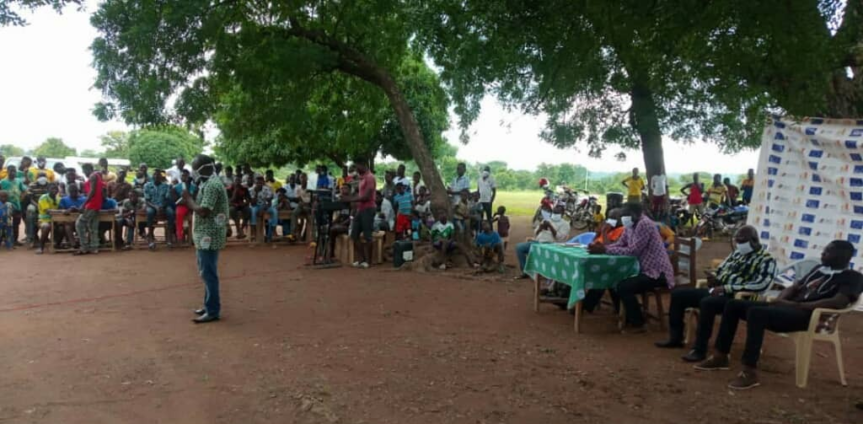
The Krachi Nchumuru District Office of the National Commission for Civic Education (NCCE) has engaged residents of Wornando, a farming community in the Krachi Nchumuru District of the Oti Region to social auditing regime.
The programme funded by European Union (EU) is aimed at promoting discourse among citizens and office bearers on planning, implementation, monitoring and evaluation of development projects and programmes.
Abass Yussif, Krachi Nchumuru District Director of NCCE, speaking at the inauguration called on the people to initiate their own development projects and take steps to get all community members to monitor the execution of development projects in their areas.
He advised them to be innovative in charting the course of their developmental projects and refrain from bottling up their hopes on the District Assembly or central government.
He urged Assembly-members to continue to lobby for projects from the level of the District Assembly and NGOs and discuss policies and programmes of the Assembly and central government with their electorates.
Robert Boame, acting Oti Regional Director of NCCE said the project was to promote anti-corruption, rule of law and accountability among duty bearers.
Mr Boame added that it was meant at helping community members to understand the operations of the Local Governance system and to get them to take part in decision-making affecting their daily livelihood.
He explained that the NCCE was mandated among others to campaign, advocate and lobby for increased accountability and reduction in corruption in the country.
The District Planning Officer, James Awapoay, Krachi Nchurumu District Planning Officer outlined the operations of the local government system including; how the District Assembly works.
He said the District Assembly was owned by the people through the elected and appointed members and not the District Chief Executive or any head of decentralised departments.
Mr Awapoayi said the District Assembly had two main sources of funding; the District Assemblies’ Common Fund (DACF) and Internally Generated Funds (IGF).
According to him, the Assembly did not have enough money to develop all communities at the same time and called on the people to have patience and that all projects in the area would be completed in due course.
At the end of the durbar, the community identified two developmental projects they wished got completed.
That is the completion of the CHPS Compound, which has been abandoned since 2016 and the completion of Rural Electrification Project, which has also been stalled.
A six-member committee was formed and inaugurated to lobby for the completion of the said projects.
Latest Stories
-
The Chief Justice is not a Touring Minister: Baffoe-Bonnie’s SOE visits are unconstitutional officiousness
9 minutes -
Enforcing environmental laws carries political cost, while offenders go unpunished – Frimpong-Boateng
16 minutes -
Galamsey fight collapsed after safeguards introduced in 2018 were abandoned – Prof Frimpong-Boateng
21 minutes -
Jail officials who approve projects in wetlands and forest reserves – Prof Frimpong-Boateng
33 minutes -
Ghana needs $21bn to restore lands damaged by illegal mining – Frimpong-Boateng
40 minutes -
Law student killed in hit-and-run on Tema Motorway; family offers GH¢50,000 bounty
47 minutes -
Gas explosion near Larteh school contained after fire outbreak
50 minutes -
Nigerian-British businessman dies after penis enlargement procedure in Thailand
1 hour -
CHEAP JUSTICE? – Occasional Kwatriot Kwesi Yankah writes
1 hour -
WASSCE 2026: English performance decline requires urgent action – EduWatch
2 hours -
Old Tafo MCE pledges action as residents raise alarm over faulty drainage systems
2 hours -
Abossey Okai dealers reject spare parts cost as justification for 30% transport fare hike
3 hours -
NPP to hold balloting for national elections on September 9
3 hours -
DirectAid concludes flood relief distribution across Greater Accra, Kasoa
4 hours -
Volcano eruption leaves 150,000 passengers stranded in Indonesia
4 hours