

Audio By Carbonatix
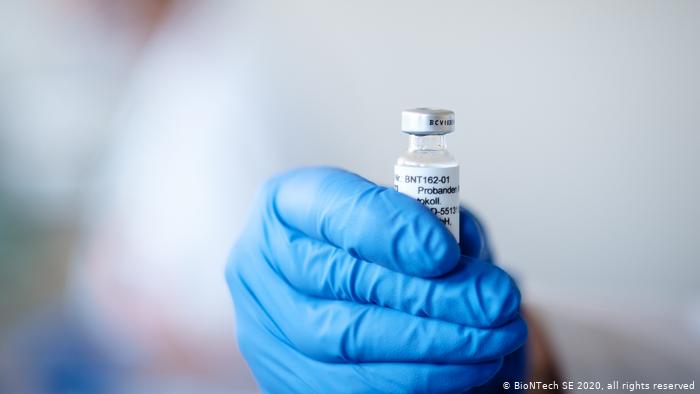
A vaccine jointly developed by German company BioNTech and Pfizer has proven to be 90% effective at preventing COVID-19 infections, according to phase 3 trials.
German company BioNTech and its US partner Pfizer announced on Monday that early results from ongoing phase 3 trials showed that their vaccine was 90% effective in preventing COVID-19 infections.
The statement from the two companies is the first release of successful data from a large-scale trial of coronavirus vaccines. According to their reports, they found no serious safety concern connected with the vaccine. Researchers believe the immunising effects will not be short-lived.
If substantiated, the Pfizer BioNTech vaccine would be a breakthrough in the fight against the coronavirus pandemic.
BioNTech's CEO Ugur Sahin told Reuters that: "We should be more optimistic that the immunisation effect can last for at least a year."
"The first set of results from our Phase 3 Covid-19 vaccine trial provides the initial evidence of our vaccine's ability to prevent Covid-19," Pfizer chairman and CEO Albert Bourla said in a statement.
Analysis of the experimental vaccine trials appeared to effectively prevent infection in participants "without prior evidence of SARS-Cov-2 infection," the joint statement said.
Vaccine already in production
Over 43,500 people took part in the trial which has been ongoing since late July. The two companies said they would apply for authorization with the US Food and Drug Administration in the coming week.
Pfizer and BioNTech already have a $1.95 billion (€1.64 billion euros) contract to deliver 100 million vaccine doses to the USA. They also have agreements with the EU, UK, Canada and Japan. Production of the vaccine has already begun in order to save time. They expect to produce up to 50 million doses in 2020, enough to vaccinate 25 million people.
Pfizer expected that it could produce up to 1.3 billion doses in 2021. 90% effectiveness is well above the 50% effectiveness that the US Food and Drug Administration requires in order to authorize a coronavirus vaccine.
Results are met with optimism
Stock markets reacted positively to the news with Pfizer's share increasing 6% while BioNTech's US stocks lept by 18%.
William Schaffner, infectious diseases expert at Vanderbilt University Medical Center in Nashville, Tennessee responded to the published data, saying: ""The efficacy data are really impressive. This is better than most of us anticipated. I would have been delighted with efficacy of 70% or 75%. 90% is very impressive for any vaccine. The study isn't completed yet, but nonetheless the data look very solid."
Marylyn Addo, head of tropical medicine at the University Medical Center Eppendorf in Hamburg, Germany was more cautious, saying: "Primary data are not yet available and a peer-reviewed publication is still pending. We still have to wait for the exact data before we can make a final assessment."
Vaccine testing doesn't end at Phase 3
While the speed at which these vaccines are progressing is unrivalled in humanity's vaccinology history, experts warn we still have a long way to go to achieve a safe and effective vaccine.
Although clinical trials can show that a vaccine is safe and effective among tens of thousands and even hundreds of thousands of people, it's not possible for these trials to encapsulate every possible side effect that could occur among certain people or after an extended period of time.
That's why, even after a vaccine has been rolled out, it's critical to monitor the safety and efficacy of vaccines, says Naor Bar Zeev, deputy director of the International Vaccine Access Center at the John Hopkins Bloomberg School of Public Health in the US.
"There is never certainty," Bar Zeev told DW. This ongoing surveillance is sometimes referred to as 'Phase 4' in clinical trials — and it can take many years.
"I think the public expectation is that once a vaccine is available we go back to the way things were — we stop wearing masks, we stop social distancing. But that is a misjudgement of what a vaccine — at least in the initial phase — can do," Bar Zeev said, emphasizing that the delivery and ongoing evaluation of widespread vaccine deployment is a lengthy process.
Latest Stories
-
This government should expect scrutiny – Asiedu Nketiah
11 minutes -
Two-year-old girl dies in domestic fire at Cantonments
56 minutes -
Asiedu Nketiah urges better working conditions for journalists
1 hour -
JoyNews’ Precious Semevoh wins climate change reporting award at Bono GJA Awards
1 hour -
Kumasi Central Market phase 2 to begin in October after years of abandonment
1 hour -
Sentuo offers fuel supply reassurance as NPA sees steady output through December
2 hours -
Ghanaian smock showcased at Lesotho Tourism Summit
3 hours -
Four pupils to one desk: The painful plight of schools in New Juaben North
3 hours -
Ipswich launch investigation into racist abuse of Abdul Fatawu
3 hours -
Arrest of Techiman nurse is purely political persecution – ‘Ghana Jollof’
4 hours -
Isak nets winner as Liverpool edge Bournemouth
4 hours -
I dare gov’t of Ghana to extradite me; they can never do it – ‘Ghana Jollof’ speaks
4 hours -
Semenyo scores twice as Manchester City beat Sunderland 5-3 in eight-goal thriller
4 hours -
Parliament calls for government-private sector collaboration to improve waste management
4 hours -
Volta Region described as cleanest so far in Parliament’s nationwide sanitation monitoring
4 hours