

Audio By Carbonatix
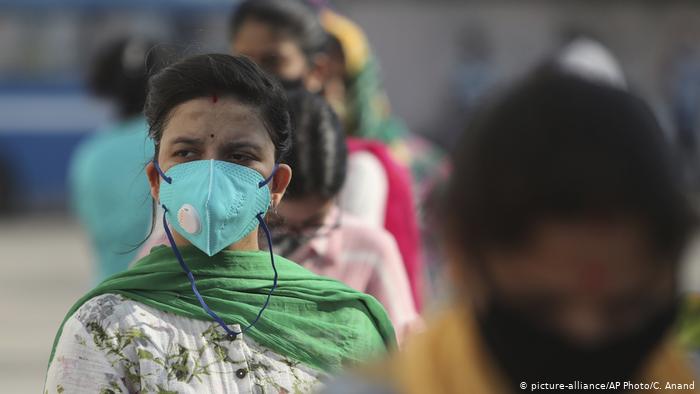
People in India are increasingly lowering their guard during the ongoing festival season, despite the high risk of contracting COVID-19. Many restrictions have been lifted, but the pandemic is far from over.
Rudra Nath, 42, a factory foreman in Alwar district of Northwestern Rajasthan state, says he feels exasperated having to tell his co-workers to keep their masks on all the time.
It has been over a month since the iron fabrication factory resumed production. Since June, the government has been gradually relaxing restrictions on public movement and commerce meant to contain the coronavirus.
Business has been slowly picking up, with orders coming in from across the state.
"Many of the workers are not afraid of the virus anymore. They feel the worst has passed and a cure is round the corner even if they become sick," Nath told DW.
Wearing a mask seems an exception in Rajasthan, particularly in rural areas, where most people are going about their lives as if the pandemic is over. Many are ignoring rules on physical distancing, and authorities' lax enforcement of the measures has compounded the problem.
No longer afraid?
In the Central state of Madhya Pradesh, it would almost seem as if the pandemic did not exist. Across vast swathes of its hinterland, people are carrying on with work, travel and shopping in markets without wearing masks.
"We are more wary of visitors coming from cities. We maintain physical distance from them. On our own, we have nothing to worry about," Prabath Kumar Singh, a postmaster from Mandsaur district, told DW.
India has so far recorded over 8.5 million coronavirus infections, second only to the United States in the total number of cases, and more than 126,000 related deaths.
The country has witnessed a drop in the recorded daily new cases over the past month. However, India still registers about 50,000 new cases on average every day.
People now do not appear to fear the virus as much as they did eight months ago, when the government first announced a nationwide lockdown.
"When the strict lockdown was in place and public movement was restricted, people were scared. At that time, fear was a force that directed behavior. That is no longer the case," Anant Kumar, a urologist and surgeon, told DW.
Latest Stories
-
VC inaugurates three committees ahead of UG’s 80th anniversary celebration
4 minutes -
Today’s Front pages: Monday, September 14, 2026
12 minutes -
The Or Foundation to launch recycled textiles platform Foose Materials during London Design Week
18 minutes -
110 children at Cardiothoracic Centre get second chance at life as Ghana Medical Trust Fund marks first year
22 minutes -
‘I’m suffering’ – Motherless 12-year-old who lost both legs, father in Ofankor-Pokuase crash seeks support
26 minutes -
Education Ministry extends 2026 SHS placement exercise by one week
2 hours -
Better roads will create sustainable jobs for Ghana’s youth – Joyce Bawah Mogtari
2 hours -
Kumasi Expressway to cut travel time, boost economic activity – Joyce Bawah Mogtari
2 hours -
GOIL could hold fuel prices despite $100 crude oil shock – Edward Bawa
2 hours -
Fitch lifts Ghana’s 2026 current account surplus forecast to 7.8%
2 hours -
Do not identify yourself as Ziavi Paramount Chief or Queen – Volta Region House of Chiefs warns
2 hours -
Sosu demands probe into $260m cocaine shipment seized in France
2 hours -
Mahama to receive cleared Accra-Kumasi Expressway right-of-way today
2 hours -
Mahama to cut sod for US$1.3bn Sentuo Airport Garden City on Tuesday
3 hours -
Ghana, China agree to tighten crackdown on illegal mining
3 hours