

Audio By Carbonatix
The new shipment of doses should give a shot in the arm to Germany's vaccination drive, which has faced criticism for being too slow and poorly supplied.
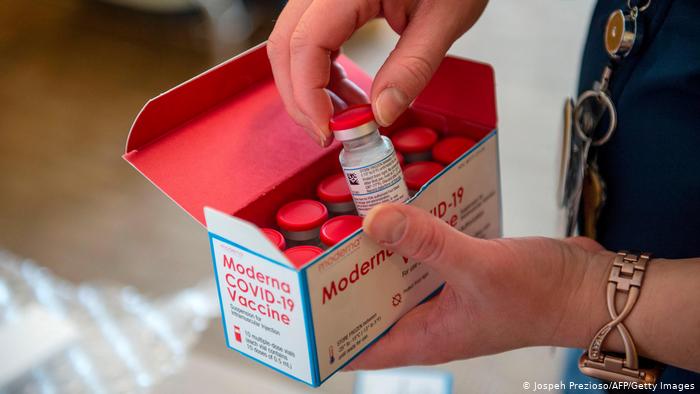
German vaccination centers received the first doses of the Moderna vaccine on Tuesday, as health officials ramp up a vaccination campaign that has been criticized for its relatively slow start.
The first doses arrived at German storage facilities in Lower Saxony on Monday.
Over 63,000 doses were shipped out on Tuesday, and some 2 million doses are expected to be delivered to Germany's 16 federal states by the end of March, according to the German Ministry of Health.
Up to 50 million doses of the Moderna vaccine are expected to be shipped to Germany by the end of 2021.
Vaccination off to sluggish start
Hundreds of vaccination centers have been set up across Germany in sports halls and arenas, with capacity for up to 300,000 shots a day, according to Health Minister Jens Spahn.
However, Germany's federal states have criticized the central government for not securing enough doses.
More than 600,000 people in Germany have received a first dose of the Covid vaccine, according to the Robert Koch Institute (RKI), which is little less than half of the 1.3 million doses that were supplied in a first shipment at the end of December.
Another 2.7 million doses of the BioNTech-Pfizer vaccine are expected by mid-February, according to the Health Ministry.
Tobias Kurth, director of the Insitute for Public Health (IPH) at Berlin's Charite Hospital told DW that the vaccination drive will take time to be fully rolled out.
"The numbers of people who have been vaccinated in Germany or in other countries is not enormous," he said. "We need several weeks and months before we see a turnaround in the number of infections because of the vaccination."
On Tuesday, the RKI reported a record number of vaccinations, with over 60,800 people receiving a shot. Vaccinations in Germany are entirely voluntary.
Equivalent to BioNTech-Pfizer
Vaccinations using BioNTech-Pfizer vaccine, the first to receive EU approval, began in Germany on December 27.
Like the BioNTech-Pfizer, Moderna's vaccine is also a so-called mRNA vaccine, a new kind of vaccine that teaches cells how to trigger a immune response to the virus without injecting parts of that virus into the body.
Thomas Mertens, the head of Germany's vaccine commission, said that both vaccines are "equivalent in effectiveness and safety."
Latest Stories
-
Cocobod pitches $1.4 billion domestic financing plan
39 minutes -
Eriksen leaves Wolfsburg by mutual consent
50 minutes -
Trump offers warm welcome as China’s Xi arrives for US visit
1 hour -
Bentley unveils its first fully electric car
1 hour -
OpenAI agent ‘infiltrated’ Australian government website, PM says
1 hour -
US pledges $267m more to fight Ebola in central Africa
2 hours -
Oil prices edge lower as Iran says it is open to diplomacy to end the war
2 hours -
Rule of Men is replacing Rule of Law – Abu Jinapor
2 hours -
US rejects pleas from OpenAI, Anthropic for global AI standards
2 hours -
Seidu Agongo launches initiative to distribute 10,000 sewing machines to vulnerable women and youth
2 hours -
AI superpower ambitions take centre stage as Trump and Xi meet
2 hours -
Ronaldo spurred on by 1,000 goals and Portugal glory
2 hours -
Man Utd still £1bn in debt with £63.5m spent on new stadium
2 hours -
‘We were just careless’ – Kofi Adams on African Games expenditure
2 hours -
England players carrying World Cup scar – Saka
2 hours