

Audio By Carbonatix
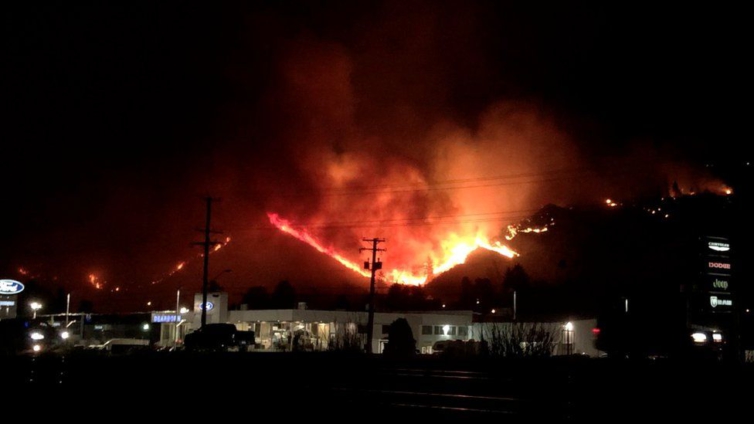
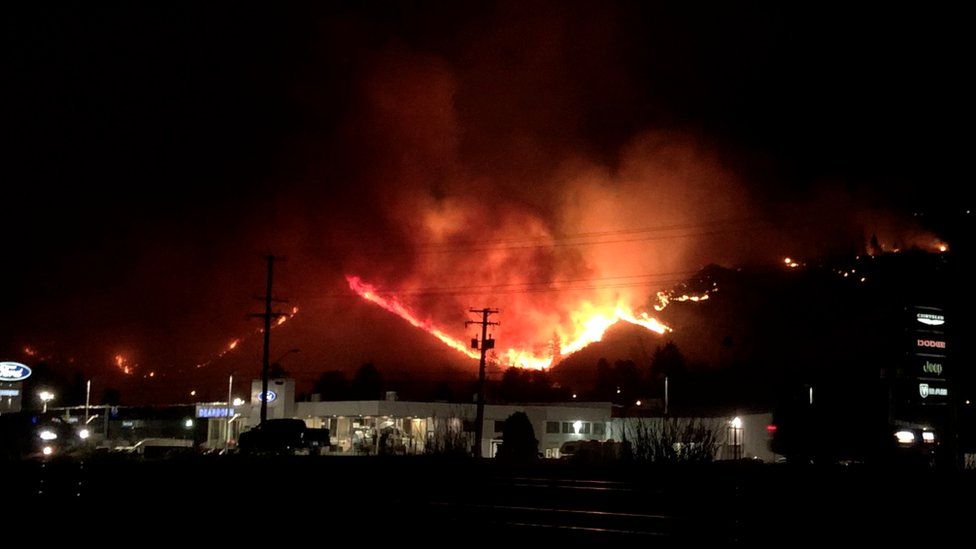
More than 130 wildfires - fuelled by lightning strikes - are burning across western Canada following a record-breaking heatwave.
Canada's federal government said it would send military aircraft to help emergency workers battling to control the fires in British Columbia.
Earlier this week, people had to flee the village of Lytton in the province.
Lytton, which recorded Canada's highest ever temperature of 49.6C (121.3F) on Tuesday, was destroyed by fire.
The blaze in the village - about 260km (160 miles) north-east of Vancouver - forced many of its 250 residents to leave without their belongings on Wednesday evening.
"Within about 15 minutes the whole town was engulfed in flames," Mayor Jan Polderman told the BBC.
Abnormally high temperatures have been recorded in swathes of North America in recent days.
Experts say that climate change is expected to increase the frequency of extreme weather events, such as heatwaves. However, linking any single event to global warming is complicated.
On Friday, the British Columbia Wildfire Service said that 136 fires were active across the province following some 12,000 lightning strikes the previous day.
Hundreds of people have been warned they may have to leave their homes.
Canada's Defence Minister Harjit Sajjan said the government would provide aid, including military helicopters and personnel, to help tackle the fires and reach people threatened by the flames.
The blazes have forced the closure of a number of major roads.
Public Safety Minister Bill Blair said the weather and the wildfires were having a "devastating" and "unprecedented" impact on British Columbia.
"These wildfires show that we are in the earliest stages of what promises to be a long and challenging summer," he said.
Health officials say extreme heat is likely to have contributed to 719 sudden deaths over the past week.
"Many of the deaths experienced over the past week were among older individuals living alone in private residences with minimal ventilation," Chief Coroner Lisa Lapointe said in a statement.
Temperatures have been easing in coastal areas of Canada, but there is not much respite for inland regions. The British Columbia Wildfire Service said it was bracing for more wildfires throughout the weekend.
Latest Stories
-
Conflicts among care providers linked to maternal, neonatal deaths – Expert
3 minutes -
GIS marks 10th TIME conference, champions improved teaching practices
10 minutes -
BRICS Or Balance? What Ghana’s bid really means
36 minutes -
GPRTU wants full TRAFFITECH-GH implementation to start in 2027
55 minutes -
Mahama announces plans to import electric wheelchairs for PWDs
59 minutes -
KGL U17 Colts 2026: Western beat Prempeh Elite Academy to set up final final with Greater Accra Region
1 hour -
Late Solanke strike salvages 10-man Spurs draw at Man United
1 hour -
Gender Ministry to monitor welfare of Nana Akua Addo’s children amid domestic violence case
2 hours -
Benedict Okyere Yeboah: Ghana’s football problem goes beyond sacking a coach
2 hours -
GPL 2026/27: Darkwah Wiafe’s winner sees All Blacks beat Kotoko
2 hours -
ITF World Tour : Patel Wins Boys’ Singles Final at J100 Accra
2 hours -
Ghana must pursue BRICS partnership if it brings economic benefits – Kpebu
2 hours -
Success and Wright Claims J100 Accra Girls’ Doubles Championship
2 hours -
ITF J100: America’s Wright wins J100 Accra Girls’ Singles Title
2 hours -
Expedition hopes to find aviator Amelia Earhart’s plane on remote island
2 hours