

Audio By Carbonatix
There is a concerted effort to restore Tinte Bepo Forest Reserve at Mankranso in the Ashanti region.
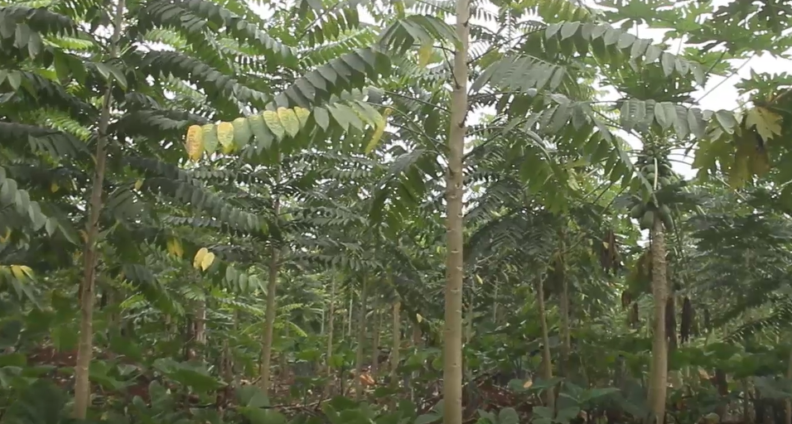
Commercial Plantation Development under the model called ‘Youth in Plantation as Occupation Programme' funded by the Forest Plantation Development Fund Management Board yields positive results.
In 2019, a total of 54 hectares of the area was planted with various tree species such as Ofram, Mahogany and Cedrela, while preparation is underway to plant the remaining hectares.
The planting of the trees has become necessary as temperatures and extreme heat keep rising.
The initiative would not only provide vegetation to the environment but create an economic empowerment program for women.
The programme will restore the forest and increase food production through the adoption of agroforestry systems.
Farmers are allowed to inter-crop foodstuffs with the trees, and over two hundred hectares of the degraded Tinte Bepo Forest Reserve in the Mankranso forest district would be restored.
Deputy Minister of Lands and Natural Resources, Benito Owusu-Bio, says the species planted include teak, Wawa, Mahogany, Cedrela, Ofram, and cassia.
Tinte Bepo was once a beautiful rainforest dominated by economic trees like Odum, Mahogany, Mansomia, Emire, and Danta.
Rainforests provide humans with more than just trees. Lack of vegetation could result in rapidly increasing climate change.
The latest report by the Intergovernmental Panel on Climate Change (IPCC) has projected an increase in average temperatures and heat extremes on the African continent.
According to the report, the continent is likely to experience drier conditions, except for the Sahara and Eastern Africa.
The Director-General of the Centre for Science and Environment (CSE), Sunita Narain, says there is no time to lose on the new Intergovernmental Panel on Climate Change (IPCC) report.
The Director-General of the Indian-based centre says countries will have to work even harder to plant more trees to sequester carbon dioxide.
The report on climate change is the first part of its sixth assessment report that sounds like a dire warning.
Latest Stories
-
Elizabeth Ohene writes: Your lordship, justice must also be seen to be done
20 minutes -
Ghana Water to resume spillage at Weija Dam from Wednesday
30 minutes -
Agyarko ends 16-region tour, targets NPP parliamentary comeback in Greater Accra
38 minutes -
GIGS welcomes UN adoption of Equal Earth map as correction to ‘450 years of cartographic injustice’ against Africa
42 minutes -
‘October 3 is the only poll I believe in’ – Paul Afoko dismisses NPP chairmanship survey
2 hours -
Contractors who delay projects risk losing Big Push contracts – Agbodza
2 hours -
NPA uses Fetu Afahye to educate consumers on petroleum safety
2 hours -
Roads Minister orders contractors to keep working during official visits
2 hours -
New 4-year bond attracts GH¢4.46bn in bids
2 hours -
AIA VIP Lounge to be completed without taxpayer funds – Ablakwa
2 hours -
KEEA Assembly disburses GH¢267,518 to 94 PPCs in third quarter
2 hours -
GAF clears 175.6km corridor for Accra-Kumasi Expressway ahead of schedule
3 hours -
Dr Abu Sakara urges African youth to lead economic freedom
3 hours -
24-Hour Economy mobilises GH¢1bn for poultry value-chain transformation
3 hours -
From working in his room to building a business group – Michael Bartlett-Vanderpuye’s journey
3 hours