

Audio By Carbonatix
The Soil Research Institute (SRI) of the Council for Scientific and Industrial Research (CSIR) has rolled out new technologies for effective management of soil fertility for increased crop yield.
The move is to support the government's flagship programme of planting for food and jobs.
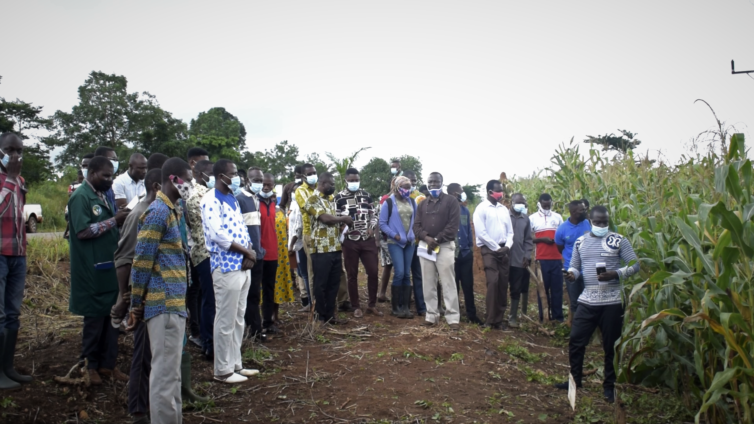
The CSIR-Soil Research Institute has been carrying out demonstrations to showcase some of its fertility management strategies to increase maize yield at Biokrom in the Tano South District.
The newly developed technology is geared towards improving agricultural sustainability in the country.
Two regions have benefited from the implementation of the new technology rolled out by the Soil Research Institute.
Dr. Emmanuel Dugan is a research scientist at the Soil Research Institute.
“The growth and yield of every crop, including maize is strongly influenced by soil fertility management.
“Effective soil’s fertility management is one of the most important factors for improving productivity and increasing maize crop.
“The Council for Scientific and Industrial Research CSIR-Soil Research Institute SRI) is supporting government's flagship programme of planting for food and jobs by rolling out technologies for effective management of soil fertility for increased crop yield,” he said.
The Institute observes inappropriate farm practices have contributed to soil fertility decline across the country.
This affects the quality and quantity of farm yields.
“Soil fertility decline has been identified across the country, as a factor contributing significantly to low yield of crops.
“The extent however varies from region to region
“Soil fertility does not only affect the quantity of crop yields but also quality as well,” he noted.
The Chief Executive for Tano South Municipality, Collins Offinam Takyi, advised farmers to adopt the modern farming methods introduced.
“Farmers have to rely on science and research so they can apply the new technologies on their farms
“They should also desist from the traditional way of farming if they want to improve their yield, income and livelihoods,” he emphasized.
Some of the new technologies for soil fertility introduced in the Ahafo Region include: Biochar (a soil conditioner that helps to conserve both soil nutrients and moisture).
Mineral fertilizer; a new fertilizer blend (NPK 15-20-20+Zn) specifically developed and recommended at 90-60-60 kilogram per hectare by the CSIR -SRI for transition and part of semi-deciduous agroecology.
The new technology was developed by the CSIR-SRI in collaboration with the Department of Agriculture (DoA) and sponsored by the Government of Canada through Modernizing Agriculture in Ghana (MAG).
Latest Stories
-
PHOTOS: Proposed Vice-Presidential Villa abandoned for 13 years after over $2.4m spent
11 minutes -
Buem MP Kofi Adams raises alarm over flooding, damaged roads in constituency
16 minutes -
Kotoko should hire best local coach available – Kojo Addae Mensah
21 minutes -
GPL 2026/27: Asante Kotoko, Coach Boadu and two players charged by GFA
25 minutes -
Hohoe flood: Over 700 residents seek shelter in classrooms, MP appeals for help
26 minutes -
Armah-Kofi Buah has not resigned from GoldBod – Lands Ministry
28 minutes -
Attacks on Lordina Mahama, Samira Bawumia reinforce unequal power – Victoria Hamah
44 minutes -
Ghana’s Starlets step up training ahead of second friendly with Morocco
1 hour -
COCOBOD says $1.4bn domestic funding is a strategic shift, not market exclusion
2 hours -
Richmond Quarcoo appointed Ghana’s Chef de Mission for 2028 Olympics
3 hours -
‘Our missing players are more important’ – Gambia coach fires shot at Ghana
4 hours -
Today’s front pages: Tuesday, September 29, 2026
4 hours -
Ghana ‘showing up differently’ on global stage – Joyce Bawah Mogtari
4 hours -
Ghana’s tuna industry in crisis as 20 hook-and-line vessels collapse
5 hours -
South Tongu MP launches apprenticeship programme for 159 young people
5 hours