

Audio By Carbonatix
Nigeria has been placed on the UK's travel red list - a move the UK government says will help slow the spread of the Omicron variant of the Covid-19 virus.
The Nigerian high commissioner to the United Kingdom has said the restrictions amount to "travel apartheid".
So why has Nigeria been added to the red list, and are the measures fair?
What is the red list?
Nigeria is the latest African country to join the UK's travel red list - along with South Africa, Namibia, Zimbabwe, Botswana, Lesotho, Eswatini, Angola, Mozambique, Malawi and Zambia.
The only people allowed to enter the UK from these countries are UK or Irish nationals, or UK residents.
Arrivals from red-list countries are required to enter hotel quarantine - at their own expense - and isolate for 10 days.
These countries have been targeted because the Omicron variant was first identified in southern Africa.
But the fact all of the nations currently on the red list are African has been described as "wicked and unfair".
What is the criteria for the red list?
The decision to place a country on the red list is based on risk assessments from the Joint Biosecurity Centre (JBC), including:
- the quality of its testing structures, including checking for variants
- the number of cases those systems have identified
- whether people have been catching new variants there or the cases have come from overseas
- whether it has exported cases of new variants to other countries, including to the UK
- the quality of travel links with the UK
Why was Nigeria added?
The UK government says Nigeria was added to the list because:
- its analysis suggests a strong indication of Omicron in Nigeria
- several cases identified in the UK are linked to travel from Nigeria
- Nigeria has strong travel links with South Africa, where Omicron was first detected
The JBC provides reports summarising the data used to inform specific country decisions but the one on Nigeria is yet to be published.
A UK government statement announcing Nigeria's addition to the red list said the "vast majority" of Omicron variant cases in the UK "have clear links to overseas travel from South Africa and Nigeria".
How many Covid cases are there in Nigeria?
With about 90 cases identified a day over the past week, reported Covid cases in Nigeria are far lower than in most of Europe - but testing in Africa is way below European levels.
During the last week of November, Nigeria completed about 0.07 tests per 1,000 people a day, compared with about 14 per 1,000 in the UK and about eight per 1,000 in France.
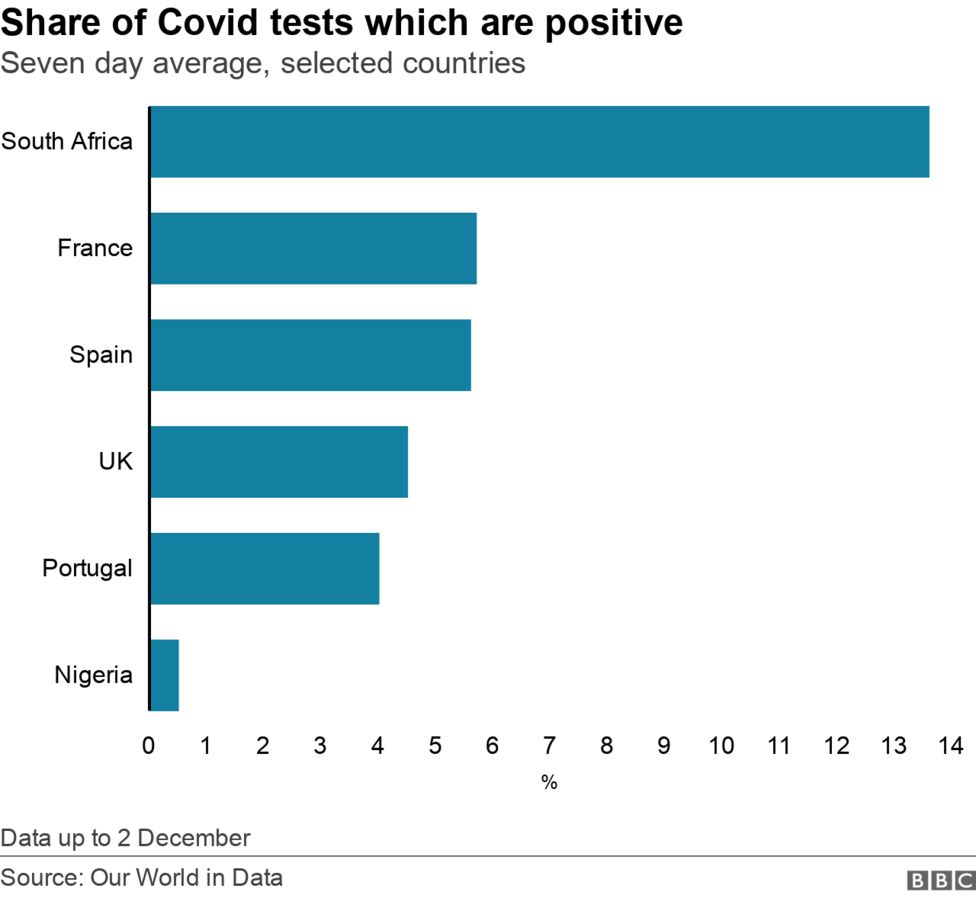
But in the week up to 2 December, Nigeria still identified fewer cases per test than several European countries - and South Africa.
However, on top of different testing regimes, all countries collect and share data differently, making international comparisons tricky.
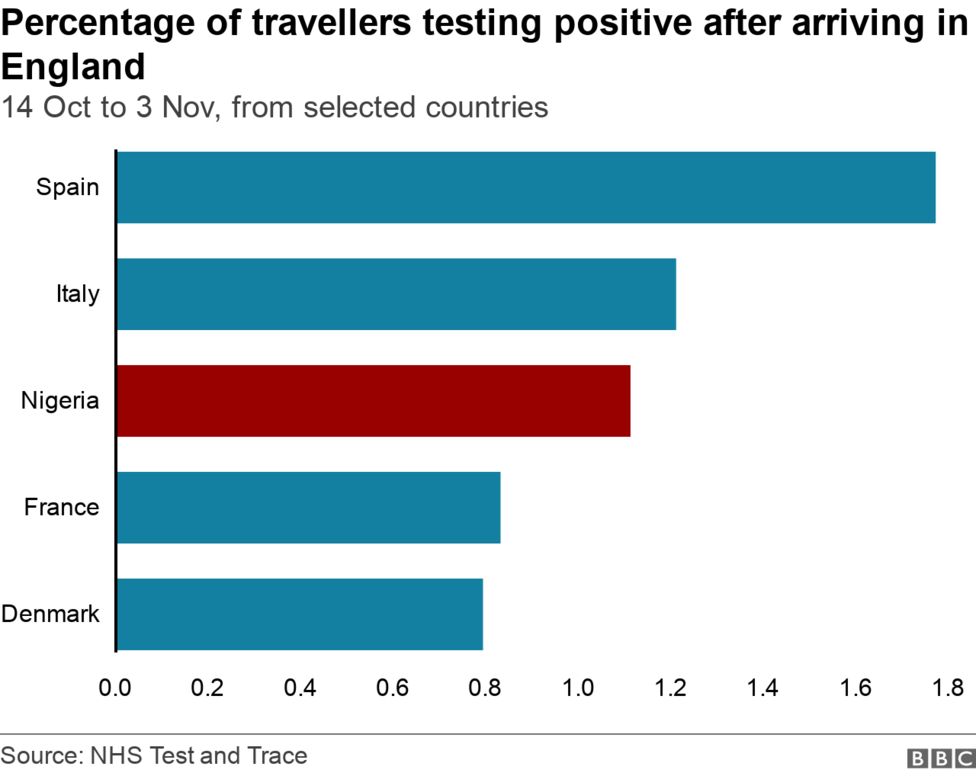
The UK government collects data on people testing positive for Covid after arriving in the UK.
The latest, from the start of November, shows 1% of those arriving from Nigeria tested positive, similar to the proportion among those arriving from several European countries.
What about cases of Omicron?
The Nigerian Centers for Disease Control (NCDC) has identified only three cases of Omicron in the country, all linked to travel from South Africa.
This is fewer than in several European countries, including the UK - where there have been 336 reported Omicron cases.
But the NCDC data is five days old, so the numbers are likely to have risen since.
Genome sequencing - the very sophisticated and relatively rare process required to identify variants - is also less advanced in Nigeria than in the UK or South Africa, for example, so the extent of the Omicron spread there may not have been picked up effectively.
In England, 21 Omicron cases had been linked to travel from Nigeria, Health Secretary Sajid Javid said.
What about vaccination rates?
A country's vaccination rate is also considered before restricting travel, although this is just "contextual information" alongside genome-sequencing ability and Covid transmission.
Vaccination rates in Africa are well below the global average.
In Nigeria, as of 5 December, there had been just 4.8 doses given per 100 people, compared with more than 178 per 100 in the UK.
Latest Stories
-
Nepal rescuers blast hillside in search of hydropower workers as families wait anxiously
14 minutes -
Teachers who pass promotional exam to get January 2026 start date after gov’t resolves promotion dispute – Apaak
16 minutes -
NSMQ 2026: St. John’s School rally from slow start to book semi-final spot
16 minutes -
Promotion pay row: Gov’t gives teachers September to complete salary adjustments
28 minutes -
Financial irregularities plummet by 62.9% as state tightens fiscal controls
28 minutes -
DVLA to expand mobile services to underserved communities in Ghana’s Eastern Corridor of the Northern Region
44 minutes -
GUTA urges GPHA to act swiftly to end Tema Port congestion to avert rising business costs
44 minutes -
Port congestion could undermine 24-hour economy policy – GUTA
45 minutes -
NSA opens three-day window to resolve national service biodata mismatches
54 minutes -
Abu Jinapor highlights increased gold exports after Domestic Gold Purchase Programme
59 minutes -
NPP UK branch calls for independent audit into gold purchasing operations and parliamentary probe
2 hours -
Zanetor Agyeman-Rawlings pledges decisive action on climate change, galamsey and environmental degradation
2 hours -
Bawumia was brainchild behind Domestic Gold Purchase Programme – Samuel Jinapor
2 hours -
Fuel prices set to go up from September 1, Petrol to sell at GHC 16.69 and Diesel, GHC 17.90 – COMAC
2 hours -
Our World Our People withdrawn due to curriculum duplication, not politics – Adutwum’s spokesperson
2 hours