

Audio By Carbonatix
The newly-introduced semester-based academic calendar for basic schools in the country has been met with fierce resistance from stakeholders in the educational sector.
Some teacher unions, including the Ghana National Association of Teachers (GNAT), have vowed to kick against its implementation should the government refuse to withdraw it immediately for broader consultations.
GNAT believes the policy is dead on arrival and has blamed the Ghana Education Service (GES) for violating a collective agreement between the stakeholders.
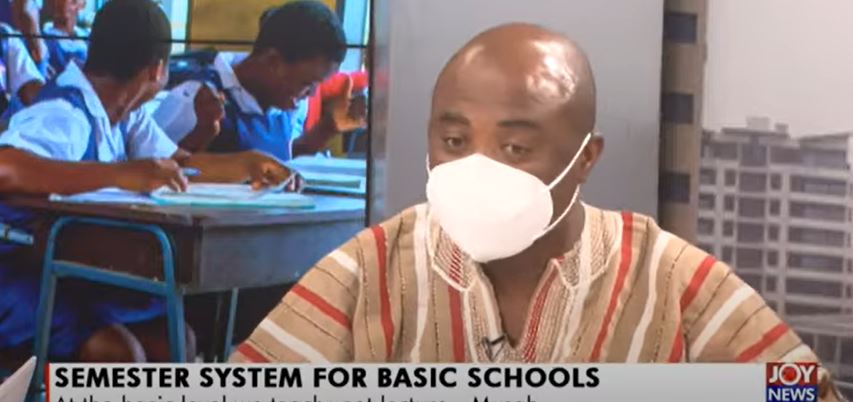
Speaking on JoyNews’ AM Show on Tuesday, the General Secretary of GNAT, Thomas Musah, said the new system is flawed and fails to meet standard.
“This particular [semester] thing is dead on arrival, it is dangerous. It is dangerous to introduce a semester system at the KG level. I am speaking from a professional point of view and as a practitioner. I have taught at every level from KG till I became head teacher.
“At the basic level, we teach, we don't lecture. And if you look at UNICEF's own concept of teaching and learning, they have what we call learning through play. You don't lecture somebody at KG level. It is an activity oriented. The principle there is that it is child-centred learning and UNICEF is promoting it,” he told host, Benjamin Akakpo.
The GES earlier introduced a new semester system in the quest to help reduce congestion in basic schools, ease pressure on teachers and help align academic calenders.
Under this module, students will spend 40 weeks in an academic year, instead of the usual 52 weeks.
But Ranking Member on Parliament's Education Committee, Peter Nortsu-Kotoe has backed calls for the Education Ministry and GES to withdraw the policy.
In an interview on the same show, he added that the Education Committee in Parliament supports the position.
“If one teacher is going to handle a class from 7.30am to 3.30pm, how does he get home and prepare for the next day? Even at the tertiary level, they do 16 weeks. To me, this arrangement is professionally wrong and not workable. The Ministry must resolve it."
“We don't even have the resources to do this. We have poorly ventilated schools and some students have to carry chairs to school to learn. And they'd be uncomfortable for long hours. It's not proper to keep the children in that environment for long,” he stressed.
Latest Stories
-
Fuel prices set to rise again from Sept 1; petrol could hit GH¢16.21 – COPEC
17 minutes -
REGSEC restricts Akwasidae celebrations in Denkyira amid security concerns
23 minutes -
Eric Adjei distributes free fertiliser to farmers in Jaman North
30 minutes -
Akufo-Addo urges NPP factions to unite behind Bawumia for 2028 victory
41 minutes -
NDC mourns Western Regional Elections Director Papa Assan
48 minutes -
Minerals Commission warns against fake job recruitment schemes
55 minutes -
10 recruits dismissed for defying phone ban – Interior Minister
1 hour -
IEAG commends GoldBod, BoG for improving forex stability
1 hour -
Bawumia donates GH¢50,000 to St Jude Catholic Church at Weija
1 hour -
Mahama calls for faster mobilisation of AU Peace Fund resources
1 hour -
Improved roads bring new vehicle options to Tumu-Bolga, Tumu-Tamale, Tumu-Wa routes
1 hour -
Cedi records 7.9% depreciation against US dollar in first half of 2026
2 hours -
GIS launches operation on anti-human trafficking and exploitative street begging
2 hours -
Awutu-Senya District Assembly organises clean-up ahead of Awubia Festival
2 hours -
Vice President Opoku-Agyemang receives Democracy Cup
2 hours