

Audio By Carbonatix
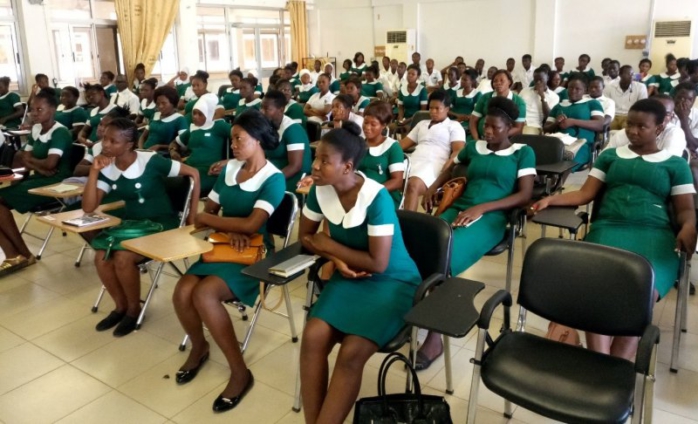
A senior lecturer in Nursing and Midwifery at the Kwame Nkrumah University of Science and Technology (KNUST) has blamed the prevailing quota system with regard to the training of nurses and midwives for the inadequate number of practitioners in the country.
According to Adwoa Bemah Boamah Mensah, the system has created a huge deficit in relation to the required number of this cadre of health personnel for the health sector.
Government, in 2018, introduced the quota admission system for nursing training schools. The government explained that the move was to reduce pressure on the training schools and help improve the quality of nurses in the country.
This new directive meant public and private institutions accredited to train nurses in the country have to reduce their intake by almost 2,000 nurses for the 2018/2019 academic year.
Speaking on the Super Morning Show, Tuesday, Mrs. Mensah bemoaned the fact that the system restricts the number of applicants health training institutions can recruit although most of them have capacity to accommodate more than the specified quota.
“Are we training more nurses? In my view, No. This is because of the quota system that was introduced some few years back. As of now, if you're a training institution in the country, you cannot admit all the numbers that apply to your institution. We are not training as many nurses as we need," she said.
She noted that the impact of this development can be heavily felt in the remote areas where there are inadequate nurses to attend to patients.
“Those of us living in the city may not feel this, but move to the rural communities, you would go to very remote communities and you won’t have a midwife or a nurse there to attend to patients and this affects them since they are also citizens and deserve quality health service as being propagated by the Sustainable Development Goals (SDGs).
In spite of the adverse impact of the quota system on the sector, President of the Ghana Registered Nurses and Midwives Association, Perpetual Ofori Ampofo, kicked against suggestions that the system should be scrapped.
She contended that if abolished, it will go away with the allowance for trainee nurses.
“Allowances are important parts of training and if you understand the concept of the training you'll realise that student nurses and midwives don’t only stay in the classrooms and learn.
“They also contribute in terms of service delivery per the clinical attachments that they do, spending a number of hours at the clinical area. The essence of the allowance is to support them, get them what they need to be able to work and so allowances are important and it's important that it stays.”
Latest Stories
-
Okai Mintah seeks Sabah Zita Benson’s support for NDC National Youth Organiser bid
14 minutes -
Okai Mintah vows to strengthen NDC campaign machinery ahead of 2028
20 minutes -
Mother of four and Jasikan teacher among new Telecel M’ahitti Promo winners
21 minutes -
International Youth Shakers Conclave 2026 set to bring global young leaders to London
22 minutes -
Gov’t is committed to addressing teachers’ conditions of service, deprived-area allowance – Education Minister
26 minutes -
GoldBod’s structure encouraging galamsey – Afenyo-Markin
28 minutes -
Tullow starts selling Jubilee, TEN crude to Ghanaian refineries
30 minutes -
Local Government Service authorises rationalisation, redistribution of staff
33 minutes -
PURC assures consumers of working to ensure quality services in Northern Region
39 minutes -
Ghana develops US$4.28bn water financing framework
46 minutes -
Christian Council calls for protection of mission schools’ religious identity
53 minutes -
Mahama holds discussions with India’s External Affairs Minister
59 minutes -
Even when you cough, they come after you — Abanga accuses Mahama govt of criminalising free speech
1 hour -
Mahama Ayariga proposes bank-adopted streets as part of stronger public-private partnership
1 hour -
NPP will impose $500m bail bond on NDC offenders if we return to power — Abanga
1 hour