

Audio By Carbonatix
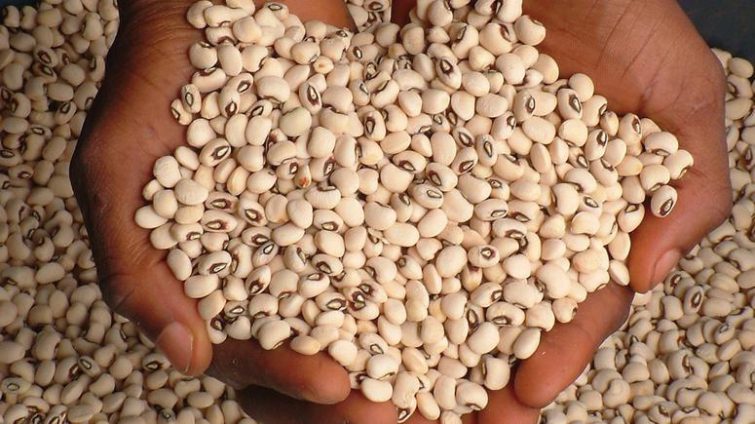
Ghana’s food security will receive a good boost if the country’s first genetically modified crop gets environmental release approval from government, the scientist leading the project has said.
The National Biosafety Authority of the Environment, Science, Technology, and Innovation Ministry announced in February that it has received a request from the Savannah Agricultural Research Institute (SARI) of the Council for Scientific and Industrial Research (CSIR) for environmental release approval of a GM cowpea or beans variety.
The gazette notification announcing the process said if approved, the request will allow for the “placing on the market of genetically modified Pod Borer Resistant (PBR) cowpea in Ghana.”
The gazette quotes the application to the Biosafety Authority as saying farmers and consumers will benefit from PBR cowpea as a result of higher yields, lower costs of inputs, and greater on-farm safety because of reduced pesticide usage, and decreased pesticide residue on the beans.
The authority says it is reviewing the application together with relevant regulatory agencies and independent experts. A decision is expected in or around August 2022.
Dr Jerry Nboyine, who is the principal investigator in charge of the GM cowpea project, said the variety will help farmers cut down on the amount of spray they use on cowpea farms every season from more than eight times to about two times.
“Cowpea or beans. Your 'yo ke gari' popularly called red-red or gari and beans are made from it. Most of us are excited to see it in our dishes. But we don’t know farmers' hustle to produce it.
"From planting to harvest, even in storage, even in storage, this particular crop is loved by pests…,” he explained.
“What scientists were able to do with the help of biotechnology tools is to identify a particular gene responsible for resistance and it was introduced into crops.
"Cowpea is one of them… It has helped make the cowpea resistant to the maruca pests,” he added.
The application for environmental release follows almost 10 years of research.
Chief Executive Officer of the National Biosafety Authority Eric Okoree says the authority is well-positioned to be able to appropriately scrutinize the GM cowpea and ensure it benefits Ghanaians.
“The authority was established in 2011 and implemented in 2015. As soon as it was established, the then biosafety committee gave two approvals for GM cowpea and GM rice. And the permits were given to the CSIR. The research has been ongoing, and the authority is monitoring it,” he said.
“Now Ghana has a law in place to regulate GMOs. An authority has been established. And our aim is to ensure the safety of health and the environment. And when that is done, all the benefits of GMOs will be realised,” Mr Okoree added.
Latest Stories
-
No room for another false start as Ghana begin AFCON qualifying campaign
14 minutes -
“We are grateful for what you have achieved” – AGI President tells Finance Minister
23 minutes -
“No Nation is Inferior”: Mahama champions human dignity and security council reform at the UN
45 minutes -
Manhyia South residents, NPP executives fume over botched EOCO arrest of MP
55 minutes -
Mahama unveils new deal with global philanthropy
1 hour -
Daily Insight for CEOs: Building customer-centric leadership
1 hour -
Democracy must deliver food, jobs and healthcare, not just elections – Mahama
1 hour -
Capacity constraints must never be a barrier to restitution – Mahama
1 hour -
COMAC pushes for suspension of sections of Customs Act 2026
1 hour -
Mahama calls for Great African Museum to anchor continent’s heritage revival
1 hour -
Mahama cites return of Mpomponsuo sword as model for restitution
1 hour -
Mahama: Africa must inherit more than the story of what it lost
1 hour -
Mahama pushes for permanent UN system for restitution of African artefacts
1 hour -
Ghana is arguably Africa’s most stable democracy, says Mahama
1 hour -
Mahama calls for investment in Africa’s cultural infrastructure
1 hour