

Audio By Carbonatix
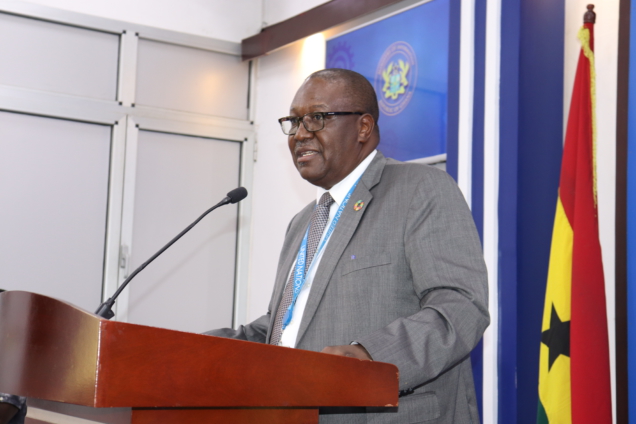
The World Health Organization (WHO) Representative to Ghana, Dr Francis Kasolo has called for concerted action to bridge the gap in the distribution of doctors between rural and urban areas in Ghana.
Delivering the keynote address at the 64th Annual General Conference of the Ghana Medical Association (GMA) on the theme: 'Doctor distribution dilemma – the case of Ghana and its underserved areas', Dr. Kasolo described the unfair distribution of doctors and other health care workers across the country as a threat to efforts towards improving the health and wellbeing of all people and urged all stakeholders to take action immediately to address that.
“The inequitable distribution of doctors between rural and urban areas is now a crisis. It seriously undermines our progress towards Universal Health Coverage and we must all work together to address it,” Dr. Kasolo noted.
Ghana has made tremendous gains in the doctor to population ratio, improving from one doctor to 17,899 in 2005 to one doctor to 6,500 in 2020.
However, available data also show that 42% of the doctors are in Accra alone, and up to 81.3% of all doctors are concentrated in 5 regions – i.e., Greater Accra, Ashanti, Central, Northern and Volta regions, with the Teaching Hospitals in these five regions together having over 60% of all the doctors in Ghana.
“Over the years, Ghana has made progress in improving the doctor to population ratio, but we must remember that the unfair distribution of these doctors leads to unmet health needs in rural and remote areas resulting in a decreased life expectancy; higher preventable maternal and under-5 mortality rates,” he added.
Dr. Francis Kasolo identified migration and retention challenges as some of the causes of the shortage of doctors in Ghana and recommended some key interventions in line with WHO guideline on health workforce development, attraction, recruitment and retention in rural and remote areas.
“Providing differential incentives for those working in rural and under-served areas and re-engineering the training and regulation of doctors to include extensive exposure to rural and under-served areas will help improve the situation,” he said.
He added that, “We must also provide deliberate opportunities for the admission of medical students from rural and deprived areas and providing financial support for their training.”
WHO has been supporting the Government of Ghana to improve the maldistribution of doctors and other healthcare workers in Ghana. This includes an assistance to develop the multi-criteria deprivation index to be used to objectively classify the districts according to their relative levels of deprivation. This when implemented, can address both monetary and non-pecuniary aspects of encouraging retention in rural and under-served areas.
In addition, WHO is helping the development and implementation of health sector staffing norm whilst also providing support for training needs assessment of health workers. WHO with funding from the UK Department of Health and Social Care, (UK-DHSC) is also currently helping Ghana to embark on a health labour market analysis to contribute to future policies and strategies in addressing the health worker challenges, especially the needs of rural and under-served areas.
Dr. Francis Kasolo pledged the WHO’s continuous support to Ghana in ensuring that no one anywhere is left behind in the access to healthcare services.
“As WHO, we will continue to work with all partners to help drive government’s efforts to achieve equitable distribution of doctors and other healthcare workers in Ghana”, Dr. Kasolo assured.
Latest Stories
-
Oppong Nkrumah challenges Deputy AG’s claim that his court application was based on ‘falsehoods’
22 seconds -
Germany investigates Russia links to weapons cache discovered in woods, reports say
2 minutes -
Two teenagers seriously injured after sword attack at Swedish school
4 minutes -
Prince Harry and six others face privacy case legal bill of up to £34.5m
7 minutes -
Court orders return of No. 1 Oxford Street Hotel to Keningston Residential Partners
8 minutes -
Ebola outbreak ‘growing faster, wider’ as DRC death toll passes 2,500
8 minutes -
QNET supports EOCO in repatriation and handover of 33 Burkinabes rescued during anti-trafficking operation
10 minutes -
55-year-old woman gives birth to triplets at Brofoyedru
26 minutes -
UniMAC students take ‘Project Dignity’ to Weija Leprosarium
35 minutes -
Ghana’s gaming industry emerges as $121m digital economy opportunity
42 minutes -
Why Ghana needs Regional Tribunals and why history shouldn’t prevent their establishment
52 minutes -
DVLA to print driver’s licenses at offices across the country
56 minutes -
ASEC calls on GRIDCo to publish full report on recent power outages
59 minutes -
CAGD orders covered entities to seek approval before opening bank accounts
59 minutes -
AFREIKH Summer School opens with focus on managing Africa’s extractive future in energy transition
1 hour