

Audio By Carbonatix
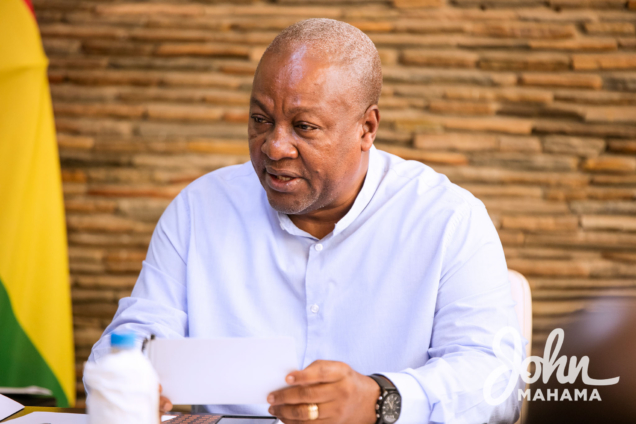
Former President Mahama has explained why he said he had dead goat syndrome.
According to him, he used the idiomatic expression due to the frustration associated with the deregulation of petroleum prices.
This, he stated, is because he knew that if the fuel prices went up, the leadership of the Trades Union Congress (TUC) and other unions will not leave him in peace.
Mr. Mahama said he could not bear the mass labour unrest that was prevailing at the time.
“I am the only government in the Fourth Republic where all organised labour came together and went on strike and shut down the country.
“I was one of the most harassed Presidents by Organised Labour. That is what led to the dead goat syndrome… because when you kill a goat, you cannot frighten it with the knife again, really!... I don't know why I said that, but of course our opponents took it out of context. They said I have said that I won't listen to anybody,” he explained during a lecture at Academic City University College on Friday.
It would be recalled that the ex-president in 2015 said he had become impervious to threats of strikes and demonstrations in Ghana and will not yield to any of such threats in the then upcoming election year.
Adopting what he calls a "dead-goat syndrome", the President said he would not be hoodwinked by such strategies by workers.
"I have seen more demonstrations and strikes in my first two years. I don't think it can get worse. It is said that when you kill a goat and you frighten it with a knife, it doesn't fear the knife because it is dead already.
"I have a dead goat syndrome," he told a Ghanaian population in Botswana where he was on a three-day official state visit.
The country, during Mr. Mahama's tenure, experienced a number of strikes and demonstrations from workers, most of whom protested against poor conditions of service.
The Trades Union Congress was one of the many workers' unions that were on the streets to protest the worsening economic crisis.
The President said such demonstrations are part of strategies by workers' groups to tie the hands of government, especially in election years.
He noted that when governments yield to such threats, the economy and budget are thrown out of gear.
Latest Stories
-
Judges’ conference forces further adjournment of Salomey Baffoe case
7 minutes -
GRA assures Tullow of collaboration to settle $393m tax liability without disrupting its petroleum operations
37 minutes -
South Korea demands apology from Pyongyang for landmine blasts that injured three
41 minutes -
Carlos Queiroz not the sort of coach Black Stars need – Nii Lante Vanderpuye
1 hour -
AFCON 2027Q: ‘Our Black Stars team is gone’ – Former Sports Minister
2 hours -
Prof. Prempeh calls for public review of draft constitutional reform bills
2 hours -
AFCON 2027Q: ‘I have never seen a poor performance from Black Stars like against Gambia’ – Nii Lante Vanderpuye
2 hours -
Bawumia backs insurance sector reforms after engagement with IBAG
2 hours -
Nigeria set to launch National Digital Address System 9 years after Ghana showed the way
2 hours -
Policy rate decision takes time to reflect in lower lending rates – BoG
2 hours -
Western Regional Minister applauds Karpowership’s role in Ghana’s power sector
3 hours -
Playback: Road safety crises: Where are we getting it wrong?
3 hours -
Enterprise Life celebrates 25 years of protecting families and building trust
3 hours -
ICC London rules in favor of Ghana against Tullow over $400m tax charge
3 hours -
We are disappointed in ICC’s ruling over our corporate income tax assessment in Ghana – Tullow Oil
3 hours