

Audio By Carbonatix
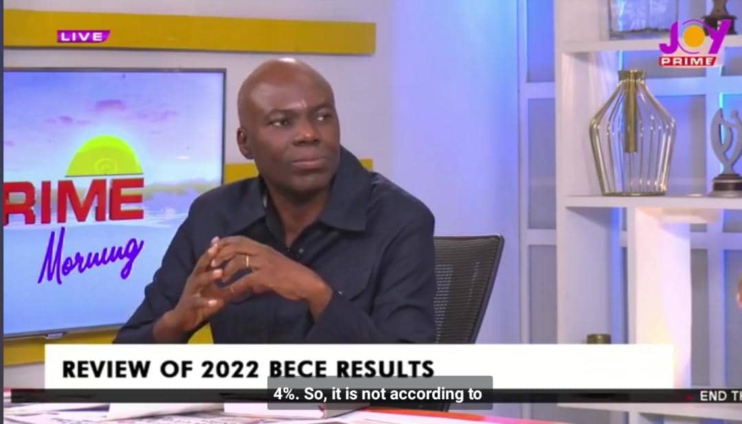
The Head of the Legal Department of the West African Examinations Council, Rev. Victor Brew, has clarified the grading system used for the Basic Education Certificate Examination (BECE).
According to him, the performance of students at various schools determine their grades. The grades awarded to students from various schools are dependent on their performance.
Speaking to Roselyn Felli on Prime Morning, Monday, Rev. Victor Brew explained that students who may be the best in their schools may not meet the first 4% range targeted by the WAEC grading system as it is a nationwide competition.
"...it's the grading system and also the performance of their candidates, because mind you, if you're a local champion where you keep getting 80s, know that if someone else has been getting 99, then you pray that your 80 falls within the 4% otherwise, you're going to get a grade 2, and that doesn't mean you're not good. You’re good, but others are better," he explained.
For the purpose of the variation of the grading system, he urged school managers to avoid comparing cohorts of their institutions, as the "Norm-Referenced Grading System" used by WAEC varies yearly.
Rev. Victor Brew further revealed that the implementation of the grading system is done in collaboration with the government, thus making grade 9 the lowest and not a failure in the BECE system.
Explaining how the grading system is done, he said, "If the first 4% are to get grade 1, what it means is that if you took mathematics, unlike English, someone can get 100% in mathematics. So, what happens is that your candidate or the champion of your school in math gets 80% during your mock trials or 89%, but then when you join forces with the candidates across the country, the question is whether your champion in math in your school can beat all the champions across the country such that your champion falls within the first 4%."
For this reason, he said WAEC is not to be blamed for the failure of candidates, as a particular batch may not fall within the range of the national grading system for the year.
Meanwhile, he thinks a coalition of a total number of candidates acquiring a grade in each subject across the country within a year will inform policy-making so as to help improve the system.
Addressing the issue of the cancellation of the exams for some candidates, he said it is done based on the rules and regulations provided for the year groups before and during the exams.
He has also notified parents whose children’s papers have been cancelled that they are permitted to appeal for remarking.
Latest Stories
-
Prof. Kwofie urges publishers to use indigenous knowledge systems to decolonise AI
2 hours -
NDC’s two years of economic gains not enough to establish stability – Alan Kyerematen
2 hours -
AFCON 2027Q: Nine new call-up for Cote, The Gambia matches
2 hours -
Ghana’s MSMEs: Burdened by regulation and overtaxed; why the system isn’t working
3 hours -
Patience Akyianu, former Barclays Bank Ghana MD and Hollard Group CEO, reported dead
3 hours -
Mahama pushes ‘health sovereignty’ agenda, says Global South needs control over resources
3 hours -
Mahama: We are reforming systems, fighting corruption and improving use of public funds
3 hours -
Catholic Bishops welcome task force to tackle drug menace, acknowledge inter-agency efforts
3 hours -
Ghana Catholic Bishops demand urgent action against drug trafficking
3 hours -
Tamale: 5 arrested over suspected drug activities; police seize pistols, narcotics
3 hours -
We have lost a great developer – Mankranso residents pay tribute to late DCE
3 hours -
Ghana Law Society sets September 30 for maiden Bar Conference on legal reforms
4 hours -
GPL Week 3: Port City’s Gyetuah bags a brace as 9 outstanding players named NASCO Players of the Match
4 hours -
Visibility without substance is just noise; I don’t seek popularity—Dr Oppong-Fosu
4 hours -
The late Abubakar Sedik was an exceptional DCE – Ashanti Regional Minister
4 hours