

Audio By Carbonatix
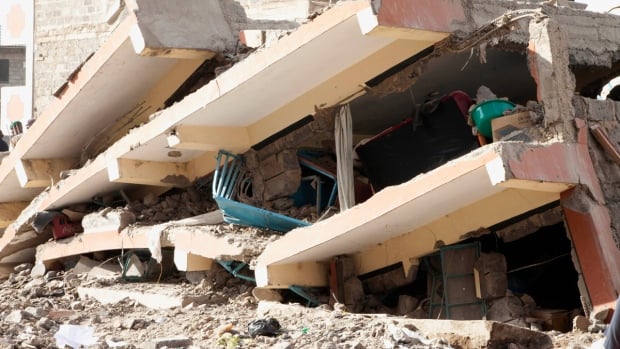
The Engineering Council of Ghana says the rampant collapse of buildings in some parts of the country should be treated as a national emergency.
The Council, which is mandated to regulate the engineering sector, said it had taken the recent disasters seriously and thus, an emergency team would be put in place soon to investigate the causes of the incidents to sanitise the construction industry.
In an interview with Wise Ametefe, the Registrar of the Council, he said the Council would also establish a permanent team that would directly respond to such disasters in the future and offer technical support to Assemblies to enforce building regulations.
The move by the Council follows four cases of collapsed buildings in less than two weeks, leading to loss of lives and injuries.
One person was reported dead on Friday, May 5 after being trapped under the rubble of the collapsed building situated at Nanakrom in the Adentan Municipality.
The tragedy occurred barely four days after a similar three-storey building collapsed at Madina in the Greater Accra Region – which reportedly killed one person and injured three others.
A six-storey building under construction at the city campus of the University for Development Studies (UDS) in Tamale collapsed last Saturday during a rainstorm.
Seven construction workers were injured after a church building collapsed on them at Old Bortianor in the Ga South Municipality of the Greater Accra Region on Tuesday.
Mr Ametefe blamed the repeated incidents on poor supervision on the part of the Assemblies.
He said preliminary investigations at the disaster sites had revealed that the owners of the buildings either did not obtain permits or extended the buildings beyond what was approved.
“The Council is taking the cases very seriously...we agree that there could be failure in one aspect of the regulation but that could not be attributed to the Engineering Council.
“It is mainly the Assemblies who are responsible for approval of buildings but the professionals in the Assemblies should ensure that buildings submitted for approvals are vetted before permits are granted,” Mr Ametefe said.
In the case of the Bortianor church building incident, the Council said preliminary investigations had shown that there were “a lot of flaws in the construction”.
“Concrete columns were there without reinforcement. Concrete work was done porously...there was very little supervision,” Mr Ametefe said.
The Engineering Council said the outcome of the investigations would make a case for punitive measures to be taken against persons found to have flouted the law.
Latest Stories
-
Dîner en Blanc Accra returns on December 28 for second edition
4 seconds -
David Selassie Anthony declares bid for NDC Deputy National Organiser
2 hours -
Amin Adam proposes 13 measures to strengthen Ghana’s debt transparency and market confidence
2 hours -
Mahama announces $2bn annual investment to accelerate industrialisation
2 hours -
Amin Adam urges monthly disclosure of Sinking Fund as Ghana prepares for DDEP repayments
2 hours -
Stronger banks will fuel business growth and jobs – ADB MD
2 hours -
Galamsey: ‘Rivers that fed our grandparents now run the colour of chocolate milk’ – Sam Jonah
2 hours -
We have been scammed by NDC, government is only doing PR – Abanga Fuseini
2 hours -
Republic Bank–JoyNews Habitat Fair opens in Ho today
2 hours -
Dr Boako challenges government over new digital tax
2 hours -
BoG pledges stability to attract investment, urges stronger Africa–Asia partnerships
2 hours -
Amin Adam warns treasury bill dependence could expose Ghana to refinancing risks
2 hours -
Ghana better placed to withstand commodity price shocks – IMF
2 hours -
GAPTE intensifies efforts to increase bus availability for Aayalolo contra-flow
2 hours -
Amin Adam warns cedi depreciation could reverse Ghana’s debt relief gains
2 hours