

Audio By Carbonatix
For the first time, U.S. regulators on Wednesday approved the sale of chicken made from animal cells, allowing two California companies to offer “lab-grown” meat to the nation’s restaurant tables and eventually, supermarket shelves.
The Agriculture Department gave the green light to Upside Foods and Good Meat, firms that had been racing to be the first in the U.S. to sell meat that doesn’t come from slaughtered animals — what’s now being referred to as “cell-cultivated” or “cultured” meat as it emerges from the laboratory and arrives on dinner plates.
The move launches a new era of meat production aimed at eliminating harm to animals and drastically reducing the environmental impacts of grazing, growing feed for animals and animal waste.
“Instead of all of that land and all of that water that’s used to feed all of these animals that are slaughtered, we can do it in a different way,” said Josh Tetrick, co-founder and chief executive of Eat Just, which operates Good Meat.
The companies received approvals for federal inspections required to sell meat and poultry in the U.S. The action came months after the U.S. Food and Drug Administration deemed that products from both companies are safe to eat.
A manufacturing company called Joinn Biologics, which works with Good Meat, was also cleared to make the products.
Cultivated meat is grown in steel tanks, using cells that come from a living animal, a fertilized egg or a special bank of stored cells.
In Upside’s case, it comes out in large sheets that are then formed into shapes like chicken cutlets and sausages.
Good Meat, which already sells cultivated meat in Singapore, the first country to allow it, turns masses of chicken cells into cutlets, nuggets, shredded meat and stays.

But don’t look for this novel meat in U.S. grocery stores anytime soon.
Cultivated chicken is much more expensive than meat from whole, farmed birds and cannot yet be produced on the scale of traditional meat, said Ricardo San Martin, director of the Alt:Meat Lab at University of California Berkeley.
The companies plan to serve the new food first in exclusive restaurants: Upside has partnered with a San Francisco restaurant called Bar Crenn, while Good Meat dishes will be served at a Washington, D.C., restaurant run by chef and owner Jose Andrés.
Company officials are quick to note the products are meat, not substitutes like the Impossible Burger or offerings from Beyond Meat, which are made from plant proteins and other ingredients.
Globally, more than 150 companies are focusing on meat from cells, not only chicken but pork, lamb, fish and beef, which scientists say has the biggest impact on the environment.
Upside, based in Berkeley, operates a 70,000-square-foot building in nearby Emeryville. On a recent Tuesday, visitors entered a gleaming commercial kitchen where chef Jess Weaver was sauteeing a cultivated chicken filet in a white wine butter sauce with tomatoes, capers and green onions.
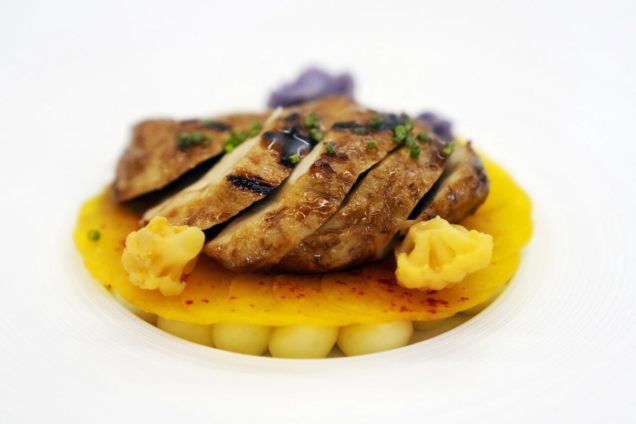
The finished chicken breast product was slightly paler than the grocery store version. Otherwise, it looked, cooked, smelled and tasted like any other pan-fried poultry.
“The most common response we get is, ‘Oh, it tastes like chicken,’” said Amy Chen, Upside’s chief operating officer.
Good Meat, based in Alameda, operates a 100,000-square-foot plant, where chef Zach Tyndall dished up a smoked chicken salad on a sunny June afternoon.
He followed it with a chicken “thigh” served on a bed of potato puree with a mushroom-vegetable demi-glace and tiny purple cauliflower florets.
The Good Meat chicken product will come pre-cooked, requiring only heating to use in a range of dishes.
Chen acknowledged that many consumers are skeptical, even squeamish, about the thought of eating chicken grown from cells.
“We call it the ‘ick factor,’” she said.
The sentiment was echoed in a recent poll conducted by The Associated Press-NORC Center for Public Affairs Research. Half of U.S. adults said that they are unlikely to try meat grown using cells from animals. When asked to choose from a list of reasons for their reluctance, most who said they’d be unlikely to try it said “it just sounds weird.” About half said they don’t think it would be safe.
But once people understand how the meat is made, they’re more accepting, Chen said. And once they taste it, they’re usually sold.
“It is the meat that you’ve always known and loved,” she said.
Cultivated meat begins with cells. Upside experts take cells from live animals, choosing those most likely to taste good and to reproduce quickly and consistently, forming high-quality meat, Chen said. Good Meat products are created from a master cell bank formed from a commercially available chicken cell line.
Once the cell lines are selected, they’re combined with a broth-like mixture that includes the amino acids, fatty acids, sugars, salts, vitamins and other elements cells need to grow. Inside the tanks, called cultivators, the cells grow, proliferating quickly.
At Upside, muscle and connective tissue cells grow together, forming large sheets. After about three weeks, the sheets of poultry cells are removed from the tanks and formed into cutlets, sausages or other foods. Good Meat cells grow into large masses, which are shaped into a range of meat products.
Both firms emphasized that initial production will be limited. The Emeryville facility can produce up to 50,000 pounds of cultivated meat products a year, though the goal is to expand to 400,000 pounds per year, Upside officials said. Good Meat officials wouldn’t estimate a production goal.
By comparison, the U.S. produces about 50 billion pounds of chicken per year.
It could take a few years before consumers see the products in more restaurants and seven to 10 years before they hit the wider market, said Sebastian Bohn, who specialises in cell-based foods at CRB, a Missouri firm that designs and builds facilities for pharmaceutical, biotech and food companies.
Cost will be another sticking point. Neither Upside nor Good Meat officials would reveal the price of a single chicken cutlet, saying only that it’s been reduced by orders of magnitude since the firms began offering demonstrations. Eventually, the price is expected to mirror high-end organic chicken, which sells for up to $20 per pound.
San Martin said he’s concerned that cultivated meat may wind up being an alternative to traditional meat for rich people, but will do little for the environment if it remains a niche product.
“If some high-end or affluent people want to eat this instead of a chicken, it’s good,” he said. “Will that mean you will feed chicken to poor people? I honestly don’t see it.”
Tetrick said he shares critics’ concerns about the challenges of producing an affordable, novel meat product for the world. But he emphasised that traditional meat production is so damaging to the planet that it requires an alternative — preferably one that doesn’t require giving up meat altogether.
“I miss meat,” said Tetrick, who grew up in Alabama eating chicken wings and barbecue. “There should be a different way that people can enjoy chicken and beef and pork with their families.”
Latest Stories
-
Supreme Court clears way for Skytrain trial to continue
33 seconds -
Djokovic in tears during US Open first-round exit
4 minutes -
Yusuf Sulemana celebrates Gonja unity at Damba festival
5 minutes -
A Minister under watch: Zanetor’s burden of expectations
18 minutes -
Don’t make funding your starting point for green businesses – Entrepreneurs urged
24 minutes -
Skills gap in electric vehicles presents jobs opportunity for Ghanaian youth
30 minutes -
Mahama heads to Serbia for 65th anniversary of Non-Aligned Movement
36 minutes -
National Children’s Day 2026: Child Online Africa calls for child-led digital protection in Ghana
41 minutes -
Manasseh sets the record straight on Northshore Apparel GH; dispels 1D1F claim
42 minutes -
Supreme Court dismisses injunction bid seeking to halt Skytrain trial
46 minutes -
AU Chairperson reaffirms commitment to global African unity
54 minutes -
Air Pollution in Accra is not random; it is a burden carried by the poor
1 hour -
GEXIM Bank grows loan portfolio to GH¢1.56bn as equity hits GH¢2.1bn in 2025 – SIGA Report
1 hour -
Ghana Shippers’ Authority grows surplus by 272% as assets reach GH¢979.92m
1 hour -
Government designates 13 blocked-out areas for small-scale mining to curb illegal mining
1 hour