

Audio By Carbonatix
Muslims across the world are celebrating Eid-ul-Adha to commemorate Prophet Ibrahim’s devotion to Allah (SWT) and his readiness to sacrifice his son, Ismail.
The celebrations, also known as the “Festival of Sacrifice” is the second of the two Islamic festivities, which is celebrated annually worldwide.
Muslims approach God on this day by sacrificing a sheep, a cow, or a camel and distributing the meat to the poor. They unite to pray together with family and friends and show love.
Eid-ul-Adha falls on the tenth day in the twelfth month of the Islamic Lunar Calendar; Dhul-Hijjah, which allows families, loved ones, and communities to fraternise, and is dependent on a legitimate sighting of the moon, following the completion of the annual Holy Pilgrimage of Hajj – which is an obligation for all Muslims.
The command from Allah (SWT) is a test of Prophet Ibrahim’s willingness and commitment to obey his Lord’s command, without question.
At the point of sacrifice, Allah (SWT) replaced Ismail with a ram, which was to be slaughtered in place of his son.
So, during the celebration, the sacrificial animal must be a sheep, lamb, goat, cow, bull, or a camel; the sheep, lamb or goat consist of one share, whereas a bull, cow or camel consist of seven shares per animal. The animal must be in good health and over a certain age to be slaughtered, in a “halal” friendly, Islamic way.
The meat can then be divided into three equal portions per share; one-third for the owner and family, one-third for friends, and the final third to be donated to those in need.
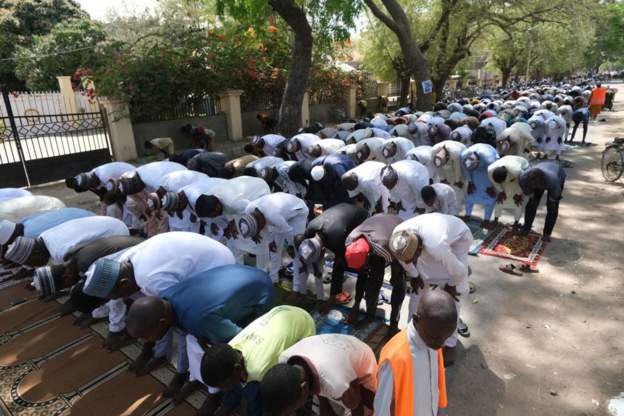
The act of the sacrifice is usually carried out after Eid Prayers, which are performed in congregation at the nearest Mosque on the morning of Eid.
The celebration of Eid-ul-Adha is to last for three days. Traditionally, the day is spent celebrating with family, friends and loved ones, often wearing new attire and the giving of gifts.
Some Muslims, the Ghana News Agency spoke to ahead of the celebrations, thanked Allah for seeing them through the year and prayed that their supplications, together with those who were able to embark on the journey to Hajj, would be answered. Some were excited about the celebration, saying though the prices of animals for sacrifice were high due to the outbreak of Anthrax in Bolgatanga, and the current economic situation, they would still enjoy the celebration.
Latest Stories
-
This government should expect scrutiny – Asiedu Nketiah
11 minutes -
Two-year-old girl dies in domestic fire at Cantonments
56 minutes -
Asiedu Nketiah urges better working conditions for journalists
1 hour -
JoyNews’ Precious Semevoh wins climate change reporting award at Bono GJA Awards
1 hour -
Kumasi Central Market phase 2 to begin in October after years of abandonment
1 hour -
Sentuo offers fuel supply reassurance as NPA sees steady output through December
2 hours -
Ghanaian smock showcased at Lesotho Tourism Summit
3 hours -
Four pupils to one desk: The painful plight of schools in New Juaben North
3 hours -
Ipswich launch investigation into racist abuse of Abdul Fatawu
3 hours -
Arrest of Techiman nurse is purely political persecution – ‘Ghana Jollof’
4 hours -
Isak nets winner as Liverpool edge Bournemouth
4 hours -
I dare gov’t of Ghana to extradite me; they can never do it – ‘Ghana Jollof’ speaks
4 hours -
Semenyo scores twice as Manchester City beat Sunderland 5-3 in eight-goal thriller
4 hours -
Parliament calls for government-private sector collaboration to improve waste management
4 hours -
Volta Region described as cleanest so far in Parliament’s nationwide sanitation monitoring
4 hours