

Audio By Carbonatix
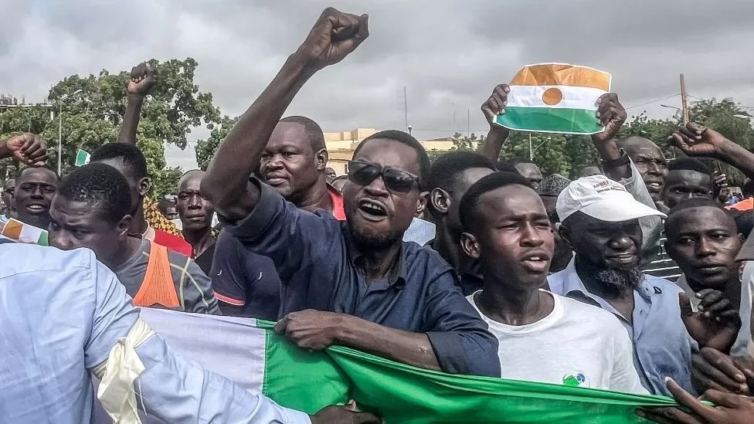
As the seven-day ultimatum given by West African leaders for the military in Niger to reinstate President Mohamed Bazoum draws to a close, both sides have crucial decisions to make.
Last Sunday evening, the regional bloc ECOWAS, headed by President Bola Tinubu of neighbouring Nigeria, said the junta had a week to restore constitutional order or face the possible use of force.
Sanctions on the coup leaders have already been imposed and electricity supplies from Nigeria have been cut, along with borders, meaning goods are no longer arriving and the land-locked country has lost access to ports.
But as the political, diplomatic and military tensions rise, what could happen as the deadline passes?
1) Deadline is extended
One option is for the Ecowas leaders to extend the deadline.
This has the danger of being seen as a climbdown, but the heads of state could save face by saying that diplomatic efforts have made progress and they want to give them more time.
The problem at the moment is that Ecowas mediation efforts have not borne fruit. A delegation sent to Niger on Thursday returned within a few hours with apparently little to show for it.
Meanwhile, the junta stepped up its rhetoric against both the West and Ecowas. It announced that it was cutting diplomatic ties with Nigeria, Togo, the US and France, and said it was cancelling the military agreements with France which allows the former colonial power to base some 1,500 soldiers there.
And President Bazoum, who is being held by the military, used stark language in an article in the Washington Post. He described himself as a "hostage" and called on the US and the entire international community to help restore constitutional order.
On Friday, the US said it will pause some of its aid to Niger's government, but will continue to provide humanitarian and food assistance.
2) They agree on a timetable for a transition
To try and cool things down and find middle ground, the junta and Ecowas could agree on a timetable for a return to democratic rule.
This could include the release of President Bazoum, as well as other political detainees, in order to keep talks going and possibly buy more time. This has been a key demand of those who have condemned the coup in Africa and elsewhere.
The West African bloc has already approved democratic transitions in Niger's neighbours in the Sahel region, Mali and Burkina Faso, which were both taken over by the military in recent years.
But the negotiations were fraught with problems, with deadlines for elections continually pushed back and it is still not guaranteed that the handovers of power will actually happen.
Sudan, which created a mixed civilian-military government in 2019 that was supposed to pave the way to democracy after a coup there, provides another model. But the collapse of that country into a bitter conflict between rival military leaders offers a cautionary tale.
3) Military intervention
The West African leaders did not say that force would definitely be used if President Bazoum was not reinstated but left it open as a possibility.
Nigerian officials have described it as a "last resort". President Tinubu said there could be a military intervention "to enforce compliance of the military junta in Niger should they remain recalcitrant".
Ecowas has used military force to restore constitutional order in the past, for example in The Gambia in 2017 when Yahya Jammeh refused to step down after losing an election.
But the calculation about whether to go ahead this time would be far more difficult.
Firstly, Niger is geographically the largest country in West Africa, while The Gambia is a tiny sliver of land surrounded by Senegal and the Atlantic Ocean, so sending troops in would be a whole different prospect.
Secondly, regional power Nigeria, which is leading the charge to restore President Bazoum, is facing a host of security challenges at home, so sending a significant portion of the army to Niger would be something of a gamble.
Thirdly, both Mali and Burkina Faso have said that military intervention in Niger would be seen as a "declaration of war" and they would go to defend their fellow coup leaders.
So it risks snowballing into a full-scale regional war, especially if the Niger population resists foreign intervention. Although it is impossible to know how they would react.
Nigeria and Niger share many historical and ethnic ties, with people on both sides speaking the same language so this could make some Nigerian troops reluctant to fight if it came to that.
Countries like Algeria, Niger's neighbour to the north, China and Russia have asked for restraint and the continued use of dialogue to douse tension.
However, after a three-day meeting in Nigeria's capital, Abuja, Ecowas defence chiefs say they have drawn up a detailed plan for military intervention for the regional leaders to consider.
Nigeria, Ivory Coast, Senegal and Benin have all said they are willing to send troops into Niger if Ecowas decided to do so.
Nigeria alone has about 135,000 active troops, according to the Global Fire Power index, while Niger has about 10,000 but that certainly doesn't mean an invasion would be easy.
A peaceful solution is no doubt preferable for all sides but Ecowas is keen to show its resolve as it has failed to prevent a spate of coups in the region in the last three years.
Latest Stories
-
Inter Milan mount stunning comeback to beat Napoli
3 minutes -
Modric plans to play for Croatia past 41st birthday
14 minutes -
Bayern fail to score for first time in 59 games
18 minutes -
Bawumia preparing new cocoa policy package for farmers – Annoh-Dompreh
22 minutes -
Wa-Tumu-Bolga road upgrade will unlock agriculture, trade – Agbodza
24 minutes -
Ghana Maritime Authority readies oil-spill response vessel for deployment
25 minutes -
Ayariga turns to drones, AI to tackle Agbogbloshie waste mountain
34 minutes -
Agbogbloshie waste heap must go – Mahama Ayariga declares
45 minutes -
Government to upgrade all rural telephony sites to 4G – Communications Minister
46 minutes -
Rural calls, data to become cheaper by Q1 2027 – Sam George
51 minutes -
National Chief Imam remains Ghana’s strongest symbol of interfaith harmony – Mahama Ayariga
1 hour -
Nhyiaesohene pledges support to ECG to curb encroachment
1 hour -
Somanya residents demand asphalt overlay to protect road investment
1 hour -
Kumawu MP leads stakeholders meeting on human rights, child labour
1 hour -
Breakfast: To skip or not to skip? An evidence-based perspective on weight management and overall health
2 hours