

Audio By Carbonatix
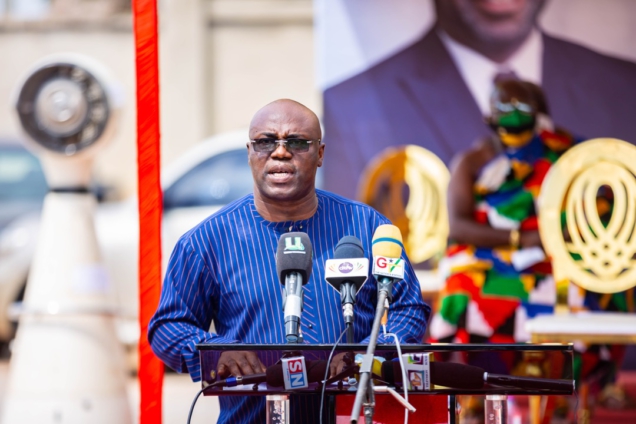
The Administrator of the Ghana Education Trust Fund (GETFund), Dr. Richard Ampofo Boadu has refuted allegations that the Fund grants scholarships based on political considerations.
According to him, the scholarships are awarded to applicants solely on merit and the process is highly transparent and open.
Dr Ampofo Boadu made these remarks in response to a comment during an open forum discussion under the theme 'Financing Higher Education in Ghana: Implications for Equity and Sustainability', organised by the Ghana Academy of Arts and Sciences (GAAS) in Accra.
This policy dialogue was part of a series of seven organised by the Academy under the project 'Motivating Higher Education Reforms in Ghana - Towards Equity and Sustainability', funded by a grant from the Carnegie Corporation of New York.
The goal of the project is to provide a platform for independent individuals and groups to address the challenges facing the higher education sector on an ongoing basis.
The GETFund Administrator urged tertiary institutions to explore innovative ways to raise funds to complement the government's support.
He emphasised that government funding alone is insufficient to sustain these institutions, necessitating the exploration of alternative sources of funding.
On his side, the Executive Director of Africa Education Watch, Kofi Asare proposed the establishment of a scholarship authority to consolidate all scholarship providers in the country.
“The reason we are not meeting our tertiary enrollment target is due to actual needy students not gaining scholarships into tertiary institutions. The scholarship system and rollouts should be reviewed.”
“We need a scholarship authority to manage all scholarships in the country and make scholarship rollouts more efficient and effective to help needy students and even prospective students enrol in tertiary institutions,” he added.
To this end, the Chairperson of GAAS' Higher Education Project Management Committee, Professor Emeritus Takyiwaa Manuh highlighted the perennial challenges faced by higher education in Ghana, including inadequate government funding, insufficient student loans, inadequate tuition fees, infrastructural deficits, and unreliable revenue streams.
She noted that these challenges have been worsened by the expansion of public institutions in the higher education sector and the conversion of polytechnics into technical universities, resulting in increased demands on resources.
Latest Stories
-
Power restoration fault suspected in Kumasi Central Market fire
3 hours -
The 7-foot giant of Ngleshie Amanfro: Seven-foot Ghanaian Ephraim Saawa dreams of joining the national basketball team
4 hours -
Government promises support for Kumasi Central Market fire victims
4 hours -
Vibes The Movie: Big Ghun’s Ghanaian film earns five nominations at 2026 REFFA
4 hours -
MamaCare CEO warns unresolved conflicts among health workers could undermine maternal and neonatal care
5 hours -
Health professionals urged to translate medical knowledge into practice to save mothers
5 hours -
Conflicts among care providers linked to maternal, neonatal deaths – Expert
6 hours -
GIS marks 10th TIME conference, champions improved teaching practices
7 hours -
BRICS Or Balance? What Ghana’s bid really means
7 hours -
GPRTU wants full TRAFFITECH-GH implementation to start in 2027
7 hours -
Mahama announces plans to import electric wheelchairs for PWDs
7 hours -
KGL U17 Colts 2026: Western beat Prempeh Elite Academy to set up final final with Greater Accra Region
8 hours -
Late Solanke strike salvages 10-man Spurs draw at Man United
8 hours -
Gender Ministry to monitor welfare of Nana Akua Addo’s children amid domestic violence case
8 hours -
Benedict Okyere Yeboah: Ghana’s football problem goes beyond sacking a coach
8 hours