

Audio By Carbonatix
The Monetary Policy Committee of the Bank of Ghana (BoG) has kept its key lending rate to commercial banks unchanged.
It held the rate at 30.0% after meeting to review developments in the economy.
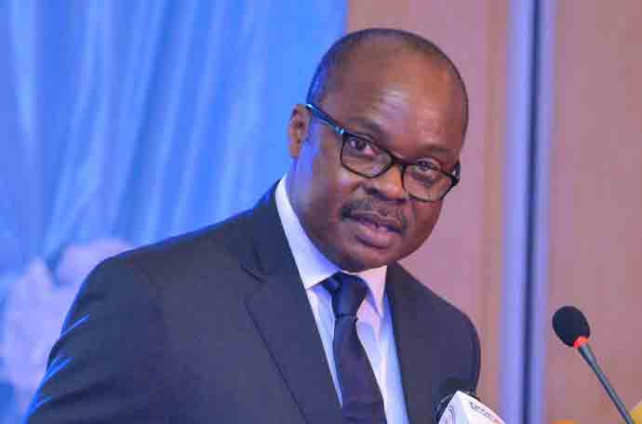
Addressing the media, Governor of the Bank of Ghana, Dr. Ernest Addison noted that the action was influenced by the fact that all the macroeconomic indicators are responding to past measures to control inflation.
"Given these considerations, the Committee decided to maintain the policy rate at 30.0 percent. The Committee further indicated that while the expectation is for continued disinflation, it stands ready to respond appropriately should inflation deviate from these broad expectations", he said.
On inflation dynamics, Dr. Addison explained that the continued maintenance of a tight monetary policy stance and relative exchange rate stability have contributed significantly to the disinflation process observed in the year thus far.
He announced that the headline inflation has declined by a cumulative 14.0% since the peak of 54.1% recorded in December 2022.
He added that non-food inflation has also declined sharply by close to 20%, broadly reflecting the effectiveness of monetary policy.
“All core inflation measures, monitored by the central bank are trending downwards, indicating continued easing of underlying inflationary pressures. In addition, one-year ahead survey-based inflation expectations seem well anchored”.
According to the Governor, while the disinflation process has resumed, it is expected to result in a gradual return towards the target band over the medium-term barring unanticipated shocks, rising international crude oil prices and adjustments to utility tariffs.
At the auctions for Government of Ghana securities, the 91-day and 182-day Treasury bill rates decreased marginally to 26.35% and 27.84%, respectively in August 2023, down from 27.68% and 29.12%, in the same month of 2022.
The rate on the 364-day instrument, however, increased to 30.88%, from 28.92% over the same comparative period. All the rates were however negative in real terms, given the rate of inflation.
The rate at which banks borrowed from each other, that is, the interbank weighted average rate, rose to 26.59% in August 2023 from 21.93% in August 2022, in line with increases in the monetary policy rate. Consequently, average lending rates of banks increased to 31.78% in August 2023, from 27.96% recorded in August 2022.
Latest Stories
-
Photos: GAF hands over 175.6km right-of-way for Accra-Kumasi Expressway construction to gov’t
40 seconds -
Accra-Kumasi Expressway to be operated and maintained for 50 years through toll revenue
4 minutes -
LGA holds Landmark Conference, AGM and Elections as the Committee on Politics and Elections emerges as the Overall Best Committee for 2025/2026.
6 minutes -
JSALK Beverages pays medical bills of struggling nursing mothers at Nkawie-Toase Hospital
11 minutes -
Accra-Kumasi Expressway to be operated as business to recover taxpayers’ investment – CEO
17 minutes -
UNFPA calls for presidential intervention as maternal deaths reach crisis levels
22 minutes -
Space reserved along Accra-Kumasi Expressway for railway line – Mahama
27 minutes -
Ashaiman’s deplorable roads: How long must residents wait?
30 minutes -
Elevate Africa Summit to push AfCFTA toward fully functional markets
32 minutes -
The search for clean water has failed — so can Nanton Zuo save the water source it already has?
44 minutes -
Accra-Kumasi Expressway construction expected to begin in January 2027 – CEO
50 minutes -
Parents in Ashanti make U-turn on Category C, D Schools as reporting deadline approaches
58 minutes -
September 21 declared public holiday for Founder’s Day
1 hour -
Indonesia rescuers battle turbulent seas in search for 129 people after passenger ship capsizes
1 hour -
Iceland’s last whaling company shrugs off threat of permanent ban
1 hour