

Audio By Carbonatix
A leading volcanologist has warned that mass evacuations might be needed in a town close to Naples, Italy, which sits on a so-called Super Volcano that has been hit by hundreds of small earthquakes in recent weeks.
A 4.2 magnitude earthquake struck the area early on Wednesday, the strongest jolt in 40 years to rattle the volcanic field, known as the Campi Flegrei or Phlegraean Fields from the Greek word for burning.
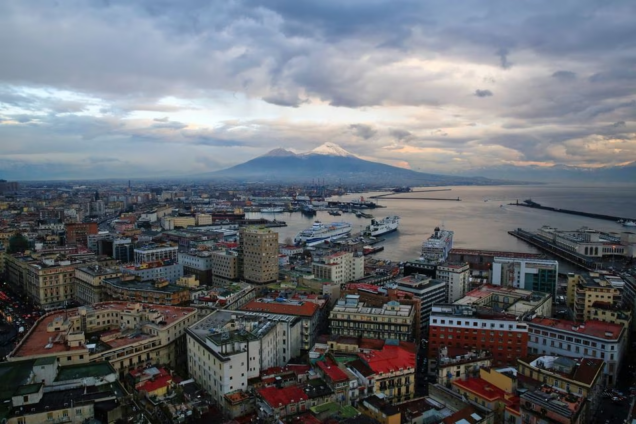
Campi Flegrei sits across the bay of Naples from Pompeii, where thousands were incinerated by Mount Vesuvius in 79 AD. However, it is a much bigger volcano than Vesuvius and if it ever exploded at full force could kill millions.
Experts say there is no imminent threat of an eruption, but Giuseppe De Natale, the former head of the Vesuvius Observatory at the National Institute for Geophysics and Volcanology (INGV), called for urgent checks on buildings after repeated seismic activity that is pushing up the ground by 1.5 cm (0.59 inches) a month.
Speaking in a personal capacity, De Natale said the last time Campi Flegrei suffered a similar burst of earthquakes in the 1980s, some 40,000 people were temporarily evacuated from nearby Pozzuoli. The town now has a population of more than 80,000.
"Currently, I believe the more immediate risk is seismic. But it is clear that one must also consider the possibility of an eruption," he told Reuters.
He said if there was an eruption, it would be a phreatic, or steam-blast eruption -- which are generally relatively weak and devoid of new magma -- at least initially.
There was no sign of structural damage in the area after Wednesday's tremor.
De Natale confirmed a report in Corriere Della Sera newspaper that he had written to the government last week suggesting possible evacuations. A local official said his recommendation was being reviewed.
The Campi Flegrei are similar to the Yellowstone caldera in the U.S. state of Wyoming but of more concern because they are in an area populated by around 3 million people in the Naples hinterland.
The Campi Flegrei caldera has a diameter of about 12-15 km (7.5-9.3 miles) and last erupted in 1538. One of its biggest eruptions took place some 39,000 years ago and might have led to the extinction of Neanderthal man, researchers say. Magma from that blast has been found in Greenland, some 4,500 km away.
Volcanologists say thousands of small tremors in the area since 2019, which have grown in intensity this year, might be being triggered by tongues of magma pushing up into the subsurface of the volcano at a depth of about 5-6 km.
The INGV says that on average more than 3,000 tons of CO2 are being released each day from the volcanic field. A typical U.S. passenger vehicle emits about 4.6 metric tons of CO2 a year.
Latest Stories
-
Cabinet approves facility manager for Borteyman Sports Complex – Kofi Adams
15 minutes -
Sanitation is improving; critics may be ‘living in another world’ – Salaga South MP replies Bekwai MP
22 minutes -
Government must do more to tackle sanitation crisis – Bekwai MP
22 minutes -
World Cleanup Day: GFF begins sanitation education in local communities
40 minutes -
EU Ambassador, IGP discuss stronger cooperation on policing and security
50 minutes -
Africa Nations Volleyball Championship: Ghana set up quarterfinal clash with Cameroon after beating Chad
1 hour -
Meet Dr Benjamin Appiah Osei — Ghana’s three-time tourism awards winner
2 hours -
UEFA & CONCACAF demand Fifa pays $10m to all 211 members
2 hours -
Inter fight back again to snatch draw at leaders Roma
2 hours -
Suzuki proves worthy replacement for Martinez at Villa
2 hours -
Brighton humbling ‘a big lesson’ for Arsenal – Arteta
2 hours -
Arsenal handed first loss by brilliant Brighton
2 hours -
VIDEO: Akwatia MP ‘clashes’ with Kofi Bentil over 3.9-tonne cocaine seizure
2 hours -
Ratcliffe ‘must go’ says Man Utd Muslim fan group
2 hours -
Ignite Social Enterprise targets global market for locally manufactured Ghanaian products
2 hours