

Audio By Carbonatix
The Health Ministry wants a strong collaboration with academia to prepare graduates for meaningful contributions to the health sector.
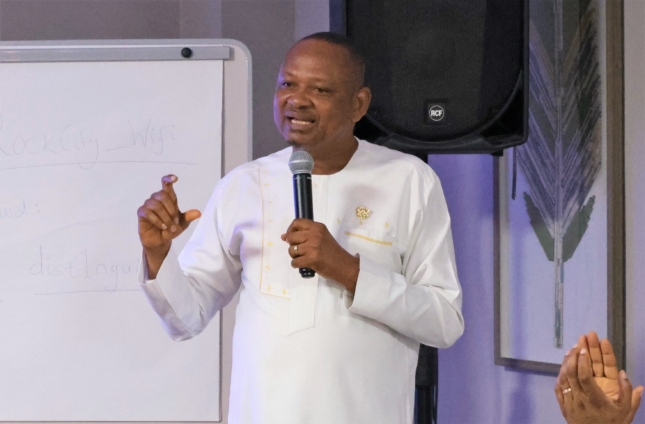
Director of Human resources, Dr. Kwesi Asabir observed the gap between academia and Ministry has produced graduates with misplaced roles.
“At times, there’s that barrier between academia and practice. Academia will come out with appropriate ideas but the implementer, ministry is cut off. So people go through an excellent programme, they come to the ministry and we tell them, we don’t have a place for you,” he revealed.
Dr. Asabir made this comment at a retreat organized by Mastercard Foundation Africa Higher Education Health Collaborative in Kwawu.
The primary objective of the Mastercard Foundation Africa Higher Education Health Collaborative is to build and strengthen the capacity of healthcare students and professionals to meet the growing demand for Primary Health Care (PHC) in Ghana.
KNUST is one of the eight partners of the Higher Education Collaborative in Health with the aim to contribute to all three pillars of the health strategy: Health Employment, Health Entrepreneurship, and Health Ecosystems.
The Health Entrepreneurship pillar aims to develop an entrepreneurial mindset and culture that supports entrepreneurs to create meaningful innovations and employment opportunities in the health sector.
The Health Ecosystem pillar also aims to train and prepare a new generation of talented professionals with the broad sets of skills required to drive equitable and inclusive growth.
The Health Employment pillar also aims to expand and improve current capacities to train primary healthcare workers. This workshop is under the auspices of the health employment pillar.
Dr. Asabir stressed the need to approach health as business for sustainable economic development.
“We always think of it as a social sector. We should look at healthcare as a business venture. If the population is not healthy, we can develop a nation,” he said.
The 3-day retreat provided the platform to forge effective strategies to fulfil the Collaborative’s ideals in the coming years.
The Principal Investigator of the Africa Higher Education Health Collaborative, Prof. Ellis Owusu-Dabo emphasized the importance of equity and diversity in the operations of the Collaborative.
“For the Collaborative, issues of gender and persons with disabilities are very critical to us. It’s important we put some of these things into action as a country,” he said.
Latest Stories
-
AMA says Konkomba traders were consulted ahead of Agbogbloshie 24-hour market project
27 minutes -
Let’s pilot Chinese in public schools before scaling up – EduWatch
35 minutes -
Ghanaian tech professionals develop SMS-based AI tool for non-smartphones
1 hour -
MTN@30: Three customers drive away brand-new Land Cruiser Prado in Kumasi
2 hours -
If BOST made GH¢684m profit, why use NPA Bill 2026 to weaken it? – IERPP questions Gov’t
2 hours -
NPP alleges executive, administrative confusion over Arabic, Chinese language policy
2 hours -
Minority accuses AMA of targeting Konkomba Yam Market in planned demolition over 24-hour market
2 hours -
Ghana struggles to raise local funds for delayed cocoa season as investors demand higher returns
2 hours -
GSA delays laboratory equipment replacement despite available funds
2 hours -
IERPP calls for withdrawal of proposed NPA Bill, raises concerns over BOST mandate
2 hours -
We’re not demolishing Konkomba Yam Market – Accra Mayor dismisses Minority’s claims
3 hours -
Nitiwul, Accra Mayor clash over Konkomba Yam Market demolition for 24-Hour-Economy market
3 hours -
BoG urges digital asset businesses to build compliance into operations at Digital Assets Summit Africa
3 hours -
NGIS Money Market Fund’s net assets rise 33.3% to GH¢11.78m
3 hours -
Vaglas join Vughin to mark Dɛng Festival of Sonyor in Savannah Region
3 hours