

Audio By Carbonatix
Rescuers are digging for survivors of a powerful earthquake that flattened whole villages in Afghanistan, killing more than 1,000 people.
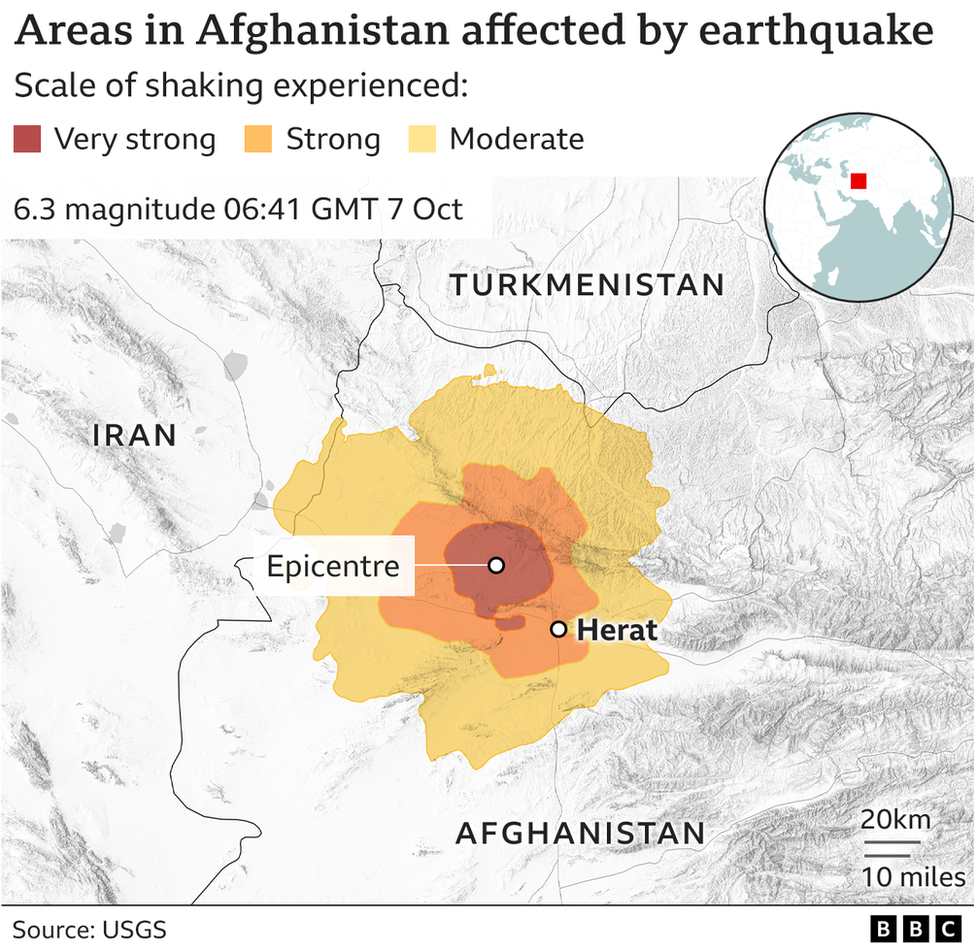
The 6.3-magnitude quake struck Saturday morning in Herat province, a barren landscape dotted with mud brick homes.
Villagers are still using shovels and bare hands to search for more than 500 people missing, the UN says.
Aid, delayed by blocked routes and communication lines being down, only started to trickle in on Monday.
There are fears the death toll could be much higher.
The quake hit Zindajan, a rural district some 40km (25 miles) from Herat city, where "100% of homes are estimated to have been completely destroyed," according to the UN Office for the Coordination of Humanitarian Affairs (OCHA).
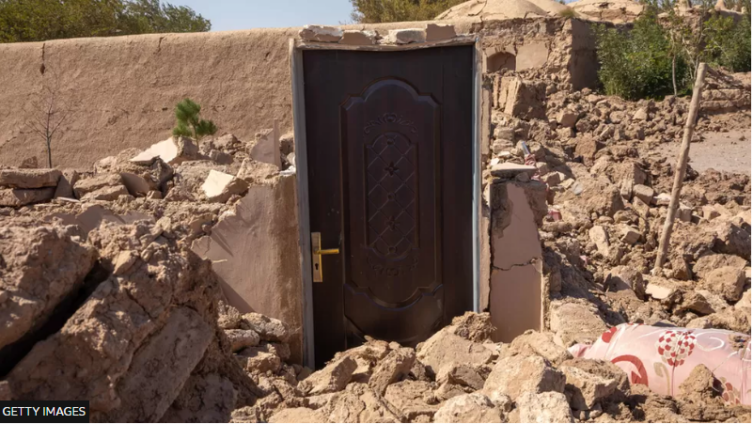
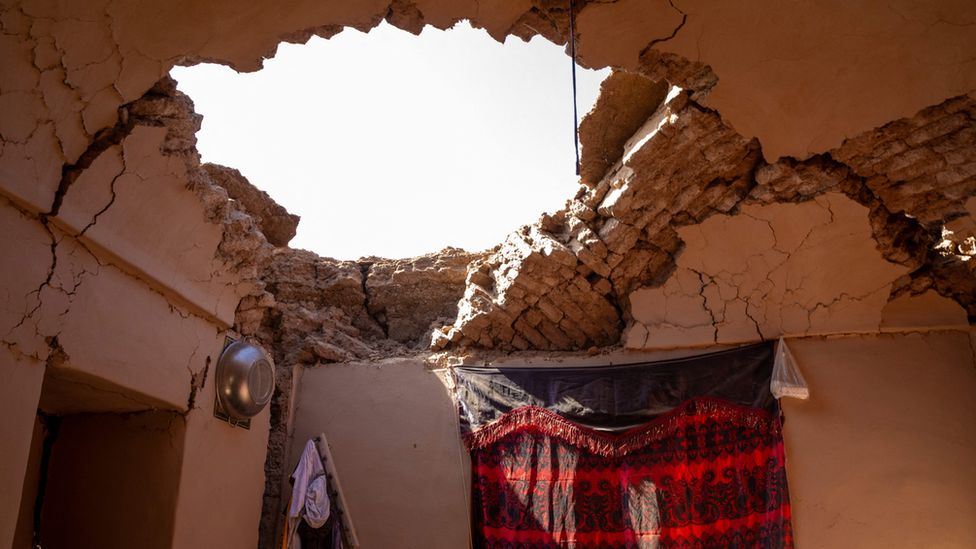
Images from the villages show entire houses, which were too fragile to withstand such a quake, reduced to rubble.
"We came home and saw there was nothing left. Everything had turned to mud," one resident Nek Mohammad told AFP news agency. "We started to dig with shovels and whatever we had to rescue women and children from the rubble."
The Taliban government and aid agencies initially struggled to estimate the death toll, or how many remained missing. It's unlikely officials had population records for such remote villages.
The area is also home to communities displaced by war and drought, making it difficult for the local administration to know exactly how many people have been living there.
"From what the colleagues in the field tell us, survivors were terrified, hungry, and desperate for help," said Philippe Kropf, the head of communications for the World Food Programme (WFP). He stressed that a "complete picture" of the situation on the ground is still being formed.
Warning that winter is only a month away, Mr Kropf told the BBC that the latest crisis comes at a time when 15 million people - a third of the population - already do not know where their next meal will come from. The WFP needs some $400m (£327m) in funding to deliver food to remote locations and help millions of the most vulnerable people, including widows and the disabled, to survive winter.
Ill-equipped hospitals have also been struggling to accommodate the injured, who now number more than 1,600. Many of them were sent to the Herat Regional Hospital, where teams from the medical charity Médecins Sans Frontières (MSF) have been since Saturday.
"Fortunately, most of the patients arriving are non-emergency cases," says Prue Coakley, the acting country representative for MSF in Afghanistan. "However, many of them do not have homes to return to, that is why many of them are remaining in the hospital while authorities look for alternative places for them to stay."
She added that a team focused on paediatric patients had been sent to the hospital in Herat. The UN says a majority of the quake survivors who are being treated are women and children, while doctors tell the BBC women and children also account for many of the dead.
The Taliban government has said quake survivors are in urgent need of food, drinking water, medicine, clothes and tents for shelter. Several aid agencies have dispatched help, including the Afghan Red Cross Society, MSF, WFP and Unicef. But the agencies say the cash-strapped country needs more aid.
Afghanistan has been reeling from an economic crisis since the Taliban takeover in 2021, when aid given directly to the government was stopped.
Few countries have pledged money since Saturday's quake. China's Red Cross Society has offered $200,000 (£164,220) in emergency cash aid, Chinese media reported.
Neighbouring Pakistan has said it is in contact with Afghan officials and will "extend all possible support to the recovery effort".
Afghanistan is frequently hit by earthquakes - especially in the Hindu Kush mountain range as it lies near the junction of the Eurasian and Indian tectonic plates.
In June last year, the province of Paktika was hit by a 5.9 magnitude quake which killed more than 1,000 people and left tens of thousands homeless.
Latest Stories
-
Bonsu Baah sets up opener in Al Qadsiah win over Al Wasl
12 minutes -
Ghana has now become a distribution hub for drugs
31 minutes -
Africa Nations Volleyball Championship: Ghana’s Black Spikers leave for tournament in Tunisia
45 minutes -
Today’s Front pages: Tuesday, September 15, 2026
1 hour -
Auditing the Auditor-General: How special audit understated a COVID-19 expenditure
2 hours -
A Partnership for Progress: Why the ProMark–KPMG collaboration matters for Africa’s digital assets future
2 hours -
Catholic Bishops pressure gov’t to sign long-delayed mission schools agreement
3 hours -
Cedi under fresh pressure as Christmas import demand drives dollar surge
3 hours -
Ato Forson eyes first-week November for 2027 Budget, promises jobs and major infrastructure push
4 hours -
Catholic Bishops demand probe into ‘protocol admissions’ amid SHS placement challenges
4 hours -
SHS placement: Catholic Bishops demand probe into alleged payments for school places
4 hours -
Facts about Nigeria’s Dangote oil refinery Initial Public Offering
4 hours -
Trump says AI safety fears a ‘hoax’ as he rejects calls for greater safeguards
5 hours -
Oil climbs as Saudi pipeline outage, fresh attacks heighten supply concerns
5 hours -
Donald Trump Jr and Bettina Trump say Putin ally paid for some wedding festivities as a ‘gift’
5 hours