

Audio By Carbonatix
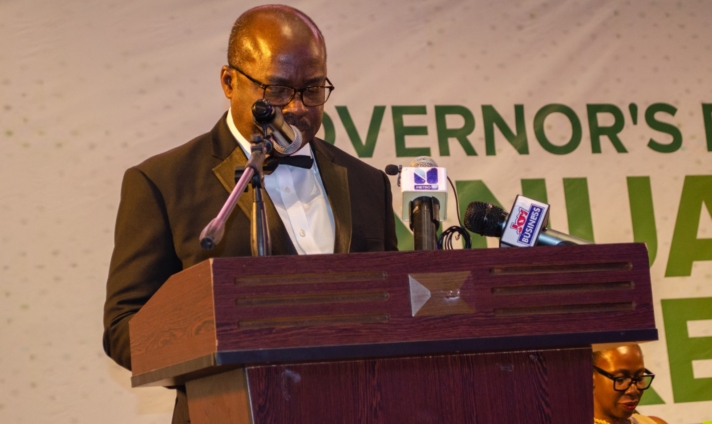
The Governor of the Bank of Ghana (BoG), Dr. Ernest Addison, has insisted that the economy would have faced dire consequences if the Central Bank had not stepped in to support government’s expenditure in 2022.
This, he stressed, contributed to the about ¢60 billion loss recorded by the Central Bank in 2022.
The minority group in parliament has demanded the resignation of the Governor after they demonstrated against him.
Speaking at the Governor’s Day Annual Bankers Dinner organised by the Chartered Institute of Bankers (CIB), Dr. Addison said the Central Bank had no option but to step in to save the economy from collapsing last year.
According to him, despite additional support to government, the fiscal cost associated with containing the COVID-19 pandemic was large and was exacerbated by the spillovers from the Russia-Ukraine war in 2022.
“It is very clear the Bank’s role in supporting the economy through this crisis has not been fully understood and in some cases deliberately misinterpreted. The Bank came under severe attack across the media space, culminating in an organised demonstration against the institution”.
Defending the decision to save the economy, Dr. Addison recalled that in 2022, the situation was so critical such that sovereign spreads on Ghana bonds widened, and credit rating agencies further downgraded Ghana’s sovereign debt rating, which blocked the country’s access to the international capital markets.
He stated that the planned external borrowing to the tune of about S$3 billion was also missed.
The situation, he pointed out, was so bad such that Ghana’s annual external debt service payments and energy payments alone was in the range of $3 to $4 billion annually as of 2020.
“A significant part of the annual borrowing was therefore to manage debt liabilities, including energy related payment obligations. Lack of access to the market for new financing immediately triggered a liquidity crisis, spilling over into a balance of payments crisis as the country had to continue to honour debt service obligations and energy payments”, he narrated.
He disclosed that in saving the situation, the BoG in two months, lost about $500 million in reserves, while overdraft facility for the government increased significantly.
According to him, throughout the first half of the year 2022, there was no new foreign financing until July 2022 when the Afreximbank stepped in with $750 million support.
“It was under these circumstances, that the government had to approach the IMF for support in July 2022. The IMF immediately sent in a mission to assess the economic situation. That mission concluded that the economy was at the tipping point”, he said.
He concluded that the Bank of Ghana and the IMF decided that the Central Bank should continue to provide the necessary support to keep the economy running until a reform programme had been put in place to trigger IMF financing.
Latest Stories
-
GPL 2026/27: Medeama ease past Basake Holy Stars
7 minutes -
Appiah Adomako writes: Why DVLA must stop treating every expired licence holder as delinquent
10 minutes -
Localization must transfer decision-making power, not just project responsibilities
19 minutes -
Modernising Ghana’s traditional markets through the 24-Hour Economy markets initiative
22 minutes -
New economy will boost local production and create jobs – Finance Minister
28 minutes -
Real-Time VAT on cross-border digital services – not a new tax and does not violate double taxation principle
1 hour -
Digitalisation, AI key to Ghana’s tourism transformation – GHATOF
1 hour -
Stronger GTA-private sector partnership needed to grow tourism – GHATOF
2 hours -
Amazon eyes Ghana for broadband expansion after talks with Mahama
2 hours -
National Investment Quiz 2026: Six schools qualify for quarter-finals
3 hours -
‘Do not let Russia pay for its madness with lives of your people’ – Zelensky to Ghana, 46 other countries
3 hours -
6,079 promotion cases fully processed and paid – CAGD says amid nationwide teachers’ strike
3 hours -
Teacher unions to meet government Monday over nationwide strike
4 hours -
Photo story: Republic Bank-JoyNews Habitat Fair clinic wraps up after three days of housing solutions, expert engagement
4 hours -
National Peace Council urges investment in youth to sustain Ghana’s peace
4 hours