

Audio By Carbonatix
A lecturer at Duke University, Professor Felwine Sarr, has called on the governments on the continent to invest in knowledge and innovation production within the education system as a crucial solution to address the social and economic challenges facing Africa.
The Senegalese writer and academician emphasized that many African governments tend to focus more on resolving immediate social and economic issues rather than prioritising long-term investments in knowledge production.

He highlighted the significance of such investment, stating that it would contribute to generating more intellectuals from tertiary institutions who could devise effective measures to tackle economic and social problems.
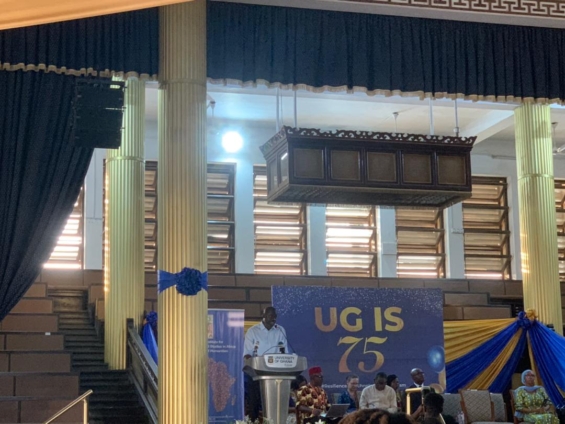
Speaking at the Anton Wilhelm Arno Lecture organised by the Department of Philosophy and Classics at the University of Ghana, Professor Felwine Sarr urged African leaders to recognise the importance of investing in knowledge production.
"The government has an important role to play in the pluralism of African knowledge. Africa has a lot of challenges, including education, health, and others, so most of the time they think that investing in knowledge is not urgent, so they respond to the needs, and knowledge comes later. It's a mistake because the investment in knowledge will allow them to respond to the needs appropriately," he said on Tuesday.

Prof Sarr further stressed that knowledge, particularly in areas such as innovation, technology, and material forms of knowledge, forms the foundation of economies.
He also highlighted the need for a broad understanding of knowledge, extending beyond traditional university and scientific domains.
He said, "They must know that the spheres of knowledge are the most important ones because economies are based on knowledge, innovation, technology, and material forms of knowledge. Also, the knowledge they have to consider should be wider than those in the universities and sciences. For instance, there is an ecological crisis that requires knowledge to adapt and respond to the African farmers and agriculture."
The lecturer also urged stakeholders in the education sector to integrate African knowledge across various domains into the curriculum of educational institutions.
"There is a lot of knowledge in different domains, which is psychological, environmental, and techniques that Africa has produced, and we need to put this knowledge in the curriculum, in courses like Maths, Sciences, humanities, and social science courses."
Latest Stories
-
E.P. Church secures radio frequency, prepares to launch Bremen Radio
6 minutes -
Two dead and hundreds evacuated as twin fires break out on Greek island
7 minutes -
EPCG clears over GH¢11.7m in debt as outgoing moderator calls for tighter controls on borrowing
7 minutes -
Mövenpick Ambassador Hotel Accra marks 15 years of premium hospitality
7 minutes -
T-bills auction: Government exceeds target by 88%, interest rates tumble
59 minutes -
Western North: Confusion erupts over NPP chairmanship election results
1 hour -
Bawumia congratulates newly elected NPP regional executives
1 hour -
Bawumia urges unity after NPP regional elections ahead of 2028
2 hours -
Russia says at least seven killed in largest Ukrainian attack of 2026
2 hours -
Ghana and Netherlands sign pact to combat illicit drugs and drug markets
2 hours -
Akandoh warns Boards against interfering in day-to-day management of health institutions
2 hours -
Rev. Prof. Frederick Amevenku elected 15th Moderator of E.P. Church Ghana
2 hours -
Photos: Nkwa Hia Fit & Free Health Walk 2026
2 hours -
A person stopped by police can record for evidence – NRSA
3 hours -
New Road Traffic Law introduces separate licensing regime for commercial drivers
3 hours