

Audio By Carbonatix
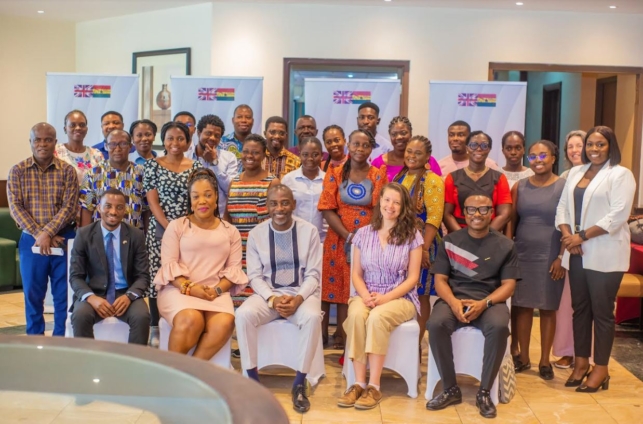
Twenty journalists from across Ghana have completed the UK-Ghana Science, Technology, and Innovation (ST&I) Strategy’s Capacity Building for Excellence in Science, Technology, and Innovation Reportage programme.
The participants underwent a comprehensive itinerary covering modules on the National System of Innovation, the power of Generative Artificial Intelligence, Frontier Tech ideation, and the art of science storytelling. They delved into enhancing STI reportage through workshops on science communication, intellectual property, technology transfer, and fostering university-industry partnerships.
UK-Ghana Science, Technology, and Innovation (ST&I) Strategy intends to increase the number, quality, and impact of UK-Ghana ST&I partnerships through its four foundational pillars: Ecosystem coordination; Knowledge and skill sharing; Partnership co-creation; Commercialization & scaling up.
The strategy hinges on recognizing that without sufficient knowledge and collaboration among stakeholders, potential opportunities may be overlooked, and the impacts limited.
Aligning initiatives, fostering the formation and utilization of new partnerships while addressing the barriers that hinder progress in ST&I initiates possibilities and improvement.
Richard Sandall, the Development Director at the British High Commission, opened the event by emphasizing the importance of excellence in reporting on science, technology, and innovation.
“The UK is a Science, Technology, and Innovation superpower. Science and technology underpin our ambitions both at home and abroad.
“There is often a big barrier between what scientists know and getting that information to the people who can use it – decision makers, businesses, activists, or teachers.
“That barrier is like a vacuum where information should be. And where there is a knowledge vacuum, misinformation rushes in.
“…society needs you. That is why perhaps, you become journalists” he said to the first cohort of journalists enrolled in the training programme.
Sandall further explained that “a journalist’s responsibility extends beyond merely documenting scientific and technological advancements; it encompasses the interpretation and communication of their relevance and effects to a general audience. This involves not only presenting facts but also contextualizing them in a way that highlights their broader implications.”
Chair of the Media Capacity Enhancement Programmed (MCEP) Prof. Kwamena-Aidoo, addressed the notable issue of scarcity of specialized journalists capable of effectively covering complex ST&I topics, leading to an increase in content generated by public relations rather than independent journalism.
“The rare collaboration between the British High Commission, the Ministry of Environment, Science, Technology, and Innovation (MESTI) and the Ministry of Information (MOI) for this event, underscores the recognition of pressing challenges within science, technology and innovation reporting, and the need for concerted efforts and comprehensive training to address such,” he started.
He continued, “The challenges we face in science, technology, and innovation reporting are multifaceted and demand strategic interventions."
Prof. Kwamena Kwansah-Aidoo acknowledged that for most journalists, they struggle to simplify scientific information and accurately present it for public consumption stemming from the use of technical language by scientists and the fast-paced news environment.
“Journalists encounter significant hurdles in translating complex scientific information into engaging, accessible stories for the public.
“Technical jargon, statistics, and research findings often pose formidable obstacles, exacerbated by the relentless pace of the news cycle with its stringent deadlines, which impede thorough research and fact-checking processes,” he said.
Nonetheless, he reminded journalists of the power they wield in shaping narratives and driving change.
“As journalists and communicators, we are not mere observers of history; we are its chroniclers and architects as well. With our pens, cameras, and voices, we possess the power to shape narratives, challenge conventions, and inspire action.”
Following five days of intense, immersive and practical training in Science, Technology and Innovation reportage, we look forward to see these journalists reconstruct Ghana’s narrative on ST&I through their compelling stories.
Latest Stories
-
Chief Justice must examine arrests of suspects on court premises – Afenyo-Markin
2 minutes -
Black Stars arrive in Bouake ahead of Cote d’Ivoire clash
6 minutes -
We’ve identified two persons who allegedly helped Manhyia South MP escape arrest – EOCO
11 minutes -
Manhyia South MP declined two invitations in February, attempted arrest was lawful – EOCO
23 minutes -
Bosomtwe Assembly ultilises PWDs fund to empower over 30 PWDs with start-up kits
27 minutes -
Nkrumah’s ideas must be given practical meaning – P.L.O. Lumumba
36 minutes -
Disproportionate arrests over criticism may create ‘undeserving martyrs’ – Mahama
38 minutes -
“This is an abuse of power” – Minority slams EOCO over attempted arrest of Manhyia South MP
39 minutes -
Time to turn Volta Region’s economic potential into action – EXIM Bank CEO
40 minutes -
Bring your appointees to order – Afenyo-Markin urges Mahama to act against alleged EOCO abuses
53 minutes -
Mahama tasks MFWA, GJA to lead national dialogue on hate speech, harmful digital content
54 minutes -
Manhyia South MP recounts alleged attempt to forcibly take him to EOCO
1 hour -
‘I had to drive off to safety’ – Nana Agyei Baffour Awuah on why he fled after High Court clash
1 hour -
Nkrumah was a lonely man because of Pan-African vision – PLO Lumumba
1 hour -
P.L.O Lumumba calls for end to ‘primitive accumulation’ in public office
1 hour