

Audio By Carbonatix
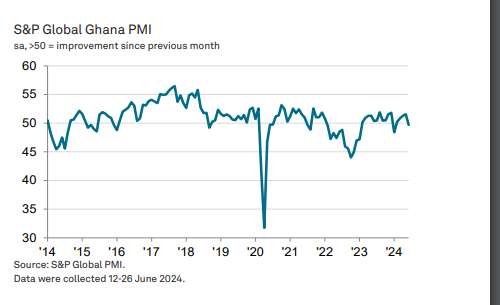
Ghana Purchasing Managers’ Index (PMI) dipped to 49.7 in June 2024 from 51.6 in May, according to S&P Global.
The index signalled a marginal monthly deterioration in business conditions, ending a four-month sequence of improvement.
According to the report, the strong inflation was a key issue for the private sector in June 2024 and was largely responsible for the renewed downturn at the end of the second quarter.
Similarly, the rate of purchase price inflation hit a 19-month high, having quickened for the fifth consecutive month. A depreciation of the cedi against the US dollar was the main cause of the rise in purchase costs, according to respondents.
Staff expenses also increased again in June 2024 as firms acted to support their workers at a time of rising living costs.
In response to the rapid increase in input prices, S&P Global said companies raised their own selling prices substantially. The pace of output price inflation was the fastest since November 2022 as 34% of respondents increased their charges.
Inflationary pressures dampened demand in June 2024 as new orders were unchanged following four consecutive months of expansion. That said, some firms indicated that their customers had accepted price rises and continued to make new orders.
The impact of price rises on client demand, S&P said fed through to business activity which decreased for the first time in four months, albeit only slightly. Inflationary pressures also impacted private sector firms' own purchasing decisions.
Andrew Harker, Economics Director at S&P Global Market Intelligence, said: "The spurt of inflation in Ghana's private sector is having an increasingly concerning impact on business conditions, and in June caused a stagnation of new orders and outright reductions in output and purchasing activity. While employment continued to rise, providing the main bright spot in the month, job creation will likely prove unsustainable should price rises continue to bear down on demand.”
"Looking at the second quarter of the year as whole, solid output growth in the opening two months of the quarter should mean that GDP [Gross Domestic Product] numbers remain solid. The worry is that the second half of the year will be more of a struggle”, said Mr. Harker.
Business confidence strong
Meanwhile, business confidence strengthened in June 2024 amid hopes of an improvement in economic conditions over the coming year.
Optimism in the outlook for output was predicated on stability of both the exchange rate and prices, however.
Latest Stories
-
NPP clears all 47 aspirants for 2026 national officers’ election
4 minutes -
Domelevo backs OSP probe into GH¢70k allegation
50 minutes -
CAF Confederation Cup: Dennis Korsah confident Nations FC can overturn Mali defeat
1 hour -
‘Avoid political comments’ – Domelevo advises Chief Justice
2 hours -
‘I don’t trust OSP’ to probe GH¢70k ‘bribe’ allegation – Kwasi Kwarteng
2 hours -
Road inspections not to witch-hunt contractors – Kwame Agbodza
2 hours -
Inter Milan mount stunning comeback to beat Napoli
3 hours -
Modric plans to play for Croatia past 41st birthday
3 hours -
Bayern fail to score for first time in 59 games
3 hours -
Bawumia preparing new cocoa policy package for farmers – Annoh-Dompreh
3 hours -
Wa-Tumu-Bolga road upgrade will unlock agriculture, trade – Agbodza
3 hours -
Ghana Maritime Authority readies oil-spill response vessel for deployment
3 hours -
Ayariga turns to drones, AI to tackle Agbogbloshie waste mountain
3 hours -
Agbogbloshie waste heap must go – Mahama Ayariga declares
3 hours -
Government to upgrade all rural telephony sites to 4G – Communications Minister
3 hours