

Audio By Carbonatix
President Nana Addo Dankwa Akufo-Addo has called for a review of the existing development cooperation framework between Africa and its international partners focusing on areas that inured to the continent’s growth.
The current framework, he said, was fraught with its own limitations, a situation that does not allow Africa to wean itself of donor support in the execution of development projects for the wellbeing of the people.
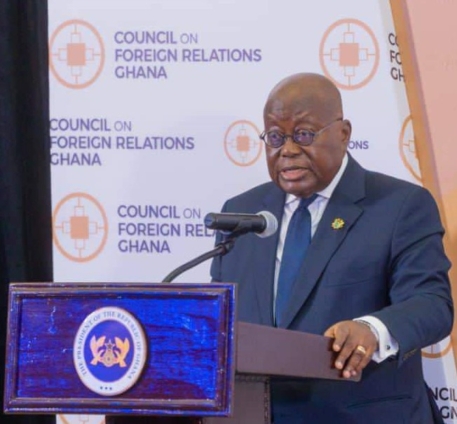
The President, delivering a paper at the 5th Anniversary Lecture series of the Council on Foreign Relations (CFR)-Ghana, in Accra, advocated a new paradigm for development cooperation.
“To achieve the continent’s transformation, it is imperative to target structural reforms that address the root cause of underdevelopment and champion its inclusive growth, which are primarily the continuing reliance of our economies on raw materials production and export.
“While aid has supported the continent to meet some immediate needs and development projects, it has also created a dependency syndrome that undermines domestic ownership and self-reliance,” he stated.
Africa continues to face numerous challenges that hinder her prospects for transformational change, he bemoaned, citing the high levels of poverty, inequality, unemployment, and underdeveloped infrastructure.
Read also: Akufo-Addo highlights AfCFTA’s role in continental transformation
The president said tackling the root cause of the continent’s slow pace of development despite its abundant resources and prospects must take centre stage in the search for more vibrant cooperation.
While short-term projects and requirements are necessary for immediate needs, they do not necessarily lead to long-term sustainable development, he cautioned.
The continent, he said, must strive to amplify domestic resource mobilisation, entrepreneurship, advancement in technology, and innovation, as well as create an enabling environment for indigenous private sector investment.
Additionally, the continent must direct substantial investment towards improving educational and healthcare infrastructure, human capital growth, and digitalisation.
“By building resilient economies and solidifying domestic capacities, especially those of tax collection agencies, we can reduce dependency on aid and pave the way for sustainable development,” the president noted.
He said that the process of prioritisation had taken on even greater urgency because of the emerging geopolitical climate in many nations of the Western world.
“Indeed, in several countries, aid budgets are being drastically reduced,” he noted, saying some populist governments have begun questioning and attacking traditional aid arrangements, some with racist undertones.
President Nana Akufo-Addo drew attention to another limitation of the current development cooperation framework relating to the fragmentation of aid efforts.
The multiplicity of donors, each with its own priorities, conditions, and defaulting requirements, often leads to duplication of efforts and inefficiencies, he stated.
That can result in a lack of coherence and coordination, impeding effectiveness for development interventions, he advised, and underlined the need for greater harmonisation and alignment of aid efforts.
“Donors and friends of Africa should work collaboratively with African governments to ensure that aid, if requested and granted, is delivered in a coordinated and coherent manner.
“This encompasses aligning aid with national development priorities, streamlining reporting mechanisms, and promoting neutral accountability. By instituting a more coordinated approach, we can maximise the impact of aid and achieve greater development outcomes,” he noted.
President Akufo-Addo said another key component driving Africa’s search for holistic development cooperation was the need for effective functioning and operationalisation of the African Continental Free Trade Area (AfCFTA) agreement, whose Secretariat is located in Ghana.
The agreement, he noted, presented the continent with the opportunity to drive inclusive growth and industrialisation, as such, its implementation should be given utmost importance.
Latest Stories
-
Chaos and confusion reign as Harry loses media battle
10 minutes -
Lammens’ error spells end for Belgium’s golden generation
2 hours -
This Saturday on Prime Insight: National cleanup, Abu Trica and Hanan troubles, and ‘Nkoko Nkitinkiti’ discussions
2 hours -
Top Boy actor Micheal Ward found not guilty of rape
2 hours -
Mikel Merino’s late winner against Belgium sends Spain into the semi-finals of the World Cup
3 hours -
England favourites to reach semis, says Norway boss
3 hours -
Man arrested on suspicion of murder after death of Ann Widdecombe
3 hours -
Sniffing chocolate before a workout could add 18 extra reps, study suggests
4 hours -
Why do mosquitoes bite some people more than others?
5 hours -
DBG launches women’s lending programme to boost female-led businesses
5 hours -
“It keeps me awake at night” – UniMAC VC reveals struggle to unite three institutions under one university
5 hours -
Photos: Vice President joins nationwide clean-up exercise
5 hours -
Ghana’s real sporting crisis lies beyond the pitch
5 hours -
Healthy food is a business investment, not a lifestyle choice — Mövenpick GM
5 hours -
Mahama urges Ghanaians to sustain clean-up exercise as he calls for community involvement
5 hours