

Audio By Carbonatix
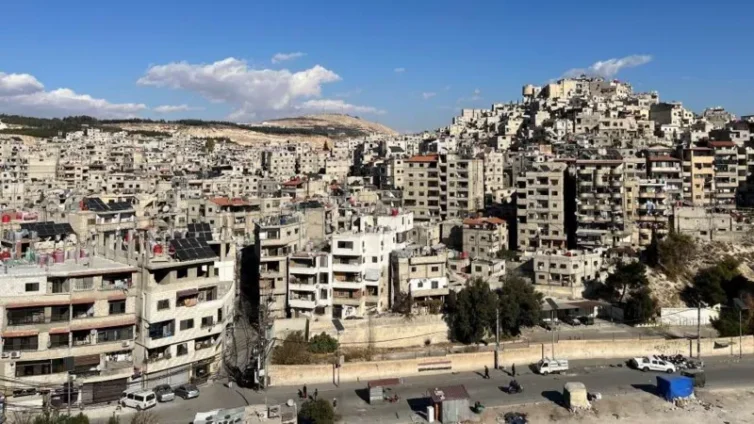
Driving into Mezzeh 86, a working-class neighbourhood in the west of Damascus, we are waved through a checkpoint manned by fighters from Hayat Tahrir al-Sham (HTS).
Buildings are rundown and in need of repairs.
This area is dominated by people from Bashar al-Assad's Alawite sect, an offshoot of Shia Islam whose members make up one of Syria's biggest religious minorities.
Alawites controlled power in the predominantly Sunni Muslim country for the 50 years of the Assad family's rule, holding top positions in the government, military and intelligence services.
Now, many from the community fear reprisals following the overthrow of the Assad regime by rebels led by HTS, a Sunni Islamist group that was once al-Qaeda affiliate in Syria.
Dozens of Alawites who we had contacted by phone had refused to speak to us, with many saying they were scared.
In Mezzeh 86, the presence of HTS fighters at a checkpoint did not appear to be a source of anxiety.
Many Alawites did come up and speak with us - keen to distance themselves from Assad's regime.
"During the Assad regime, the stereotype about the Alawites is that they got all the work opportunities and that they are wealthy. But, in fact, most Alawites are poor and you'll only find one among a thousand who is rich," said Mohammad Shaheen, a 26-year-old pharmacy student.
"Even when HTS went to Alawite villages near the coast, they found all villages were poor. Only the Assad family amassed wealth," he added, referring to the Alawite heartland in the country's west.
Hasan Dawood, a shopkeeper, chimed in: "We were slaves for him - drivers, cooks and cleaners."
There's also a sense of betrayal.
"Bashar was a traitor. And the way he fled was cowardly. He should have at least addressed people and told us what was happening. He left without a word, which made the situation chaotic," said Mohammad.
But people from the Alawite community, and indeed from this neighbourhood, did serve in Assad's brutal security forces. Do they fear reprisals against them, we asked.
"Those who were in the military and did bad things have fled. No-one knows where they are. They are afraid of revenge," said Thaier Shaheen, a construction worker.
"But people who don't have blood on their hands, they are not scared, and have stayed back."
There have been reports of a few reprisal killings in parts of the country, but so far there is no evidence to suggest they were carried out by HTS.
"Until now, we are OK. We are talking to Hayat Tahrir al-Sham and they are respectful. But there are people who aren't from HTS but pretend to be them who are making threats. They want our society to fail and they are the ones we are scared of," said Mohammad.
After taking control of Damascus, HTS and its allies said those from the deposed regime who had been involved in torture and killings would be held to account, although it is unclear so far what form that justice will take.
HTS also said that the rights and freedoms of religious and ethnic minorities would be protected.
The group has a jihadist past which it has distanced itself from. But it has an Islamist present, and many are asking what that will mean for Syria's plural society.
"I'm so happy because the Assad regime fell. This is like a dream come true. No-one wants to live under dictatorship. But there is concern. I have to be realistic," said Youssef Sabbagh, a Christian lawyer.
"HTS are here now, and they are an Islamic militia. That's what they are. I wish, I pray they will be a modern Islamic militia."
"I speak not just as a Christian, a lot of Syrians, Muslims and everyone, we don't want Syria to become another Afghanistan, we don't want to become a new Libya. We have already suffered a lot."
Syria's Christian community is one of the oldest in the world, with the country home to some renowned holy sites.
When the uprising against Assad began in 2011, Christians were initially cautious about taking sides, but eventually members from the community fought on both sides of the conflict.
In the past week, the Archbishop of Homs, Jacques Murad, told the BBC there had already been three meetings with HTS, and they had been able to express their views and concerns honestly.
So far, the signs are re-assuring for many Christians.
Bars and restaurants serving alcohol are open in the Christian quarter of Old Damascus and in other parts of the city. Christmas decorations are also up in many places.
At a restaurant in the Old City, we met lawyer Ouday al-Khayat, who is a Shia Muslim.
"There's no doubt that there's anticipation and anxiety. The signs that come from HTS are good, but we must wait and watch," he said.
"It's not possible to know the opinions of all Shia but there is a concern about a scenario similar to Libya or Iraq. I believe, though, that Syria is different. Syrian society has been diverse for a very long time."
We drove around 110km (70 miles) south-east of Damascus, through black volcanic hills, to the city of Suweida, which is home to most of Syria's Druze population.
The Druze faith is another offshoot of Shia Islam, but has its own unique identity and beliefs.
Many Druze were loyal to the Assad regime, who they believed would protect minorities.
But opposition grew steadily during the war, and there were frequent protests in recent years.
The latest started in Suweida's central square in August 2023 and continued until the day the regime fell.
Activist Wajiha al-Hajjar believes that the protests were not brutally cracked down on like others in Syria, because Assad wanted to show the world and his foreign allies that he was protecting minorities.
"They did try to suppress our protest but in a different way - not through weapons or shelling, but by depriving us of passports and civil rights, and access to official documents. It became difficult to leave Suweida and a kind of siege was imposed," she said.
Hundreds still gather at the square every day. When we visited, there was an air of celebration. Songs were blaring on a loudspeaker, and young girls and boys were doing a gymnastics performance, their families clapping and cheering for them.
"We are celebrating the fall of the regime, but this gathering is also a show of strength. In the event that there is an extreme regime with extreme laws, we are prepared to stay in this square and demand our rights and demand equality," Wajiha said.
Suweida had a quasi-autonomous status under Assad, and the Druze want that to continue.
It is just one example of the diversity and complexity of Syrian society, and the challenges facing the country's new government.
Latest Stories
-
Why I proposed Gold-for-Oil and Domestic Gold Purchase Programme – Bawumia discloses
3 minutes -
Sista Afia urges artistes to disinfect mics or get personal ones for shows
28 minutes -
Joy FM Back to School Discount Fair returns September 4–5
30 minutes -
Supporting small-scale miners to become medium-scale miners key to tackling galamsey menace – Bawumia
39 minutes -
No politician can beat Bawumia in 2028 if voters focus on issues – Miracles Aboagye
54 minutes -
Mahama reaffirms Ghana’s investment drive, calls on global investors to partner in Africa’s growth
1 hour -
Beyond the Numbers: Understanding the Bank of Ghana’s Domestic Gold Purchase Programme(DGPP)
2 hours -
AI can’t replace lawyers, Supreme Court nominee Anthony Forson warns
2 hours -
Teacher unions threaten strike over automatic promotion deadline
3 hours -
Yango Ghana earns Great Place to Work Certification for 2026
3 hours -
Over 400 companies ready to join 24-Hour Economy – Dr Rashid Pelpuo
3 hours -
Zanetor proposes CSIR funding for cassava, hemp-based alternatives to plastics
3 hours -
‘Judges don’t mingle with appointing authorities’ – Amoako Asante defends judicial independence
3 hours -
‘We’re getting close to A’ – Pelpuo rates government’s job creation B+
3 hours -
90% of planned strikes were called off under my tenure – Pelpuo
3 hours