

Audio By Carbonatix
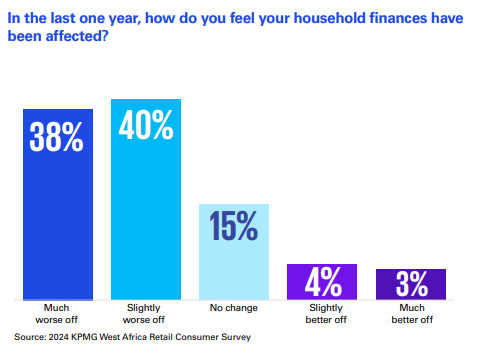
Thirty eight percent of Ghanaian retail consumers feel their finances have worsened in the last one year.
According to the 2024 West Africa Banking Industry Customer Experience Survey by KPMG, the rising costs of fuel and essential goods have further squeezed budgets, leaving little room for discretionary spending or long-term financial planning.
In response to these challenges, the report said many Ghanaians are adopting cost-saving strategies, such as seeking cheaper alternatives for food and clothing.
The financial pressure has also influenced personal decisions, with half of respondents in the retail consumer survey considering emigration to escape lasting economic hardship.
When respondents were asked respondents how they intend to adapt to the economic hardships, 36% indicated that they intend to increase their workload to cope with financial pressures while 29% remain hopeful about starting businesses, despite the economic climate.
However, 6% of respondents expressed reluctance to venture into entrepreneurship due to the uncertainties of the current environment.
While aggregate level of savings remained largely the same compared to last year, the survey observed that respondents who do not save increased from 8% to 12% this year.
“We observed that savings and investments which was the fourth largest expense area last year for Millennials shifted to sixth place”, the report added.
6% Millennials Do Not Save
There were also fewer millennials who indicated that they do not save – a drop from 11% to 6% this year.
Contrary to the Nigerian situation, Baby Boomers had the largest proportion of people who do not save – 41%.
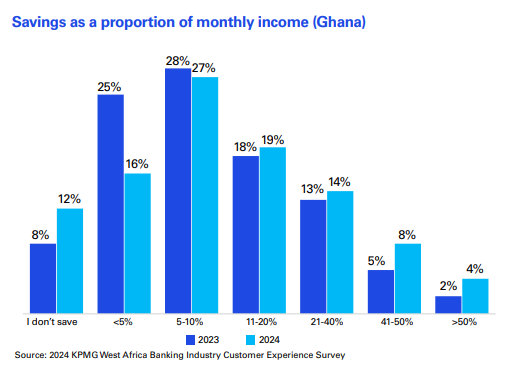
A review of their expenditure showed a focus on their health as well as fitness and catering to their family obligations. For Gen Zs, who are most likely students and early career starters, an impressive 13% indicated that they were able to save 21% to 40% of their monthly income.
The survey findings reveal that the top two expense areas for Ghanaians were food and dining (66%) and transportation (44%), same as in 2023.
Whereas savings and investments was considered a top five spending category last year, we observed a displacement by airtime and data expenses (35%) this year.
Latest Stories
-
We are largely import-dependent – NPA boss on Ghana’s fuel vulnerability
1 hour -
Ghana’s fuel market is built for turbulence – NPA’s Edudzi Tamakloe explains why
1 hour -
Postponement not an option as Kenya races to be ready for Afcon 2027
2 hours -
ICE agent shoots and wounds man in Texas as locals demand answers
2 hours -
Ed Sheeran admits ‘mistakes’ at first show since Macklemore controversy
2 hours -
We are ready for the turbulence – NPA boss on Ghana’s fuel crisis
3 hours -
Lady I wanted serious relationship with said she’s not ready – Rema
3 hours -
I’ll never discuss my finances with man, even if he’s my husband – Nancy Isime
3 hours -
Wizkid, Wande Coal advised me on how to leave school for music – Davido
4 hours -
Senegal job an ‘absolute dream’ for new boss Vieira
4 hours -
Harry and Meghan’s media treatment echoes what happened to Diana, Earl Spencer tells BBC
4 hours -
Nvidia boss rejects AI extinction fears as ‘doomsday narratives’
4 hours -
Workers came across human remains – and unearthed a mass grave of 572 people
4 hours -
Each Jehovah’s Witness member now decides whether to accept or donate main blood components
4 hours -
Trump says US will form ‘AI Force’ and appoint an artificial intelligence tsar
5 hours