

Audio By Carbonatix
Fifteen different research projects being implemented by the Council for Scientific and Industrial Research (CSIR) are on the verge of “extinction” following cutbacks in America’s foreign aid agency spending.
The projects, which the Savanna Agricultural Research Institute (SARI) is implementing as parts of efforts to boost productivity of the agriculture sector, are funded by the United States Agency for International Development (USAID).
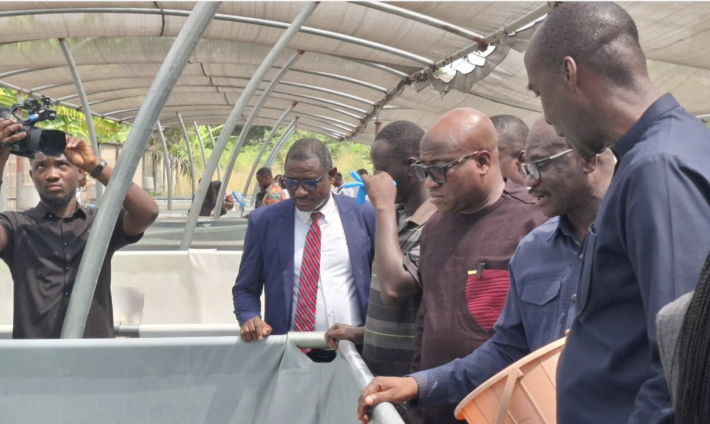
The Management of the CSIR expressed concern over the development when Mr Ibrahim Murtala Muhammed, the Minister of Environment, Science and Technology, paid a working visit to the CSIR and some of its institutions in Accra on Tuesday.
The visit formed part of his familiarisation tour to the various agencies under his supervision to apprise himself of their operations.
The SARI is one of the 13 institutes of the CSIR, located in the Tolon District of the Northern Region of Ghana.
The USAID has been supporting SARI to improve the effectiveness of its agricultural research to ensure smallholder farmers in northern Ghana had access to quality seeds and technologies.
Professor Paul P. Bosu, the Director-General, CSIR, told journalists that the Council was exploring ways to continue with the affected projects.
“We are going to have serious shortfalls with the projects that we are implementing. We have to get ourselves ready,” he said, adding that the Council would present a paper to the sector minister to discuss ways to bridge the funding gap.
Other issues discussed included declining donor support, lack of private sector investment in research and development, lack of modern laboratories and facilities, and encroachment on CSIR lands.
The Council briefed the Minister on interventions it was undertaking to swap some of its prime lands to raise funds in support of its operations and solve the funding challenges.
Mr Muhammed expressed delight about those innovations and reiterated his vision to ensuring the commercialisation of their research findings to raise revenue.
He said the CSIR could develop varieties that had the potential to reduce the millions of dollars spent on the importation of essential food items such as rice, tomatoes, and poultry products.
The Minister tasked the various institutions under the Council to present to him a paper and make a “compelling case” to attract funding and investment to boost their operations.
“If we can find a way for some of the institutes to take up the responsibility of providing some of the basic needs of state institutions such as the School Feeding Programme, and build the capacities of our SMEs, we can build upon that,” he said.
Latest Stories
-
Mahama: Africa will no longer export raw minerals without value addition
4 minutes -
NPP leaders appear in court to support Manhyia South MP
4 minutes -
Mahama demands permanent UN Security Council seat for Africa
16 minutes -
Mahama calls for structural repair after UN slavery resolution
20 minutes -
Mahama condemns Gaza carnage, backs Palestine and two-state solution
23 minutes -
Fund Accra-Kumasi Expressway with private capital, not state funds — Alan Kyerematen urges gov’t
28 minutes -
TUC calls for stronger funding and labour representation in TVET system
29 minutes -
GES threatens removal of SHS heads over illegal fees
34 minutes -
Youth power to explode at 2026 Global Changemakers Summit in Accra
41 minutes -
SIU community remembers Kofi Akamani at vigil as memorial fund is announced
42 minutes -
Shot and killed in the US: Who was Dr Kofi Akamani?
51 minutes -
Sosu challenges EOCO’s basis for attempted arrest of Manhyia South MP
57 minutes -
KMA plans to convert Adum railway enclave into cargo truck terminal
59 minutes -
2026/27 cocoa season: COCOBOD engages international trading partners in London
1 hour -
Fire contained at Dansoman’s Dayspring School, no casualties reported
1 hour