

Audio By Carbonatix
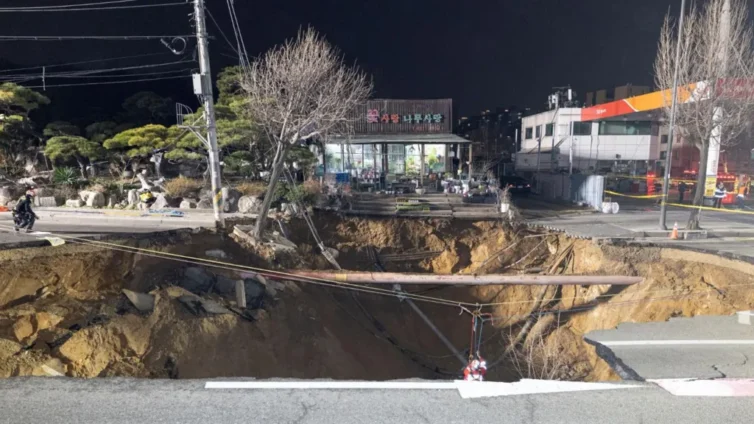
A man who fell into a large sinkhole in South Korea's capital Seoul has been found dead, according to the local fire department.
The man was riding his motorbike in the Gangdong district when the road caved in at about 18:30 local time (09:30 GMT) on Monday.
Rescuers found his body underground on Tuesday morning around 11:00 local time, about 50m (164ft) from where he had fallen in.
A car driver was also injured in the incident, which has gone viral on South Korean social media.
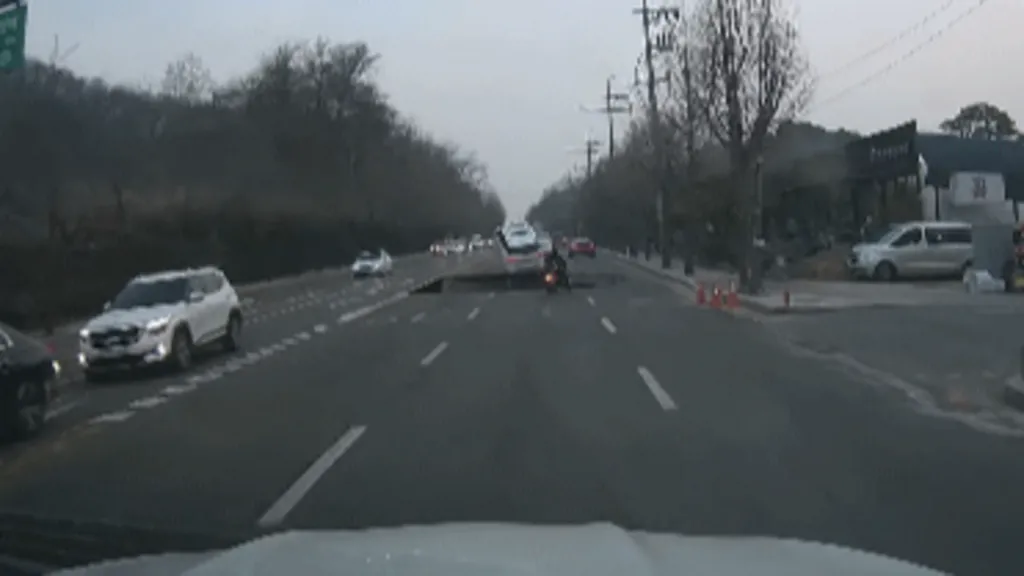
A dashcam video widely circulating online appears to show the moment the road caved in near a traffic junction. It shows the motorcyclist falling into the hole, while a car travelling in front of him narrowly escapes it.
Earlier on Tuesday, rescuers found a mobile phone and the motorcycle in the hole which is 20m wide and 20m deep, according to local media.
The man, said to be in his 30s, has yet to be named by authorities.
Kim Chang-seop, head of Gangdong fire station said at an earlier briefing that there were 2,000 tons of soil and water mixed inside the hole.
Authorities have yet to reveal the cause of the sinkhole.
A report recently submitted to the Seoul city government showed that 223 sinkholes occurred in the city in the past decade.
These were caused by poor infrastructure management, ageing or damaged pipes, long-term subsidence and accidents caused by excavation work.
In January, a truck driver went missing after his vehicle fell into a sinkhole at a junction in the Japanese city of Yashio.
Last August, a search for a woman who disappeared into a pavement sinkhole in Kuala Lumpur's city centre was called off after a week.
One of the most common reasons for a sinkhole is when rocks like limestone or chalk break down. Sometimes this process can happen gradually, where the depression becomes larger over time.
In other instances, the limestone sits below another layer of rock, which means that as it gets dissolved there are no immediate signs at the surface.
The overlying rock, sometimes clay or sandstone, will then suddenly collapse into the depression beneath - this is called a collapse sinkhole.
But human activities such as excavation works can also accelerate the formation of sinkholes or cause the ground to collapse in a similar way.
Latest Stories
-
Ghana makes history with international karting debut
6 minutes -
Livestream: The Law discusses new road traffic rules
32 minutes -
What’s driving men to get penis fillers, despite the risks?
33 minutes -
The world’s oldest president left for a ‘brief stay’ in Europe, he hasn’t returned in two months
1 hour -
Trapped driver rescued after accident on Kintampo–Tamale highway
1 hour -
Civil Service must put citizens at centre of decision-making – Vice President
1 hour -
Firefighters battle blaze at Accra New Town apartment
1 hour -
Ghana receives five new envoys to strengthen diplomatic relations – Ablakwa
2 hours -
Europe’s tallest Virgin Mary statue unveiled in rural Poland
2 hours -
Sammi Awuku denies reports of EOCO arrest
2 hours -
Stonebwoy makes history at OVO Arena Wembley with monumental BHIM Festival
3 hours -
Qatar denies capturing three Iranian pilots after downing fighter jets
3 hours -
Tano North chiefs petition Mahama over galamsey destruction in River Tano
3 hours -
Kalpohin SHS, NOBISCO qualify to represent Northern Region at National Public Speaking Competition
3 hours -
Missing records of illegal gold purchases in Ghana raise concern – Duncan-Williams
4 hours