

Audio By Carbonatix
Why won't India buy even a single bushel of American corn?
That's the question US Commerce Secretary Howard Lutnick raised recently while criticising India's trade policies, taking a swipe at its market restrictions.
In another interview, Lutnick accused India of blocking US farmers and urged it to open its agricultural market - suggesting quotas or limits as a possible approach.
Agriculture is a key battleground in US President Donald Trump's escalating trade war, with tit-for-tat or reciprocal tariffs set to kick in on 2 April.
Tariffs are taxes charged on goods imported from other countries. Trump has repeatedly branded India a "tariff king" and a "big abuser" of trade ties.
For years, Washington has pushed for greater access to India's farm sector, seeing it as a major untapped market. But India has fiercely protected it, citing food security, livelihoods and interests of millions of small farmers.
To be sure, India's transformation from a food-deficient nation to a food-surplus powerhouse is one of its biggest success stories.
In the 1950s and '60s, the country relied on food aid to feed its population, but a series of agricultural breakthroughs changed that. India became self-sufficient in staples, and became the world's largest milk producer. Rapid growth in horticulture, poultry and aquaculture expanded its food basket.
Today, India is not just feeding its 1.4 billion people but, as the world's eighth-largest agri-produce exporter, also shipping grains, fruits and dairy worldwide.
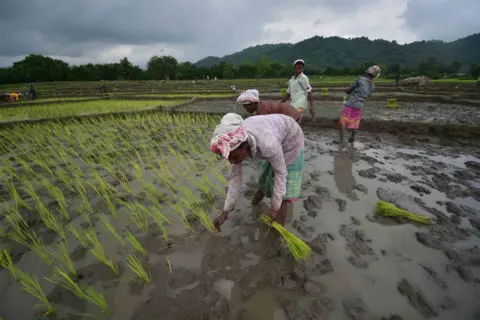
Yet, despite such major gains, Indian agriculture still lags in productivity, infrastructure and market access. Global price volatility and climate change add to the challenge. Crop yields lag far behind the global best. Small landholdings worsen the problem - Indian farmers work with less than a hectare on average, while their American counterparts had over 46 hectares in 2020.
No surprise then that productivity remains low - agriculture employs nearly half of India's workforce but accounts for just 15% of GDP. In comparison, less than 2% of the US population depends on farming. With limited manufacturing jobs, more people are stuck in low-paying farm work, an unusual trend for a developing country.
This structural imbalance also shapes India's trade policies. Despite its farm surplus, India keeps tariffs high to shield its farmers from cheap imports. It maintains moderate to high tariffs - ranging from zero to 150% - on farm imports.
The weighted average tariff - the average duty rate per imported product - in India on US farm products is 37.7%, compared to 5.3% on Indian goods in the US, according to the Delhi-based think tank Global Trade Research Initiative (GTRI).
Bilateral farm trade between India and the US is modest, at just $8bn (£6.2bn).
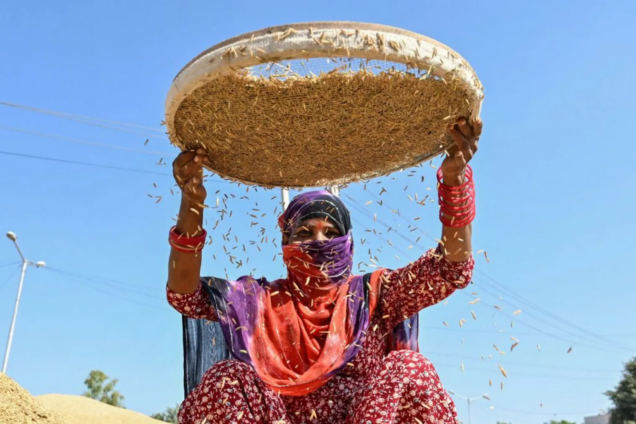
India mainly exports rice, shrimp, honey, vegetable extracts, castor oil and black pepper, while the US sends almonds, walnuts, pistachios, apples and lentils.
But as the two countries work on a trade deal, experts say Washington now wants to push "big-ticket" farm exports - wheat, cotton, corn and maize - to narrow its $45bn trade deficit with India.
"They're not looking to export berries and stuff this time. The game is much bigger," says Biswajit Dhar, a trade expert from the Delhi-based Council for Social Development think tank.
Pushing India to lower farm tariffs, cut price support and open up to genetically modified (GM) crops and dairy ignores the fundamental asymmetry in global agriculture, experts argue.
The US, for instance, heavily subsidises its agriculture and protects farmers through crop insurance.
"In some cases," says Ajay Srivastava of GTRI, "US subsidies exceed 100% of production costs, creating an uneven playing field that could devastate India's smallholder farmers."
Farming is India's backbone, supporting over 700 million people, nearly half the country's population.
"The key thing to remember is that agriculture in the two countries is entirely different," says Abhijit Das, former head of the Centre for WTO Studies at the Indian Institute of Foreign Trade.
"The US has commercial agriculture, while India relies on intensive, subsistence farming. It's a question of the livelihoods of millions of Indians versus the interests of US agribusiness."
But India's agricultural challenges aren't just external. Mr Dhar says much of the sector's struggles are "its own doing". Farming has long been underfunded, receiving less than 6% of India's total investment - funds meant for infrastructure, machinery and other long-term assets crucial for growth.
To protect millions of livelihoods, the government shields key crops like wheat, rice and dairy with import duties and price support. "But even that doesn't inspire confidence," he says.
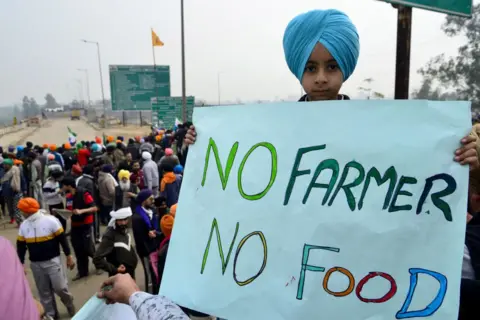
Four years ago, tens of thousands of farmers held protests demanding better prices and legal guarantees of minimum government support-price for staples, mainly wheat and rice.
"Even relatively well-off farmers selling surpluses don't see a turnaround anytime soon. And if they feel that way, imagine the plight of subsistence farmers," says Mr Dhar.
Beyond domestic discontent, trade negotiations add another layer of complexity.
Mr Das says the real challenge for India will be how "to have an agreement with the US that takes into account US export interest in agriculture while balancing India's interests in the farm sector".
So what's the way forward?
"India must not yield to US pressure to open its agriculture sector," says Mr Srivastava. He warns that doing so would disrupt millions of livelihoods, threaten food security and flood local markets with cheap imports.
"India must prioritise its national interest and protect its rural economy. Trade cooperation should not come at the cost of our farmers, food sovereignty or policy autonomy."
In the long run, experts say India must modernise its agriculture, making farming more remunerative, and become more competitive to boost exports. Unupom Kausik of agri-business Olam estimates that with top global yields, India could generate a surplus of 200 million metric tonnes of paddy - enough to supply global trade and combat hunger.
"In a way, Trump is holding up a mirror to us. We've done little to invest in agriculture's productive capacity," says Mr Dhar. "For now, buying time is the best strategy - maybe offering the US cheaper imports of industrial goods as a trade-off."
But for the best outcome, he says, India will have to "play hardball. Basically, tell the US - we're open to negotiations on other fronts, but don't destabilise our agriculture".
Clearly India's challenge is to negotiate from a position of strength - offering just enough to keep Washington at the table while safeguarding its rural backbone. After all, in global trade as in farming, timing and patience often yield the best harvest. The jury is out on whether Trump is willing to wait.
Latest Stories
-
Domelevo backs OSP probe into GH¢70k allegation
9 minutes -
CAF Confederation Cup: Dennis Korsah confident Nations FC can overturn Mali defeat
24 minutes -
‘Avoid political comments’ – Domelevo advises Chief Justice
1 hour -
‘I don’t trust OSP’ to probe GH¢70k ‘bribe’ allegation – Kwasi Kwarteng
1 hour -
Road inspections not to witch-hunt contractors – Kwame Agbodza
2 hours -
Inter Milan mount stunning comeback to beat Napoli
2 hours -
Modric plans to play for Croatia past 41st birthday
2 hours -
Bayern fail to score for first time in 59 games
2 hours -
Bawumia preparing new cocoa policy package for farmers – Annoh-Dompreh
2 hours -
Wa-Tumu-Bolga road upgrade will unlock agriculture, trade – Agbodza
2 hours -
Ghana Maritime Authority readies oil-spill response vessel for deployment
2 hours -
Ayariga turns to drones, AI to tackle Agbogbloshie waste mountain
2 hours -
Agbogbloshie waste heap must go – Mahama Ayariga declares
3 hours -
Government to upgrade all rural telephony sites to 4G – Communications Minister
3 hours -
Rural calls, data to become cheaper by Q1 2027 – Sam George
3 hours