

Audio By Carbonatix
Climate change is intensifying, as global temperatures continue to break records, with extreme weather events like droughts, floods, and storms becoming more frequent and intense, undermining socio-economic development.
According to scientists, ocean heat content has reached a new high, contributing to alarming sea-level rise and coral bleaching with significant implications for coastal communities and ecosystems.
Ghana is highly vulnerable to climate change impacts due to its dependence on climate-sensitive sectors like agriculture, energy, and forestry.
The Volta Basin's water volume is predicted to decrease by 24% and 45% by 2050 and 2100, respectively, affecting hydropower generation and access to clean drinking water.
The country's greenhouse gas emissions are relatively low, accounting for only about 0.1% of global emissions, but the effects of climate change are already being felt.
Since 1960, Ghana has experienced a 1.0 °C increase in temperature, with the northern regions warming more rapidly than the southern regions. Rainfall patterns are becoming increasingly unpredictable, with droughts and floods affecting different parts of the country.
Flooding impacts around 45,000 Ghanaians every year – the country’s coastline is experiencing erosion and flooding due to sea-level rise, with a projected surge of 5.8 cm, 16.5 cm, and 34.5 cm by 2020, 2050, and 2080, respectively.
Displacements in coastal areas
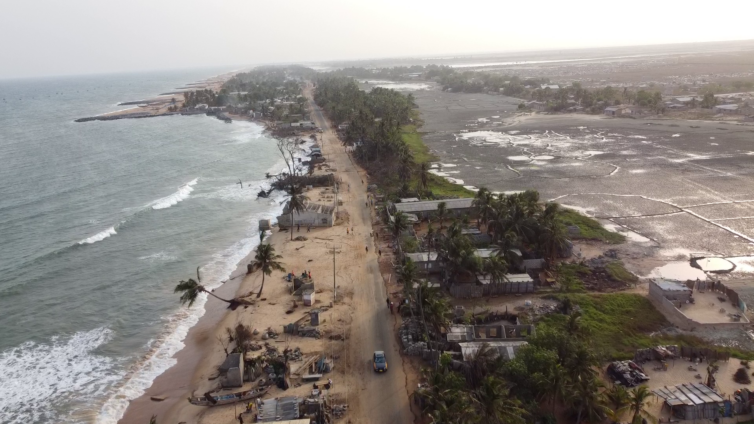
Ghana’s coastal communities are grappling with the severe impacts of climate change, particularly rising sea levels and intensified tidal waves. These environmental challenges have led to significant coastal erosion, threatening homes, livelihoods, and the very existence of these communities.
In Agavedzi, a coastal town in the Ketu South District of the Volta Region, residents have witnessed their homes and ancestral lands being swallowed by the sea. The community has suffered the loss of over 50 houses in recent weeks, displacing approximately 300 people.
The erosion has unearthed cemeteries, forcing the reburial of over 100 bodies. Despite appeals for government intervention, such as the construction of sea barriers, assistance has been limited, leaving residents vulnerable to further devastation.
The destruction of homes has not only displaced families but also disrupted local economies. For instance, in Agavedzi, an eatery owner faces the collapse of her business premises, threatening her livelihood. The psychological toll is equally profound, with residents expressing feelings of sadness, depression, and uncertainty about the future.
Beyond coastal erosion, Ghana's coastal regions are also burdened by environmental degradation due to pollution.
In Accra, areas like Old Fadama have become dumping grounds for textile waste, contributing to the pollution of water bodies such as the Korle Lagoon.
This pollution not only harms marine ecosystems but also exacerbates the vulnerability of coastal communities to climate change impacts.
Call to Action
The plight of Ghana's coastal communities underscores the urgent need for comprehensive climate adaptation strategies. This includes the construction of sea defenses, implementation of sustainable waste management practices, and support for affected populations.
As climate change continues to pose existential threats to coastal regions, Ghana must prioritize the protection and empowerment of its coastal communities to safeguard their future.
Engaging local communities in climate resilience planning is crucial to ensure that interventions are effective and culturally appropriate.
Residents of Coastal communities should also be proactive in safeguarding their future against climate change by protecting and restoring coastal ecosystems like mangroves, salt marshes, and seagrasses.
The communities can also implement strategies like eco-friendly fishing methods to maintain fish populations, creating marine reserves and protected coastal zones to preserve critical habitats, and restoring mangrove forests to stabilize shorelines and rebuild habitats.
Latest Stories
-
Tribunals alone will not fix delays in Ghana’s courts; funding is the real solution – CLRL
6 minutes -
South Africa says more than 53,000 foreigners deported in migration campaign
11 minutes -
Thousands may have died in UK’s exceptional May and June heatwaves
20 minutes -
At least 27 killed, eight critically injured in Bangkok bar fire
28 minutes -
Will Trump Accounts deliver for American children?
37 minutes -
US insists Strait of Hormuz is open as it exchanges strikes with Iran
46 minutes -
Infantino opens door to 64-team World Cup
5 hours -
Sinner says successful Wimbledon defence sweet after French Open shock
5 hours -
England have another level we can reach – Kane
5 hours -
Sinner holds off Zverev to defend Wimbledon title
5 hours -
Rice in bed for nearly three days before Norway game – Tuchel
6 hours -
Argentina midfield great Rattin dies aged 89
6 hours -
Miss Ghana 2026 contestants join national clean-up exercise to promote civic responsibility
6 hours -
Fifa official refuses to answer BBC’s Balogun ban questions
6 hours -
Rev Stephen Wengam urges sustained prayer for revival at Guyana Assemblies of God Council
6 hours