

Audio By Carbonatix
Three months into Donald Trump's second term, foreign leaders should be aware that a coveted trip to the Oval Office comes with the risk of a very public dressing down, often straying into attempts at provocation and humiliation.
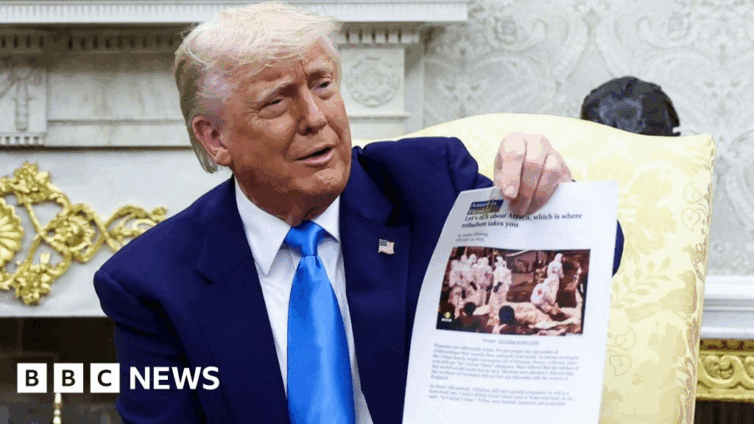
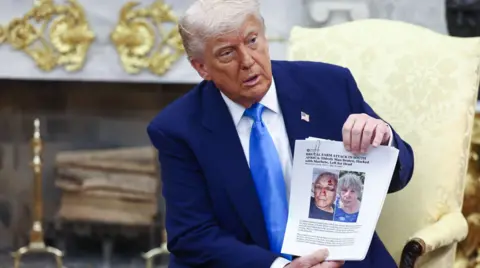
Wednesday's episode with South Africa's President Cyril Ramaphosa was a classic of its kind, with the added twist of an ambush involving dimmed lights, a lengthy video screening and stacks of news story clippings.
As television cameras rolled, and after some well-tempered discussion, Trump was asked by a journalist about what it would take for him to be convinced that discredited claims of "white genocide" in South Africa are untrue.
Ramaphosa responded first, by saying the president would have to "listen to the voices of South Africans" on the issue. Trump then came in, asking an assistant to "turn the lights down" and put the television on, so he could show the South African leader "a couple of things".
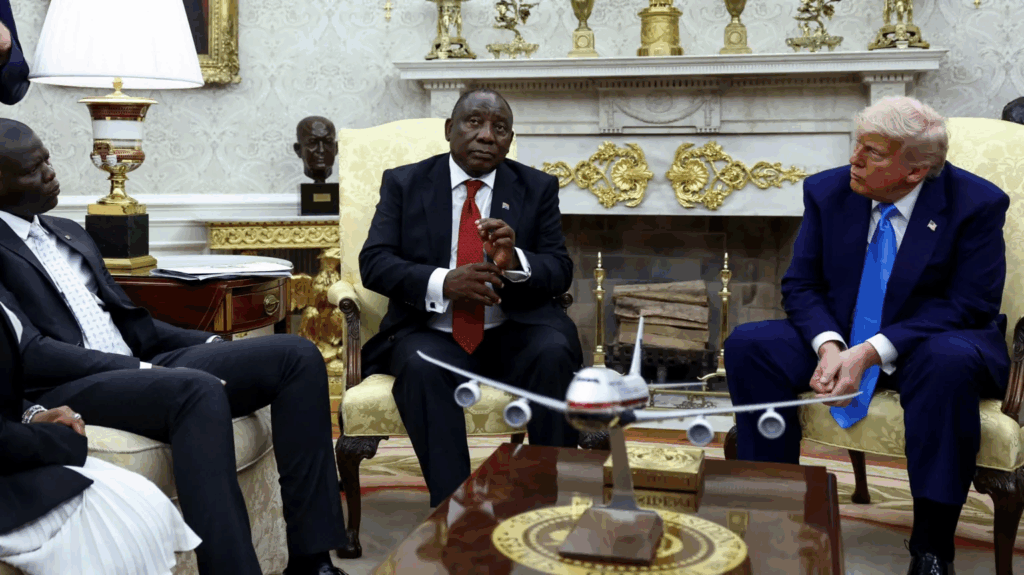
Elon Musk, his adviser and a South Africa-born billionaire, watched quietly from behind a couch.What followed was an extraordinary and highly choreographed onslaught of accusations from the US president about the alleged persecution of white South Africans, echoing the aggressive treatment of Ukraine's leader Volodymyr Zelensky during his February visit to the White House.
The footage on the large screen showcased South African political firebrands chanting "Shoot the Boer", an anti-apartheid song. And Trump, so often critical of the news media, seemed happy to parade pictures of uncertain provenance. Asked where alleged grave sites of white farmers were, he simply answered, "South Africa".
The US leader also seemed to believe the political leaders in the footage - who are not part of the government - had the power to confiscate land from white farmers. They do not.
While Ramaphosa did sign a controversial bill allowing land seizures without compensation earlier this year, the law has not been implemented. And the South African distanced himself publicly from the language in the political speeches shown.
But the top ally of South Africa's Nelson Mandela and negotiator who helped bring an end to the apartheid regime of white-minority rule came to this meeting prepared.
Trump sometimes appears unaware of transparent efforts made by foreign leaders to flatter and that was clearly part of the South African strategy.
True, Donald Trump is a golf fanatic, but Ramaphosa's gambit of bringing two top golfers – Ernie Els and Retief Goosen - to a meeting about diplomatic problems and trade policy is not taken from any textbook on international relations I've ever read.
However, the US president's pleasure at having the two white South African golfers there was on show for all to see.
Their prognostications on the fate of white farmers got nearly as much screen time as South Africa's democratically-elected president, who largely restricted himself to quiet, short interventions.
But Ramaphosa will likely be happy with that. The golfers, along with his white agriculture minister, himself from an opposition party which is part of the national unity government, were there, at least in part, as a shield - a kind of diplomatic golden dome if you will, and it worked.
Trump returned repeatedly to the issue of the plight of the farmers – dozens of whom he has welcomed into the US as refugees. But President Ramaphosa wasn't biting and the provocations were largely left to blow in the breeze.
At one point, he referred to the golfers and an Afrikaner billionaire who had joined his delegation, telling Trump: "If there was Afrikaner farmer genocide, I can bet you, these three gentleman would not be here."
But even though President Trump didn't manage to get a rise out of the South African president, that does not mean his efforts over more than an hour were in vain; they certainly were not.
This performative style of diplomacy is aimed as much at the domestic American audience as it is at the latest visitor to the Oval Office.
Central to the Make America Great Again (MAGA) project is keeping up the energy around perceived grievances and resentment and President Trump knows what his supporters want.
If some foreign leaders are learning to navigate these moments with skill, Donald Trump may have to change the playbook a bit to continue to have the impact he wants.
Latest Stories
-
First National Bank Ghana pioneers financial literacy programme for Persons with Disabilities
22 minutes -
Assembly members demand Bosomtwe DCE’s removal over alleged overspending, DRIP misuse
22 minutes -
‘Mature’ Danlad ready to make impact after Kotoko return
23 minutes -
GES investigates alleged sexual misconduct involving Mim SHS security officer
28 minutes -
Uncontrolled market pricing driving Ghana’s high cost of living — TUC’s Dr Otoo
31 minutes -
TOR’s revival and Ghana’s Petroleum Hub dream
34 minutes -
“We will not borrow simply because financing is available” – Ato Forson
1 hour -
Morgan International Community School marks 13th anniversary, celebrates 10th graduating class
1 hour -
Passport application website temporarily unavailable due to technical challenges
1 hour -
Bond market: Activity weakens as turnover fell by 58%
1 hour -
Ghanaian defender Oscar Naasei to join Real Madrid
1 hour -
Titus-Glover files nomination today to contest NPP National Organiser position
1 hour -
Interior Ministry introduces TraffiTech to track and penalise road traffic offenders
1 hour -
Rising demand for T-bills to be sustained, yields to compress further
1 hour -
Palmer and Rodgers star in Chelsea win over Fulham
2 hours