

Audio By Carbonatix
As Ghana grapples with an elevated public debt-to-GDP ratio, hovering around 85% by late 2024, and navigates stringent fiscal reforms mandated by its Extended Credit Facility (ECF) programme with the International Monetary Fund (IMF), a heated debate has erupted over the proposed establishment of an Independent Fiscal Council.
Amidst discussions envisioning this new body as a cornerstone for long-term fiscal discipline, prominent legal practitioner Professor Stephen Kwaku Asare (popularly known as Kwaku Azar) has vehemently shot down the idea, branding it as an unnecessary, costly, and counterproductive duplication of existing state functions.
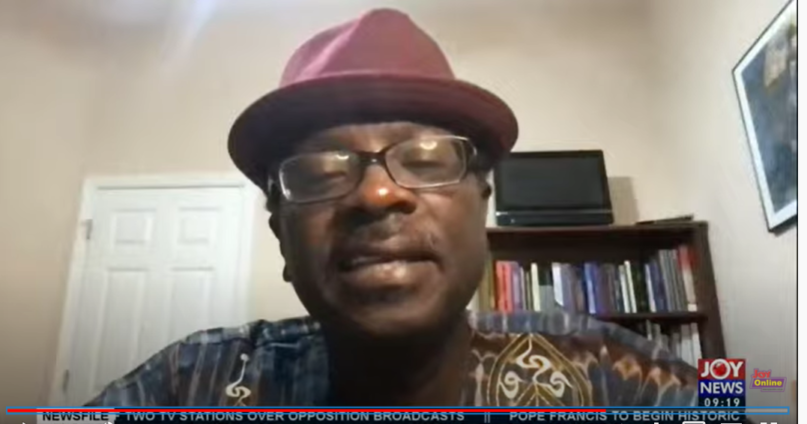
Writing from his base in the United States, Prof. Asare, a distinguished professor of accounting, argued forcefully in a social media post on Sunday, June 1, that the impetus for new oversight bodies like a Fiscal Council reflects a persistent flaw in Ghana's governance philosophy: an ingrained "institutional fetish" for creating new structures rather than fortifying established ones.
He estimates that setting up such a council, complete with a board of 7-9 members, a secretariat, salaries, logistics, and office infrastructure, could drain the national coffers by an estimated GH₵15-20 million annually.
"We have a penchant for creating new institutions for old problems," Prof. Asare observed. "This approach duplicates existing mandates, muddies responsibility and accountability, and risks becoming tools of patronage masked as technocratic solutions."
He asserted that the critical functions envisioned for a Fiscal Council – including fiscal compliance, forecasting, and policy oversight – are already embedded within the mandates of existing institutions.
He pointed to the Auditor-General's Department, tasked with ensuring financial transparency and adherence to regulations; the Ministry of Finance, responsible for macroeconomic forecasting and policy design; and parliamentary committees, which exercise oversight and scrutiny over government spending and fiscal policy.
Instead of enhancing coordination and fiscal discipline, Prof. Asare warned that the introduction of a new council could inadvertently delay decision-making processes and inflate the overall cost of governance without delivering any tangible improvements in fiscal outcomes.
As a more efficient and impactful alternative, Kwaku Azar advocated for a strategic investment in augmenting the analytical and forecasting capacities of current institutions, particularly the Auditor-General's Department and the Budget Office.
He suggested that a "modest investment" – perhaps a 15-20% increase in their current operational budgets, specifically earmarked for acquiring advanced fiscal modelling software and training a dedicated team of 20-30 economic and financial analysts – could empower these existing bodies to fully absorb the proposed functions of a Fiscal Council, legally, operationally, and independently.
"We must resist the impulse to solve every reform challenge by creating a new committee," he cautioned. "Creating new structures while neglecting existing ones reflects a misplaced confidence in form over function."
Prof. Asare maintained that while the concept of an Independent Fiscal Council might be well-intentioned, its implementation in the Ghanaian context would ultimately prove redundant.
He firmly believes it should be shelved in favour of a concentrated effort to bolster the technical capabilities and independence of Ghana's already established fiscal oversight bodies, thereby ensuring more effective and sustainable fiscal management.
Latest Stories
-
Twelve Tribes of Israel Ghana to mark 40 years with anniversary celebration
31 minutes -
GPL 2026/27: Hearts held by Bechem as Kotoko, Samartex share spoils
52 minutes -
My Story (Kwaku Antwi-Boasiako)
58 minutes -
We expect growth rate to re-accelerate in second-half of 2026 – IC Insights
1 hour -
The ungodliness and unrighteousness underlying the National Cathedral mess!
1 hour -
T-bills auction: Government fails to achieve target; yield on 91-day-bill remains unchanged
1 hour -
It’s Ghana’s shame to denigrate Nkrumah when the whole world honours him as African of the Century – Asiedu Nketiah
2 hours -
No other nationalist can compare to Nkrumah – Asiedu Nketiah
2 hours -
Collateral Registry: Foreign banks accounted for GH¢19.9bn of secured credit in quarter 2, 2026
2 hours -
This government should expect scrutiny – Asiedu Nketiah
2 hours -
Two-year-old girl dies in domestic fire at Cantonments
3 hours -
Asiedu Nketiah urges better working conditions for journalists
3 hours -
JoyNews’ Precious Semevoh wins climate change reporting award at Bono GJA Awards
3 hours -
Kumasi Central Market phase 2 to begin in October after years of abandonment
3 hours -
Sentuo offers fuel supply reassurance as NPA sees steady output through December
4 hours