

Audio By Carbonatix
The world's oldest boomerang is older than previously thought, casting new light on the ingenuity of humans living at the time.
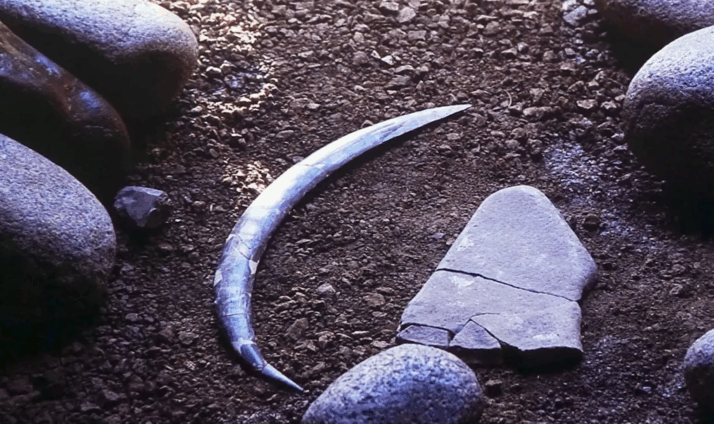
The tool, which was found in a cave in Poland in 1985, is now thought to be 40,000 years old.
Archaeologists say it was fashioned from a mammoth's tusk with an astonishing level of skill.
Researchers worked out from its shape that it would have flown when thrown, but would not have come back to the thrower.
It was probably used in hunting, though it might have had cultural or artistic value, perhaps being used in some kind of ritual.
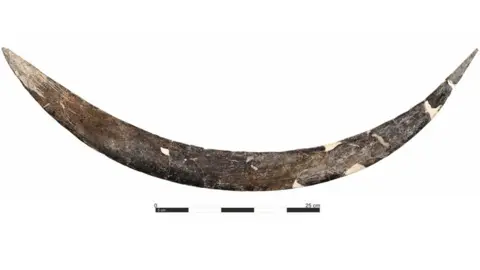
The mammoth ivory boomerang was unearthed in Oblazowa Cave in southern Poland.
It was originally thought to be about 30,000 years old. But new, more reliable radiocarbon dating of human and animal bones found at the site puts the age at between 39,000 and 42,000 years old.
"It's the oldest boomerang in the world, and the only one in the world made of this shape and this long to be found in Poland," said Dr Sahra Talamo of the University of Bologna, Italy.
It gives a "remarkable insight" into human behaviour, she said, particularly how Homo sapiens living as long as 42,000 years ago could shape "such a perfect object" with the knowledge it could be used to hunt animals.
The boomerang is exceptionally well preserved, with score marks suggesting it had been polished and carved for use by a right-handed individual.

Boomerangs are generally associated with Aboriginal culture in Australia.
However, rare finds in the historical record outside Australia suggest they were used across different continents.
The oldest known boomerang from Australia dates to about 10,500 years ago, made from wood. But the oldest images of boomerangs in Australia are rock art paintings 20,000 years old, according to the National Museum of Australia.
A wooden boomerang dating back 7,000 years has been found in Jutland, a peninsula between Denmark and Germany, while fragments of a 2,000-year-old oak boomerang, which does come back, has been found in The Netherlands.
The research by a team of scientists from Poland, Italy, Germany, France, Switzerland and the UK is published in the journal PLOS One.
Latest Stories
-
Telecel Foundation marks Fetu Afahye with HealthFest
21 minutes -
IEAG calls for urgent intervention to decongest ports
30 minutes -
Strong financial, technical capacity non-negotiable for Accra-Kumasi Expressway – Agbodza
41 minutes -
Ghana risks losing import trade to Abidjan – IEAG
52 minutes -
Driver fined GH¢900 for dumping concrete on Madina-Adenta Highway
1 hour -
Police interdict officer over death of 23-year-old law student
1 hour -
Accra-Kumasi Expressway: Only nation-wreckers will oppose project – Frank Amoakohene
2 hours -
Emerging agri-journalists gather in Croatia for global event
3 hours -
PPI Ghana congratulates Dr Abdul-Baasit Aziz-Bamba: Ghana needs a proper reset on value for money
3 hours -
Kasise Ricky Peprah writes: GBA’s face must be called out – for the record
3 hours -
Bernice Offei battled dementia for five years before death, former manager reveals
3 hours -
Jordan Ayew’s return offers Ghana timely boost ahead of AFCON qualifiers
3 hours -
De Zerbi raises doubts over Kudus’ availability for Ghana’s AFCON qualifiers
3 hours -
Ghana’s reputation must not be dented by self-centred individuals – Madina MP on cocaine seizure
3 hours -
MTN Ghana pushes digital growth for SMEs as sixth business clinic ends in Accra.
3 hours