

Audio By Carbonatix
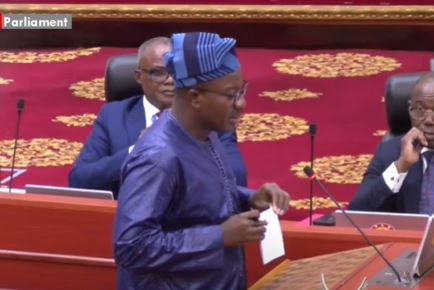
The Majority Leader, Mahama Ayariga, has defended the Public Utilities Regulatory Commission’s (PURC) recent decision to raise electricity tariffs by 2.45%, describing the move as a necessary measure to prevent the collapse of the Electricity Company of Ghana (ECG).
He asserted that the tariff increment forms part of a broader government strategy aimed at alleviating ECG’s mounting financial burden.
Addressing Parliament on Friday, 27 June, Mr Ayariga explained that while economic indicators such as inflation, the exchange rate, and fuel prices have remained relatively stable, the tariff adjustment is essential to enable ECG to generate sufficient revenue to sustain operations.
Without this intervention, he warned, the nation risks facing power outages due to ECG’s inability to meet its operational costs.
“Last year, there was an effort made to prevent the PURC from adjusting the tariff; due to that, there was no adjustment for the whole period. ECG is accumulating huge debt, and it has to be paid for, and if we do not adjust the tariff to enable ECG to pay, ECG will collapse,” he cautioned.
“They won’t be able to buy the input needed to keep the generators on, and we are going to have power outages.”
His defence came in response to concerns expressed by the minority caucus, who questioned the logic of a price increase amidst a relatively stable macroeconomic climate.
In response, Mr Ayariga maintained that economic progress alone does not erase ECG’s outstanding debts, which must ultimately be addressed, at least in part, through consumer contributions.
He assured the House that the Minister for Energy and Green Transition would appear before Parliament in the coming week to provide additional details on the review process. “The bill has to be paid,” he reiterated.
“So if PURC is doing its work, I do not think there is a basis for saying that because we have improved the economy, it doesn’t mean that the debt at ECG will just be whisked away. The bill has to be paid partly by consumers.”
The tariff increase, which comes into effect from 1 July 2025, has sparked mixed reactions from civil society groups, industry players, and consumer advocates.
Latest Stories
-
Ghana needs a law to sustain constitutional reforms – CDD-Ghana
3 hours -
COVID fumigation audit: Auditor-General has a lot of questions to answer – Akwatia MP
3 hours -
Stranded Ghanaian medical graduates in Cuba appeal to Mahama for immediate return
3 hours -
GNFS contains fire outbreak at Teshie Lekma Road near Lekma Hospital
9 hours -
Samia Nkrumah rejects the narrative that Ghanaians were happy after Nkrumah’s overthrow
10 hours -
A Mother’s pain: Tribute by Ivan Baidoo’s mother
11 hours -
‘Forgive us for staying away’ — Samia Nkrumah leads family back to Nkroful, pledges to preserve Nkrumah’s legacy
11 hours -
Ernest Nuamah scores twice as Lyon beat Rennes
11 hours -
‘My dear Ivan’ – A father’s tribute to a son tragically killed
11 hours -
GNPC Explorco advances Voltaian Basin drilling preparations with 13.5km access road
11 hours -
Cabinet approves facility manager for Borteyman Sports Complex – Kofi Adams
12 hours -
Sanitation is improving; critics may be ‘living in another world’ – Salaga South MP replies Bekwai MP
12 hours -
Government must do more to tackle sanitation crisis – Bekwai MP
12 hours -
World Cleanup Day: GFF begins sanitation education in local communities
12 hours -
EU Ambassador, IGP discuss stronger cooperation on policing and security
12 hours