

Audio By Carbonatix
President John Dramani Mahama has traced the roots of Ghana’s 24-hour economy initiative to deep reflection and lessons learned from his previous term in office, describing it as a transformative response to the country’s economic challenges and a blueprint for inclusive growth.
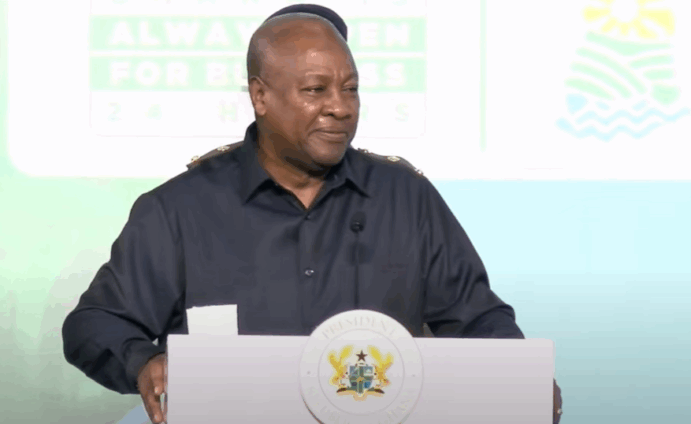
Speaking at the official launch of the 24-hour economy policy in Accra, President Mahama revealed that the vision emerged from Ghana’s long-standing struggle with an imbalanced economic model—exporting raw materials cheaply while importing expensive refined goods.
“So what are the origins of the 24-hour vision? The visions behind the 24-hour economy and the Accelerated Export Development Programme was born from reflection during and after my previous term in office,” he said.
“Between 2016 and 2020, it became increasingly clear that Ghana, like many African countries, is trapped in a model of unequal exchange. We export raw materials and we import refined finished products. We ship cocoa, gold, timber and oil abroad only to repurchase them as chocolate, jewellery, furniture and fuel at a far greater cost.”
President Mahama was unflinching in his critique of this outdated system.
“This model does not serve our people. It has never served our people. It generates foreign jobs, it fuels foreign economies, and funds foreign healthcare and education systems—while our youth remain unemployed, our industries stagnate, and our imports balloon.”
While highlighting the strides made by his administration in energy, infrastructure, ICT, and human capital, he emphasized that these foundations needed to be part of a larger, more integrated plan.
“We had laid the essential foundation then for energy and infrastructure, for roads, for ICT systems, and human capital investment. But we knew that we needed to go further. And that meant we needed an integrated, bold and coherent approach that dismantles the silos of past policies,” Mahama stated. “The 24-Hour Plus Program is that collective answer.”
What began as a policy concept soon captured national imagination.
“In 2020 and 2024, the idea of the 24-hour economy captured national attention. It became a slogan of hope, a symbol that change was necessary and possible,” he said. “Our task now is to move from vision to implementation, from aspiration to action. This launch is not the end but it is the beginning of a massive national mobilization.”
At the launch, Presidential Advisor on the programme, Mr. Goosie Tanoh, who also coordinated the programme’s development, paid tribute to the diverse and dedicated teams behind the initiative.
He noted that the programme was “framed, developed, tested, written up, and illustrated by a dedicated, talented, and youthful workforce, along with a professional team, between January and May 2025.”
“Their ages range from 24 to 69 years old. I am personally grateful to every member of the Secretariat—for your faith in Ghana, your long nights, your imagination, your competence. I could not have asked for a better team,” he said.
Mr. Tanoh also praised the leadership of President Mahama, crediting him with providing the vision that propelled the initiative forward.
“We must acknowledge the presidency—the leadership of President Mahama—whose vision for a productive, prosperous, integrated, innovative, and equitable society has driven the development of this program.”
He added that the vision did not emerge in isolation, citing the important role of the NDC’s 2024 Manifesto Committee, chaired by Danso Baffoe, now Cabinet Secretary.
“Special tribute is due to the members of the 24-Hour Economy Taskforce Team and the Jobs and Employment Sub-Committee of the manifesto committee. Thank you for your remarkable efforts, your dedication, and contributions. They are deeply appreciated” he said.
Latest Stories
-
Imaging professionals trained on Ghana’s first paediatric cancer imaging protocol
1 minute -
‘Bawumia will become President whether NDC likes it or not’ – Amin Adam
2 minutes -
Financial irregularities in some state institutions drop significantly to GHC 7.69 billion in 2025 – Nyarko Ampem
3 minutes -
Gov’t challenges ABL’s claim that beer tax changes threaten 2,000 jobs
28 minutes -
Ghana’s small businesses don’t have a marketing problem. They have a capacity problem.
32 minutes -
GNFS intensifies fire safety campaigns across Eastern Region
33 minutes -
One dead and more than a dozen missing after ‘terrifying’ flash flood hits Grand Canyon
43 minutes -
Full Report: SIGA releases 2025 State Ownership Report on performance of state entities
48 minutes -
Messi retires from international football
52 minutes -
Accra Institute of Technology holds 22nd graduation as 572 students graduate and PhD alumni surpass 100
52 minutes -
Metro Mass Transit returns to profit as revenue rises to GH¢161.85m
57 minutes -
Barcola joins Liverpool from PSG in £123m move
60 minutes -
GOIL profit rises to GH¢90.67m despite 9% revenue decline
1 hour -
Aid system is broken, African Civil Society leaders say; 200 gather in Accra to build a new Africa-Led model
1 hour -
TrustGH records more than 6,000 ‘scam’ numbers as TikTok emerges a major fraud channel in Accra, Ghana
1 hour