

Audio By Carbonatix
As the world’s second-largest cocoa producer, Ghana plays a crucial role in the global cocoa industry. However, the sector faces complex, interconnected challenges, including climate change, child labour, deforestation, low farmer incomes, market volatility, unsustainable practices and more recently, illegal gold mining.
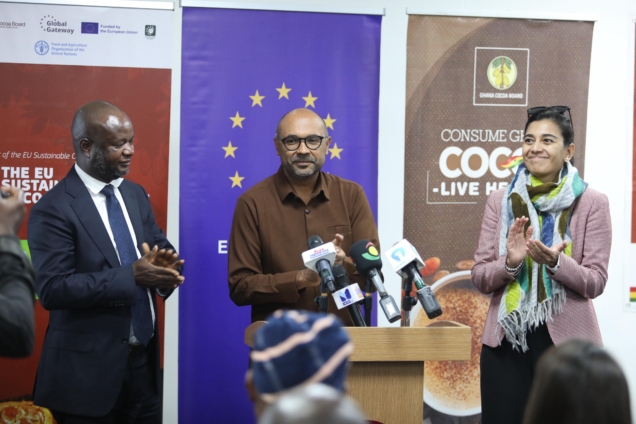
To address these challenges, the Ghana Cocoa Board (COCOBOD), working in collaboration with private sector actors, civil society and with financial support from the European Union and both technical and financial support from the Food and Agriculture Organization (FAO) under the EU Sustainable Cocoa Initiative and Programme, have launched the Ghana Cocoa Monitor (GCM).
The Ghana Cocoa Monitor will serve as a multi-actor platform for cooperation, dialogue and collective, evidence-driven decision-making. Its goal is to bridge institutional gaps, align policies, foster inclusive dialogue and coordinate sustainable cocoa initiatives across the country.
During its launch, Director of Research of the Ghana Cocoa Board (COCOBOD), Dr. Isaac Manu, explained that the GCM aims to consolidate data, track progress, promote transparency and ensure that decisions are guided by evidence and informed by the voices of all key actors, from small-scale farmers to the largest processing company.
He emphasized that the GCM is a key instrument to ensure that every policy and intervention is aligned with the imperative of sustainable cocoa production.
“Cocoa is not just a crop in Ghana, it is a national treasure. Cocoa is woven into the fabric of our economy, our communities and the livelihoods of over 1.5 million households.”
A platform for evidence-based, inclusive action
The GCM is designed to strengthen effective public-private partnerships, facilitate structured dialogue and address sector-wide challenges while unlocking opportunities for sustainable growth.
EU Ambassador to Ghana, Irchad Razaaly said, “the cocoa sector is not just the backbone of Ghana’s economy, it is the livelihood of millions of farming households, the source of cultural identity and a product that connects Ghana to consumers across Europe and the world. But we also recognize the challenges: environmental degradation, child labour, low farmer incomes and market vulnerabilities that demand collective and coordinated responses.”
He added, “That is why the European Union, through our Sustainable Cocoa Initiative, is proud to support the establishment of the Ghana Cocoa Monitor. This platform represents a turning point, a shift from fragmented efforts to structured collaboration. From working in silos to building partnerships. From isolated impact to collective progress.”
To ensure that the GCM reflects sector-wide priorities, FAO has adopted an inclusive, evidence-based approach, consulting over 100 stakeholders, including farmer groups, government agencies, private sector actors, NGOs and academia, through surveys and interviews. Their insights helped shape the platform’s design and functionality, helping to place farmers and sustainability at the heart of cocoa sector development.
FAO Representative ad interim, Priya Gujadhur acknowledged the broader context saying, “Ghana has made significant progress in improving its cocoa value chain’s environmental, economic and social outcomes. However, challenges such as deforestation, child labour, climate vulnerability and low farmer incomes persist. Despite broad engagement, lack of coordination has caused also inefficiencies and missed opportunities.”
She emphasized the GCM’s role in addressing these challenges, “The Ghana Cocoa Monitor is a transformative tool that promotes inclusive dialogue, aligns sustainability initiatives and enhances transparency to and coherence across the sector.”
Gujadhur also highlighted FAO’s integrated support, “FAO is pleased to contribute both technical expertise and financial support. This support goes even beyond, encompassing strategic guidance, capacity building and institutional strengthening, aimed at empowering Ghanaian institutions to take full ownership and ensure lasting.”
The Ghana Cocoa Monitor will guide decision-making, monitor progress and help Ghana lead sustainable cocoa production, not just to meet international standards but to support thriving communities and resilient farming systems.
Latest Stories
-
GNFS contains fire outbreak at Teshie Lekma Road near Lekma Hospital
4 hours -
Samia Nkrumah rejects the narrative that Ghanaians were happy after Nkrumah’s overthrow
5 hours -
A Mother’s pain: Tribute by Ivan Baidoo’s mother
5 hours -
‘Forgive us for staying away’ — Samia Nkrumah leads family back to Nkroful, pledges to preserve Nkrumah’s legacy
6 hours -
Ernest Nuamah scores twice as Lyon beat Rennes
6 hours -
‘My dear Ivan’ – A father’s tribute to a son tragically killed
6 hours -
GNPC Explorco advances Voltaian Basin drilling preparations with 13.5km access road
6 hours -
Cabinet approves facility manager for Borteyman Sports Complex – Kofi Adams
7 hours -
Sanitation is improving; critics may be ‘living in another world’ – Salaga South MP replies Bekwai MP
7 hours -
Government must do more to tackle sanitation crisis – Bekwai MP
7 hours -
World Cleanup Day: GFF begins sanitation education in local communities
7 hours -
EU Ambassador, IGP discuss stronger cooperation on policing and security
7 hours -
Africa Nations Volleyball Championship: Ghana set up quarterfinal clash with Cameroon after beating Chad
7 hours -
Meet Dr Benjamin Appiah Osei — Ghana’s three-time tourism awards winner
8 hours -
UEFA & CONCACAF demand Fifa pays $10m to all 211 members
8 hours