

Audio By Carbonatix
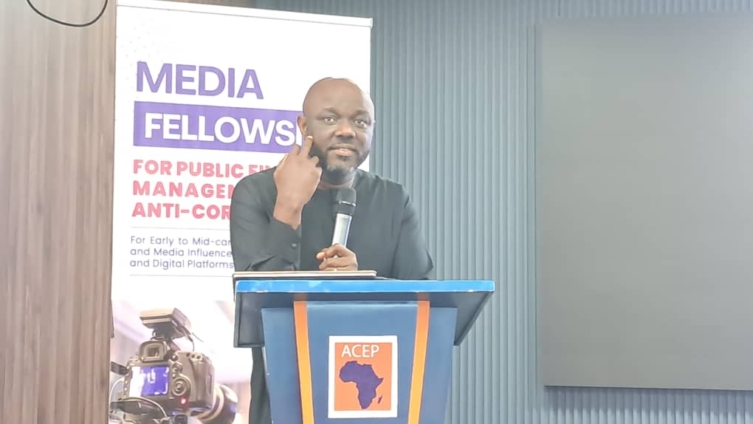
Executive Director of the Africa Centre for Energy Policy (ACEP), Benjamin Boakye, has challenged the media and civil society to intensify their role in demanding accountability from duty bearers, stressing that effective resource prioritisation is the key to transforming Ghana’s infrastructure and social services.
Speaking at a two-day Media Fellowship organized by ACEP for selected journalists from across the country, Mr. Boakye said that if the country could trace and improve the use of its financial resources, Ghana could generate an additional GH₵2 billion next year and as much as GH₵50 billion over the next few years.
He argued this could be invested in critical infrastructure such as roads, hospitals, and schools — significantly transforming the nation.
He lamented that despite Ghana’s annual budget of about GH₵50 billion, the country still struggles to procure basic medical equipment, often outsourcing laboratory tests to other countries. According to him, many of these lifesaving tools cost less than $10 million, meaning the challenge is not a lack of money but poor prioritisation of national needs.
“Governments will prioritise anything, but what impacts you? If they need to have a fanfare, they will do that immediately and spend money on it,” he said, calling on citizens and the media to demand that public resources are spent on what matters most.
Mr. Boakye noted that inefficiencies in governance and public service delivery cost lives, citing cases where inadequate ambulance services, medical negligence, and under-resourced health facilities prevent citizens from receiving timely care.
He further decried the poor quality of publicly funded projects, sharing personal observations of substandard buildings, schools, and offices across the country — including structures without iron rods or proper slabs, and school buildings so unsafe that authorities forbid pupils from accessing upper floors.
“These are projects executed with public funds, under the supervision of engineers, yet the results are sometimes dangerously inadequate,” he said. “If resources are not optimized, we can not develop.”
He called for reform in how the country invests and monitors public projects, emphasizing the media’s crucial role in exposing inefficiencies and ensuring accountability.
“We are depending on you to take up the hard job of monitoring and examining the delivery of public services,” Mr. Boakye told the participants. “This is just the beginning. We must improve governance to improve the lives of our people.”
The ACEP Media Fellowship, held over two days, was aimed at equipping journalists with the knowledge and skills to effectively track public resource use, investigate governance lapses, and amplify citizen voices in demanding transparency and accountability.
Latest Stories
-
KGL U17 Colts 2026: Western beat Prempeh Elite Academy to set up final final with Greater Accra Region
22 seconds -
Late Solanke strike salvages 10-man Spurs draw at Man United
10 minutes -
Gender Ministry to monitor welfare of Nana Akua Addo’s children amid domestic violence case
17 minutes -
Benedict Okyere Yeboah: Ghana’s football problem goes beyond sacking a coach
26 minutes -
GPL 2026/27: Darkwah Wiafe’s winner sees All Blacks beat Kotoko
32 minutes -
ITF World Tour : Patel Wins Boys’ Singles Final at J100 Accra
45 minutes -
Ghana must pursue BRICS partnership if it brings economic benefits – Kpebu
48 minutes -
Success and Wright Claims J100 Accra Girls’ Doubles Championship
48 minutes -
ITF J100: America’s Wright wins J100 Accra Girls’ Singles Title
55 minutes -
Expedition hopes to find aviator Amelia Earhart’s plane on remote island
56 minutes -
US seeks changes to rejected $109m health compact with Ghana – Mahama
1 hour -
Nine dead in mass shooting at Pennsylvania home
2 hours -
‘Time for Ukraine to get new president,’ says Trump after Zelensky condemns diesel deal
2 hours -
Hincapie injury adds to Arsenal issues after Guimaraes rescue act
2 hours -
Henderson scores twice as Chelsea thumb Bournemouth
2 hours