

Audio By Carbonatix
Churchill Otieno, President of The Africa Editors Forum (TAEF), has urged African media leaders to innovate, collaborate, and defend press freedoms amid rising threats to journalism and democracy across the continent.
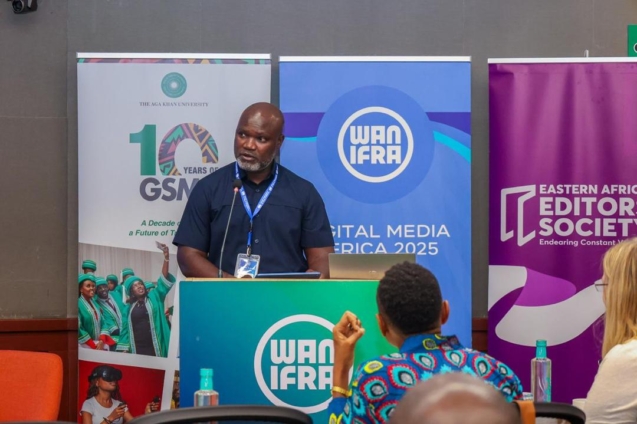
Speaking at the Digital Media Africa 2025 conference in Nairobi, Kenya, on Wednesday, September 17, he outlined a roadmap for survival and growth in an era marked by economic disruption, disinformation, and shrinking civic space.
Churchill Otieno delivered a passionate call to action for journalists, editors, and publishers across the continent. Highlighting both the urgent challenges and emerging opportunities, Otieno declared that the African media industry must adapt or risk irrelevance.
“Across our continent, the operational space for journalism is tightening,” Otieno warned. “In the past year alone, hundreds of attacks on journalists were documented: arbitrary arrests in Uganda, newsroom raids in Ethiopia, and the shuttering of stations in West Africa.”
The TAEF President stressed that these attacks are not isolated incidents but part of a worrying trend threatening democracy itself. He cited recent events in Ghana to illustrate the human cost of a hostile environment.
“In Ghana this July, journalists were assaulted during the Ablekuma North by-election and detained at a Spintex demolition site. Every such attack silences a community. We must insist on red lines.”
Economic Pressures Mounting
Beyond safety concerns, Otieno drew attention to the financial crisis facing African newsrooms, driven by a shift in advertising revenue to global tech platforms.
“Ad spend keeps tilting to platforms. In South Africa, digital already accounts for nearly 60% of total advertising and is heading toward two-thirds within just a few years,” he said.
This shift, he explained, has forced difficult decisions for many outlets. “In Kenya, two major broadcasters cut nearly a fifth of their editorial staff in just three years.”
Otieno, however, insisted that survival is possible through innovation and diversification. He pointed to The Daily Maverick in South Africa as an example of sustainable revenue models: “The Daily Maverick now covers nearly 40% of its budget from reader membership, proof that trust-based models can sustain quality reporting.”
Fighting Disinformation in the Digital Age
The rise of disinformation and propaganda, Otieno said, has added a new layer of complexity to journalism.
“In an age of disinformation and propaganda, our work has never been more essential. Just look at Sudan: weaponised videos and propaganda have spread faster than fact-checkers can respond, inflaming tensions and endangering communities.”
He urged editors to lead with integrity and adapt to changing audience behaviours. “In a time when propaganda lands daily in our WhatsApp groups, gatekeeping must mean more than filtering. It means safeguarding the civic square,” he said.
“Young audiences in Ghana are engaging with TikTok explainers, while in Kenya, Gen-Z protests showed how quickly young people turned to creators and live digital video for updates. We must learn from those styles without compromising standards.”
Otieno emphasised that collaboration with creators and influencers is no longer optional but a necessity. “Young people are consuming news in 15-second bursts on Instagram, in memes, and in WhatsApp voice notes. They live in ecosystems where credibility is not always clear, but relevance is everything. If we cannot adapt, we will lose them. If we can, we will secure our future.”
Policy Reform and Collective Action
Otieno also called for stronger legal and policy frameworks to protect journalism as a public good. “Journalism must be ring-fenced, including with enabling tax and data policies.”
He highlighted recent global and regional initiatives aimed at strengthening the media’s bargaining power.
“At the M20 Summit in Johannesburg two weeks ago, editors and other media leaders pressed G20 governments for fair compensation, clearer rules on AI, and stronger protections for information integrity.”
Similarly, the CTRL+J Africa conference, held shortly after, provided a platform for concrete proposals.
“We heard proposals for collective bargaining with big tech, regional safety mechanisms, and cross-border newsroom collaboration. These proposals have been distilled into actionable documents — let us find them and breathe life into them.”
Otieno stressed the importance of uniting these efforts at the local level. “Fragmented voices will not win against consolidated power.”
Defending Democracy and Rights
Framing the fight for journalism as a fight for democracy, Otieno spoke candidly about the stakes.
“With military takeovers and shrinking civic space across Africa, journalists must remain the vanguard for rights defenders. When human rights activists are silenced, when opposition voices are erased, when citizens are manipulated by algorithms, then the press must be louder, bolder, and more determined.”
A Call to Action
Closing his address, Otieno encouraged delegates to leave the conference energized and focused on building a resilient future for African journalism. “The road is difficult, but our purpose is clear. If we innovate wisely, collaborate deeply, and defend courageously, African journalism will not only survive, it will lead.”
He concluded with a rallying call: “Let us use this conference to sharpen our strategies, deepen our alliances, and renew our commitment to journalism that serves the public.”
The Digital Media Africa 2025 conference brought together media leaders, editors, and innovators from across the continent to confront the challenges and chart a bold path forward for journalism in a rapidly changing world.
The Digital Media Africa is an annual convention organised by the WAN-IFRA (World Association of News Publishers) that brings together media professionals to discuss innovation, digital transformation, and challenges in the African media landscape.
Latest Stories
-
Ablakwa seeks Russian support for Africa-led fight against Sahel extremism
2 minutes -
Host mining communities are partners in development, not obstacles – GJA President
4 minutes -
Ghana to sign 5 new petroleum agreements soon – Energy Minister
4 minutes -
GJA President urges Ghana to weigh environmental and social costs alongside mining revenues
16 minutes -
Irresponsible mining: The land is not your own – Prof Mike Oquaye cautions
24 minutes -
62 Ghanaians killed, 15 missing in Russia-Ukraine war – Ablakwa
24 minutes -
GJA President urges responsible, sustainable mining
25 minutes -
Ghana must take charge of its mineral resources – Prof. Mike Oquaye
32 minutes -
KickedIn uses technology to connect African football talent with global opportunities
33 minutes -
GoldBod did not record GH¢22bn loss; audited accounts show GH¢5.44bn surplus – Institute of Fiscal Policy Governance
36 minutes -
Mining comes with responsibility to future generations – Ga Mantse
39 minutes -
Ga Mantse calls for measurable CSR and stronger local participation in mining communities
46 minutes -
Ga Mantse urges mining industry to protect communities beyond the life of mines
1 hour -
Empowerher in Upper West region
1 hour -
Ga Mantse challenges mining stakeholders to consider long-term impact of Ghana’s mineral wealth
2 hours