

Audio By Carbonatix
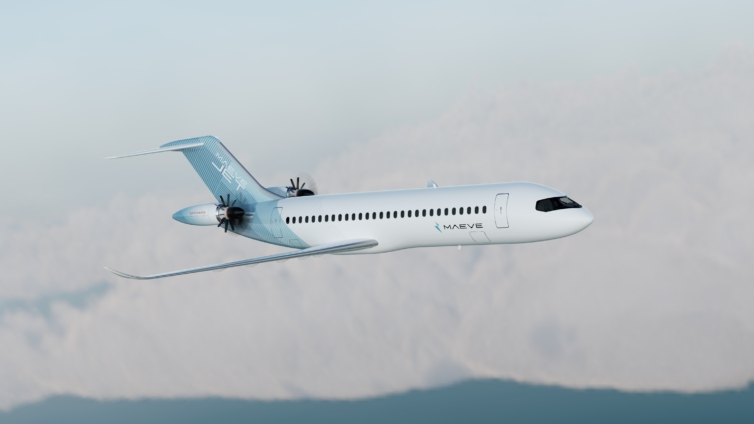
Delta Air Lines is partnering with Maeve Aerospace to advance the development of Maeve’s revolutionary hybrid electric aircraft for regional flights.
Compared to today's regional aircraft designs, the MAEVE Jet is designed to reduce fuel consumption and emissions by up to 40% using conventional jet fuel, with further lifecycle emissions reductions possible when using sustainable aviation fuel (SAF). This collaboration is the latest milestone in Delta’s ongoing journey to identify potential alternative and more fuel-efficient aircraft solutions, drive fuel savings, elevate the customer experience and achieve net-zero emissions by 2050.
As Maeve's North American global airline partner, Delta will lend its operational expertise to support the MAEVE Jet’s development. The design of the MAEVE Jet is a first-of-its-kind interpretation of a regional aircraft that brings the economics and comfort of a narrow-body aircraft to short-haul operations. With a five-abreast, single-aisle seat configuration, the regional solution will set a new standard for more sustainable regional flights.
Maeve joins Delta’s Sustainable Skies Lab as the fifth revolutionary fleet partner, advancing a key milestone in Delta’s 2023 Sustainability Roadmap to accelerate innovative solutions for a more sustainable future of travel. As a regional, hybrid-electric solution, Maeve’s exclusive partnership with Delta’s Sustainable Skies Lab strategically rounds out Delta’s portfolio of revolutionary fleet partners across short, medium and long-haul markets. Other revolutionary fleet partners include JetZero with its blended wing body mainline aircraft; Joby with their home-to-airport air offering; and Airbus and Boeing, both of which are exploring aerodynamic design solutions.
This collaboration builds on Delta’s broader sustainability strategy, which focuses on three key pillars: “what we fly, how we fly, and the fuel we use.” From investing in next-generation aircraft and scaling SAF usage to optimizing flight operations and reducing weight onboard to save on jet fuel, Delta is taking a holistic approach to decarbonizing air travel.
“Delta is proud to collaborate with Maeve to help shape the next chapter of regional aviation and accelerate progress toward a more sustainable future of flight,” said Kristen Bojko, Vice President of Fleet at Delta Air Lines. “As we work toward the next generation of aircraft, we look to partners like Maeve who embody the bold, forward-thinking innovation we champion at Delta – solutions that advance aircraft design, enhance operational efficiency, elevate employee and customer experiences, and cut emissions. While driving toward transformative technologies that strengthen our network and redefine regional air travel remains a key priority, we’re equally focused on safety and a more sustainable future of flight.”
The next-generation MAEVE Jet is expected to be compatible with both conventional jet fuel and SAF. The MAEVE Jet is designed to achieve up to 40% fuel reduction through a hybrid-electric engine architecture that provides power assistance at low altitude operations. This enables an optimization of the power plant and the wing for lower fuel consumption. The hybrid-model can also support the efficient integration of more electric aircraft systems.
“It’s a privilege to have Delta as a partner in the development of groundbreaking technologies and processes,” shared Martin Nuesseler, Chief Technology Officer at Maeve Aerospace. “Their expertise in fleet innovation and commitment to aviation sustainability is unmatched, and we’re proud to work together to tailor the MAEVE Jet for the U.S. market.”
Delta’s regional focus extends to partnership with Green Taxi to explore electric taxiing solution
Delta is also partnering with Green Taxi Aerospace through its Sustainable Skies Lab to develop electric aircraft taxiing technology that aims to reduce fuel use, operating costs, taxi time and carbon emissions. Delta’s Sustainable Skies Lab is contributing decades of airline operating experience to help Green Taxi optimize its electric taxiing system at airports for regional aircraft, though the vision extends far behind a single aircraft model or airline. The Green Taxi partnership is another example of Delta’s approach to impact what it can control today while innovating future technologies like scaling sustainable aviation fuel and revolutionary fleet development.
Latest Stories
-
Trump confirms meeting with Anthropic’s Amodei, repeats dismissal of AI fears
23 minutes -
China pushes back against US on Iran and Cuba in UN speech
32 minutes -
OpenAI, Anthropic CEOs called to appear at Australian AI probe
53 minutes -
T-bills auction: Government exceeds target marginally; yield on 91-day bill remains unchanged
4 hours -
GPL 2026/27: 10-man Aduana hand Kotoko defeat in Kumasi
4 hours -
GPL 2026/27: Medeama ease past Basake Holy Stars
5 hours -
Appiah Adomako writes: Why DVLA must stop treating every expired licence holder as delinquent
5 hours -
Tuchel rues ‘big mistakes’ – did Manchester City charges have impact?
5 hours -
Localization must transfer decision-making power, not just project responsibilities
5 hours -
Modernising Ghana’s traditional markets through the 24-Hour Economy markets initiative
5 hours -
New economy will boost local production and create jobs – Finance Minister
5 hours -
Manchester City chairman confident club will prove innocence
5 hours -
Republic of Ireland ‘raised awareness worldwide’ in Israel game
5 hours -
Germany still winless under Klopp after loss to Greece
5 hours -
Ronaldo on bench as Portugal beat Norway
5 hours