

Audio By Carbonatix
US scientists have, for the first time, made early-stage human embryos by manipulating DNA taken from people's skin cells and then fertilising it with sperm.
The technique could overcome infertility due to old age or disease by using almost any cell in the body as the starting point for life.
It could even allow same-sex couples to have a genetically related child.
The method requires significant refinement - which could take a decade - before a fertility clinic could even consider using it.
Experts said it was an impressive breakthrough, but there needed to be an open discussion with the public about what science was making possible.
Reproduction used to be a simple story of a man's sperm meeting a woman's egg. They fuse to make an embryo, and nine months later, a baby is born.
Now scientists are changing the rules. This latest experiment starts with human skin.
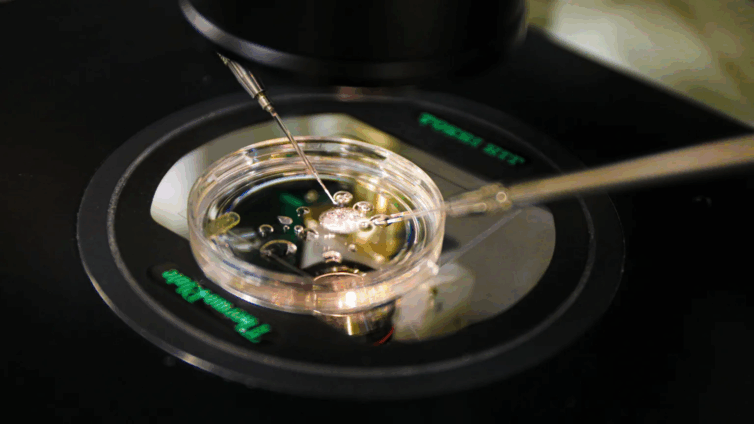
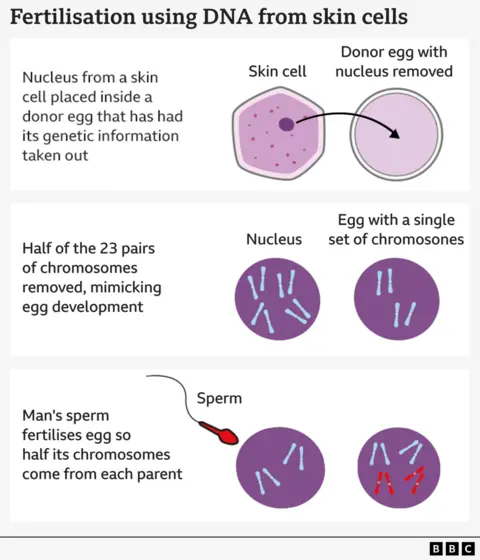
The Oregon Health and Science University research team's technique takes the nucleus, which houses a copy of the entire genetic code needed to build the body, out of a skin cell.
This is then placed inside a donor egg that has been stripped of its genetic instructions.
So far, the technique is like the one used to create Dolly the Sheep – the world's first cloned mammal – born back in 1996.
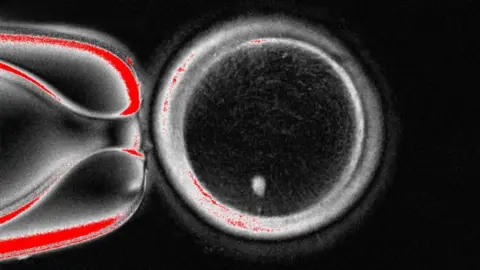
However, this egg is not ready to be fertilised by sperm as it already contains a full suite of chromosomes.
You inherit 23 of these bundles of DNA from each of your parents for a total of 46, which the egg already has.
So the next stage is to persuade the egg to discard half of its chromosomes in a process the researchers have termed "mitomeiosis" (the word is a fusion of mitosis and meiosis, the two ways cells divide).
The study, published in the journal Nature Communications, showed 82 functional eggs were made. These were fertilised with sperm and some progressed onto the early stages of embryonic development. None were developed beyond the six-day stage.
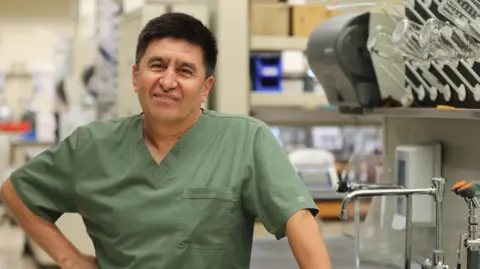
"We achieved something that was thought to be impossible," said Prof Shoukhrat Mitalipov, the director of the Oregon Health and Science University's centre for embryonic cell and gene therapy.
The technique is far from polished, as the egg randomly chooses which chromosomes to discard. It needs to end up with one of each of the 23 types to prevent disease, but ends up with two of some and none of others.
There is also a poor success rate (around 9%), and the chromosomes miss an important process where they rearrange their DNA, called crossing over.
Prof Mitalipov, a world-renowned pioneer in the field, told me: "We have to perfect it.
"Eventually, I think that's where the future will go because there are more and more patients who cannot have children."
This technology is part of a growing field aiming to make sperm and eggs outside of the body, known as in vitro gametogenesis.
The approach is still at the level of scientific discovery rather than clinical use, but the vision is to help couples who cannot benefit from IVF (in vitro fertilisation) because they don't have the sperm or eggs to use.
It could help older women who no longer have viable eggs, men who don't produce enough sperm or people whose cancer treatment has left them infertile.
The field also re-writes the rules of parenthood. The technique described today does not have to use a woman's skin cells - it could also use a man's.
That opens the door to same-sex couples having children that are genetically related to both partners. For example, in a male same-sex couple, one man's skin could be used to make the egg and a male partner's sperm used to fertilise it.
"In addition to offering hope for millions of people with infertility due to lack of eggs or sperm, this method would allow for the possibility of same-sex couples to have a child genetically related to both partners," said Prof Paula Amato, from Oregon Health and Science University.
Build public trust
Roger Sturmey, a professor of reproductive medicine at the University of Hull, said the science was "important" and "impressive".
He added: "At the same time, such research reinforces the importance of continued open dialogue with the public about new advances in reproductive research.
"Breakthroughs such as this impress upon us the need for robust governance, to ensure accountability and build public trust."
Prof Richard Anderson, deputy director of MRC Centre for reproductive health at the University of Edinburgh, said the ability to generate new eggs "would be a major advance".
He said: "There will be very important safety concerns but this study is a step towards helping many women have their own genetic children."
Latest Stories
-
Glasner suffers loss on Selhurst return as Palace beat Forest
18 minutes -
WAFU B U17: ‘We won but I expected more from my boys’ – Kassim Ocansey
23 minutes -
Man City cruise to statement win over 10-man Liverpool
32 minutes -
Be careful with cross-border lending, foreign currency exposures – BoG to financial institutions
3 hours -
GPL 2026/27: Medeama go three clear as Hearts of Oak recover and Bechem stage stunning comeback
3 hours -
Ntiamoah Foundation launches “BEYOND 20” anniversary campaign
3 hours -
Credit Risk Management Directive: BoG to begin implementation for banks, others from July 1, 2027
4 hours -
Ghana Brands Awards 2026: Leading brands, business trailblazers to shine on November 20
4 hours -
T-bills auction: Demand improves as government exceeds target by about 76%; interest rates soften
4 hours -
Ziope undertakes initiative to build a technologically inclined community, commissions self-help ICT lab
4 hours -
ECG announces power outage in parts of Tema, Central Region due to network fault, maintenance
5 hours -
When the Gospel Becomes a Weapon: The church, blackmail and the abuse of faith
5 hours -
JoyNews’ Jacqueline Ansomah Yeboah selected for UK Media Excellence for Emerging Technologies Fellowship
6 hours -
Mental Health Alliance urges government to operationalise Mental Health Fund
6 hours -
Ghana–Holy See agreement heads to Parliament after Cabinet approval
6 hours